Categories
LAVORATO 当代 艺术家

Contemporary | Wang Wanglin oriental heroes


Young artist Wang Ruilin
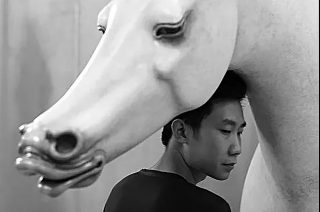
Wang Ruilin (1985-), born in Anshan, Liaoning, is a young artist in Beijing. After graduating from the Central Academy of Fine Arts, he began to create the series of Dreams of Dreams in 2012. He said: “Because of this real and false world of impermanence, the restlessness and goodness gradually brought me. In this way, the soothing narrative of the work allows me to find the balance of my soul. Let nature take its course and bring to my creation Soil and sweet springs. ”
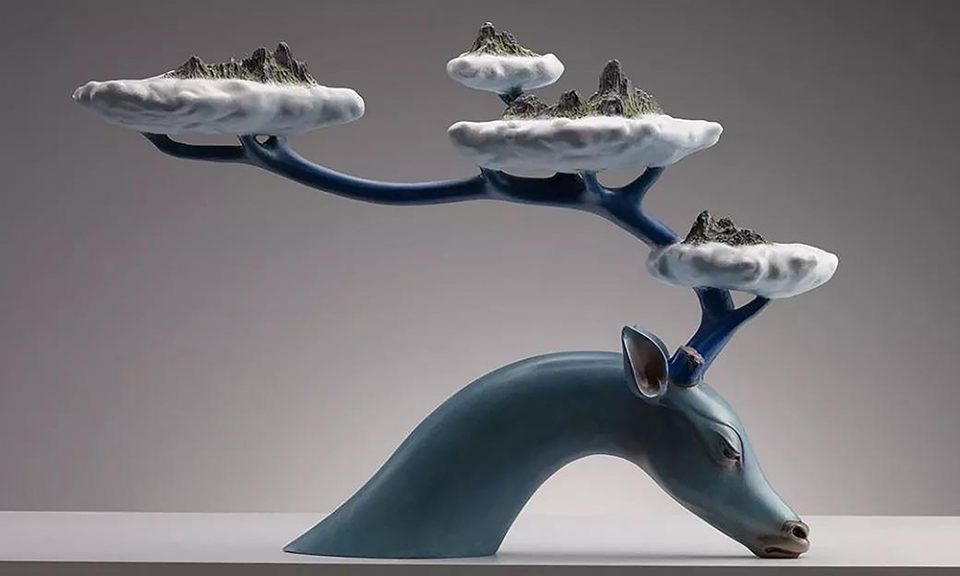
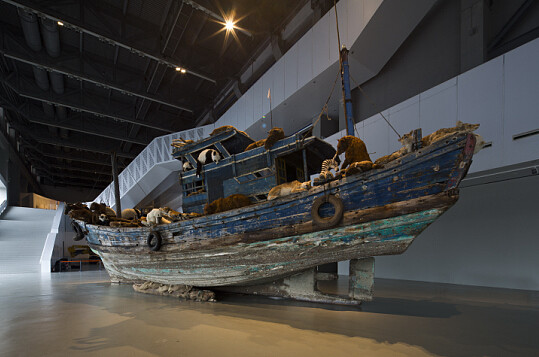
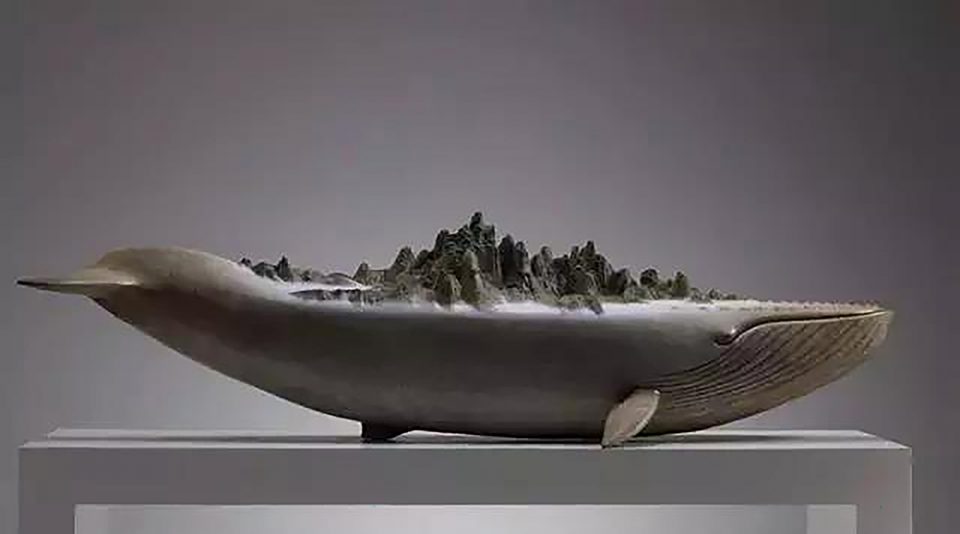
Wang Ruilin said that isolation from this world is painful, but it can also reduce the impetuosity and temptation of the world, and let him see the essence and value of life. As the main work of the Dream by Dream series, Dream by Ark represents most of his original intentions and emotions.

Dream by Dream series Ruilin
The next series is about Sun Wukong’s sculpture called “Mi · Hang”. Before making this sculpture, he studied all the monkey images of China and the West. He thinks that Sun Wukong in the United States and imported monkeys are all large and one kind. The image of King Kong. He thinks this understanding is wrong. He thinks that Sun Wukong is a monkey because in animals, the monkey is a kind of spirit beast, and the wisdom is relatively high. It should be won by wisdom and aura, so the direction of Chinese and Western understanding is different. He believes that what really represents Chinese superheroes is not tights and muscular blood vessels. It does not need those hard conditions to prove himself, more should be internal.
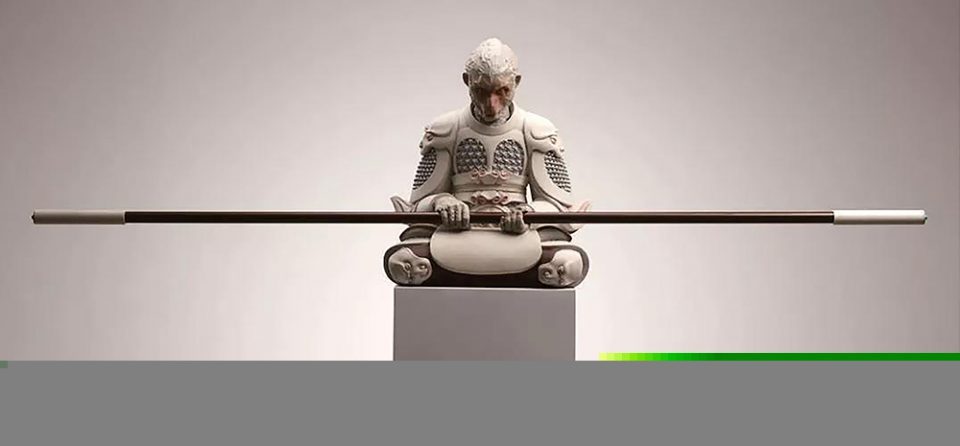

“Hidden” series of works

Many people do not understand why he was a monkey. He replied, “I just want the world to see the Eastern hero.”
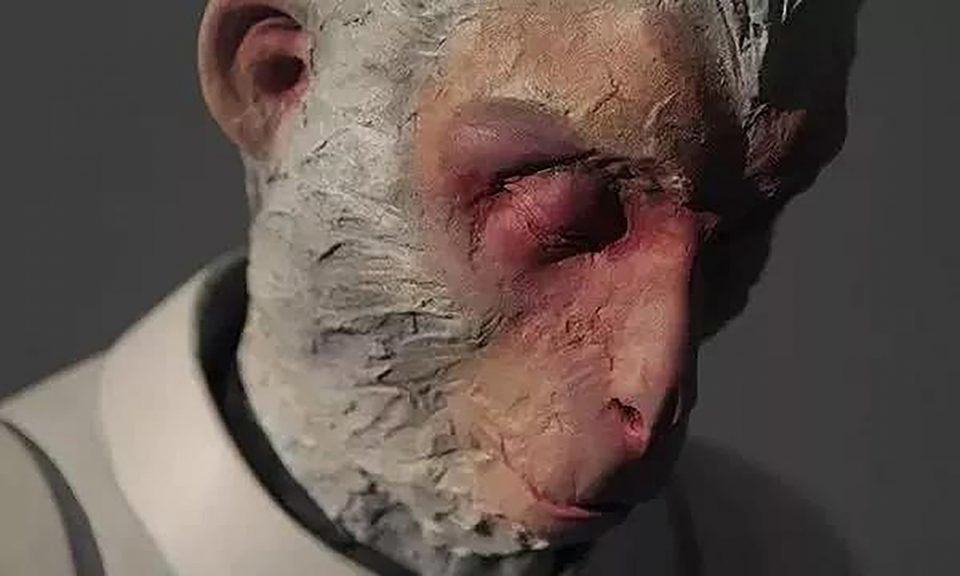

“Hidden” series of works

Wang Ruilin’s intention to create Qi Tian Da Sheng

Wang Ruilin’s intention to create Qi Tian Da Sheng is to let the world see the appearance of an oriental hero. I always think that the great saint of the hide-out series is Wang Ruilin himself. From the work itself, this quiet, formidable and powerful aura is undoubtedly his own. It seems that Wang Ruilin himself is also happy to hide this energy under a calm appearance, like the sea of ​​gentle wind, the undercurrent surging but quiet.
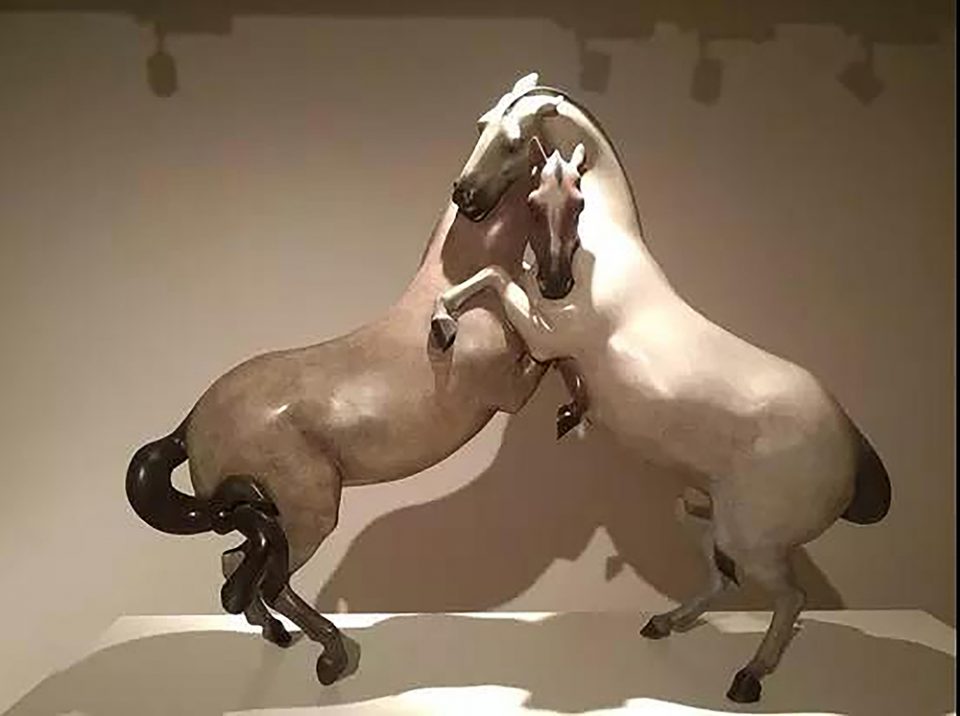

“Circus” series of works

He always remembered the first time he was touched when he saw Xu Beihong’s “Running Horse” when he was 4 or 5 years old. In his eyes, it was a subtle fusion of Eastern detachment and Western reason. Coupled with Wang Ruilin’s love for horses, horses gradually became the theme of his creation in a period of time, and eventually formed a series of “horse drama”. He blended the life energy of this animal into a quiet gesture, creating a wonderful tension in the work.

infinite charm of art

Wang Ruilin believes that once the work is completed, he will exist in a completely independent form, no longer under the author’s control. In the face of viewers, different life backgrounds and hearts, the original intention of creation is no longer important. Wang Ruilin believes that once the work is completed, he will exist in a completely independent form, no longer under the author’s control. In the face of viewers, different life backgrounds and hearts, the original intention of creation is no longer important. Of course, people will try to understand the work with their own values, world view, and aesthetic consciousness. The harder you understand, the more you focus on your feelings. Different feelings are also connected through the same work. This makes us viewers also become participants in the work. This is the meaning of his existence and the infinite charm of art.
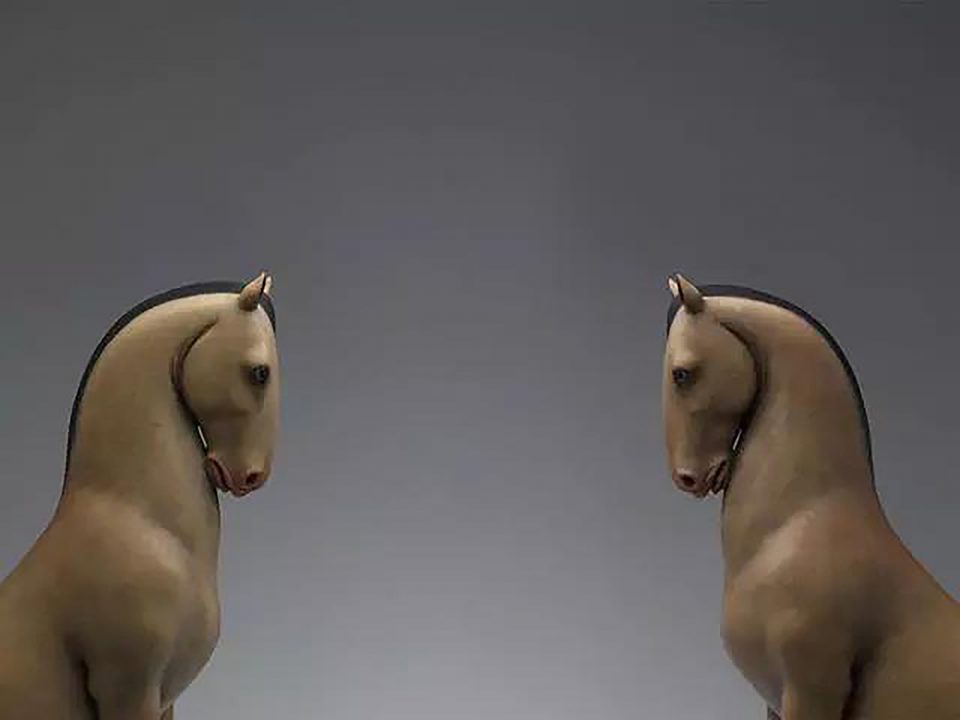

“Circus” series of works


If music is a flowing art, then sculpture is still music. Wang Ruilin’s work may not be the best in China today, but it can be said to be one of the most moving works.

Art is not just an ornament, but a window. When we gaze at it, we gaze at the great moment that the world once had.

Categories
LAVORATO 当代 纵观艺术 艺术家

Contemporary | Ren Han: Reality with a Mirror

Ren han, male, was born in Tianjin, China in February 1984. He is currently living in Tianjin, a contemporary artist.

Ren han the definition of art

Ren han said: “the definition of art has been changing, such as the one of painting. The interpretation of Mona Lisa in different eras and topics, is different”

“Mirror” by Ren Yi

He graduated from the National Institute of Fine Arts of Vera Arson, France in 2011. As an artist, he has participated in exhibitions around the world, including the Paris 104 Art Center, the Moscow Museum of Modern Art, the Berlin Chinese Cultural Center, the Nice Asian Art Museum, the Beijing Today Art Museum, the Times Art Museum, and Taikang Space. He has also held solo exhibitions at the Less Is More Projects Gallery in Paris, C-Space, LAB47 and Qimu Space in Beijing. He is also the co-founder of the Renewable Space Program, which asks artists to organise and to expose in non-display spaces such as ruins.

he ambiguous nature of human nature

Ren han used pencil as the main material to carry out an orderly study in the field of plastic arts. Using graphite’s essence to present reflection and texture, and through the outline of his painting, we see a two-dimensional plane, but the artist’s special treatment of the picture makes us feel a sense of volume, as it happens with sculptures. His works often use mirrors, labyrinths, water, and virtual landscapes to reveal the ambiguous nature of human nature, explore the boundaries of sketches and sculptures, and the possibilities.

“Maze” by Ren han

The power of art is to wake up the soul. The reason why art can support us to seek truth is that art can play down the self-center. It requires us to observe and understand, and to do our best to express and gain valuable experience.

Untitled Work
Untitled Work

In “Mirror” series, he said that he chose it because the mirror will have a reflection when it is photographed, it is visually similar to the graphite texture. With white as the base, the relationship between black and white is more confusing in the Mirror.The line gathered in the center is like a road to the exotic world. Infiltrating, hitting the wall, and reflecting, lead the viewer into a spiritual space of meditation.

“Mirror Seires” by Ren han

“I don’t have rules in the form of works. I set myself the rule of not creating new images, but reducing, reorganizing, and copying ready-made images and ready-made products. Because it is realistic or abstract, as long as it is hand-made.. I choose to be a developer and implementer of ideas.” He said

“Mirror Seires” by Ren han
Side view of “Skull”

In the world we live in, every item is unique. They have different self-expressions and they hold different emotions and hopes. Only by doing everything possible to faithfully restore every seemingly ordinary item will people see the purest beauty in the world. That kind of beauty will lead people and be brave in themselves.

Categories
LAVORATO 传统 艺术家

Tradition | Master of Chinese Painting “Qiao Weiming”


The master of Chinese painting Qiao Weiming

Chinese painting emphasizes him as an excellent artist, who needs to learn from the outside world and get the source from his heart, in order to have the wonderful feeling of creating the gods, mountains and rivers at the same time. Helping artists understand the true meaning and essence of art.
Canzone d’autunno
Chinese art requires saving the intention with the pen first, when the painting is finished the existence of the intention is still here. Emphasize the dissolution of things, create an artistic conception, arrive at drawing mien with form, form and spirit that must be established together.
Silenzio

And him, he did it. He is the outstanding Chinese artists – Qiao Weiming, born in 1961 in Luo yang Xiaolangdi. He is the member of China artists association. The researcher at the Chinese poem calligraphy institute of fine arts. The visiting professor of Lu Xun Academy of Fine Arts. Hebei Academy of Fine Arts and PLA Information Engineering University, the expert of cultural relics appreciation.the member of Luoyang CPPCC. The dean of Luoyang University Painting and Calligraphy Institute, and the art teacher of Luoyang Institute of Technology.

Chinese painting

Untitle

His material comes from the flowers and birds in his hometown. The composition of painting is a concrete embodiment of years of experience. For example, the basket series of paintings. All of which are mainly composed of baskets, are composed in the middle. However, the most annoying part of the composition of Chinese painting is that the main body is placed in the middle. which is precisely because the basket series is placed in the middle, which makes it very comfortable to look at. It breaks the limitation of the traditional painting composition from Song dynasty to modern times, which also forms its personal characteristics.

Fish Basket
Childhood Fun

In 1982, the work “Underestimating the wealth”, won the first prize of the Army Art Exhibition.

Red and fragrant peony

In October 1988, he held his solo exhibition in the Cultural Center in Tainan City, Taiwan.

In 1992, the work “Red and fragrant peony ” won the bronze medal in the International Chinese Painting Grand Prix.

In July 1993, he was graduated from the Fine Arts Department of Xinjiang Normal University.

From September 1993 to July 1994. he studied master’s degree in flower and bird painting at the Chinese Painting Department of Guangzhou Academy of Fine Arts. His creation “Red Kaki” was collected by the college.

In October 1994, his work “Reminiscences of Childhood” was selected for the 8th National Art Exhibition and won the first prize of Henan Art Exhibition.

In July 1997, his work “People in the Country” was selected by the China Artists Association, which held the Exhibition of  welcoming Hong Kong return to the Chinese artists .

In November 1997, the work “The Nest” won the second prize of contemporary Chinese meticulous paintings organized by the Ministry of Culture.

In August 1999, the work “Return” was selected by the China Artists Association which held the “welcome Macao to return to China’s calligraphy and painting exhibition.”

In October 1999, the work “Homeland” was awarded the Achievement Award by the China Artists Association for. “Celebrating the 50th Anniversary of the Founding of the Republic of China”.

In November 1999, the work “Bumper Harvest” was selected into the National Second Flower and Bird Painting Exhibition organized by the China Artists Association.

In February 2001, he participated in a joint exhibition of eight paintings and calligraphy organized by the Ministry of Culture of the People’s Republic of China to Egypt, Britain, France and Italy.

Hometown
Flowers

SEE FOR DETAILS:http://qiaoweiming.orgcc.com/works/v3710.html

Categories
LAVORATO 当代

Contemporary | Artist Pan Xi: Eternal Femininity

Pan xi is a Chinese artist born in Wenzhou, China, in November 1971. Since childhood, has developed a strong artistic and aesthetic sense because, every week, with her sister, she went to the art institute directed by her father to visit the workshops of the artists at work.

She is so passionate about drawing and painting, she starts taking lessons at the age of ten, from an artist friend of her father.
She began her fine arts studies, after finishing high school, in 1989 at the National Academy of Fine arts in Hangzhou, China, and a year later she received a scholarship and moved to the Academy of Fine Arts in Moscow where he earned a Master in Fine Art.
Lunch break
She is so passionate about drawing and painting, she starts taking lessons at the age of ten, from an artist friend of her father.
She began her fine arts studies, after finishing high school, in 1989 at the National Academy of Fine arts in Hangzhou, China, and a year later she received a scholarship and moved to the Academy of Fine Arts in Moscow where he earned a Master in Fine Art.
Pan Xi 2
In 1999 he obtained a master's degree in oil painting and with the work "Seven Beauties" he won the gold medal of the University.
 Since then he has lived in Europe, between Germany, Austria, Holland and France, and in the United States working as a professional artist.
 He currently lives in Hangzhou, China, where he opens his personal studios on the Jade Mountain Emperor's Hill on the outskirts.
In 1999 he obtained a master's degree in oil painting and with the work "Seven Beauties" he won the gold medal of the University.
Seven Beauty
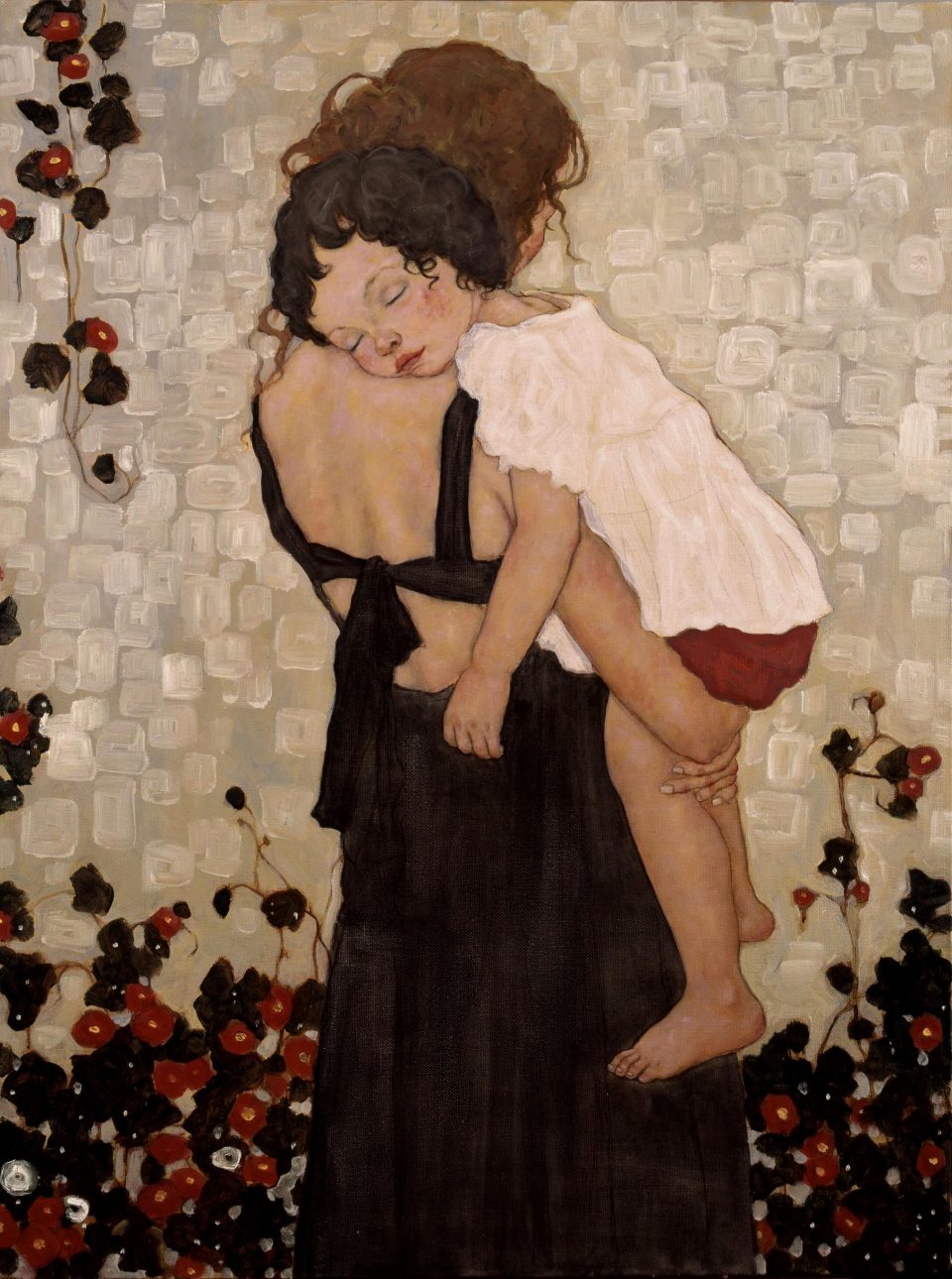
Mother and son

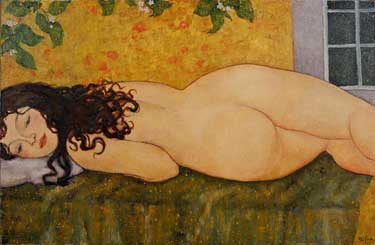
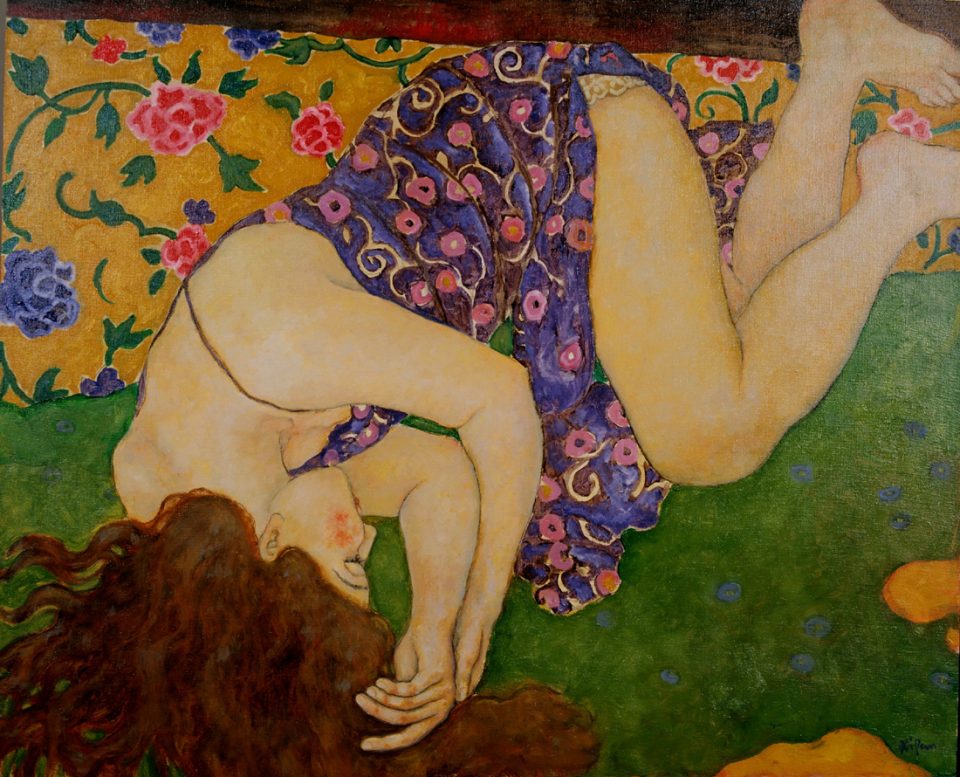
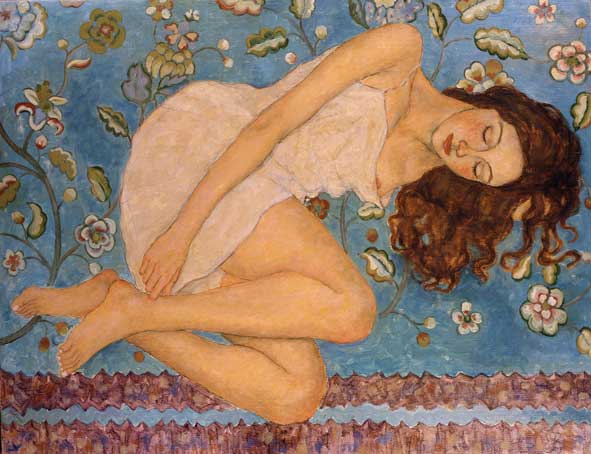
From her works shines through the modernity and power of the early twentieth century artists such as Klimt, especially for the use of colors, Modigliani, as regards the idea of dreams and reality that floats in an unreal time, and Schiele in reference to the yield of the bodies and the positions they assume.

Paris in the spring

Although her works are very twentieth-century they maintain a very powerful bond with the ancient Chinese art that makes the works are fascinating, overwhelming but at the same time extremely delicate and poetic.

Siesta

In her works the female subject is undoubtedly predominant. The women of are rendered in all their femininity and sensuality, dormant and dreamy but at the same time so determined and sure to be able to show their body with total ease, seducing the viewer and taking him to another dimension where everything is always immobile and eternal.

spring

Exhibitions:
2003  Veronica, Gallery “de Arte”, Nantes, France
2005  Girl in a Black dress, Gallery “de Arte”, Nantes, France
2008 Body temperature present, Gallery Zhongdao, Suzhou, China
2009  Mother and Child, Gallery “de Arte”, Nantes, France
2010 Carmine, Art scene Warehouse
2011 In my secret garden, M Art Center, Shanghai, China

References:

http://ilmondodimaryantony.blogspot.com/2016/06/xi-pan.htmlhttp://www.xipan.com/Gallery.htmhttps://www.tuttartpitturasculturapoesiamusica.com/2012/03/xi-pan-chinese-professional-fine-art.htmlhttp://www.artistsandart.org/2010/04/xi-pan.htmlhttps://www.chinesenewart.com/chinese-painters3/xipan.htm

Categories
LAVORATO 当代

Contemporary | Dai Guangyu: Transfer in Ink

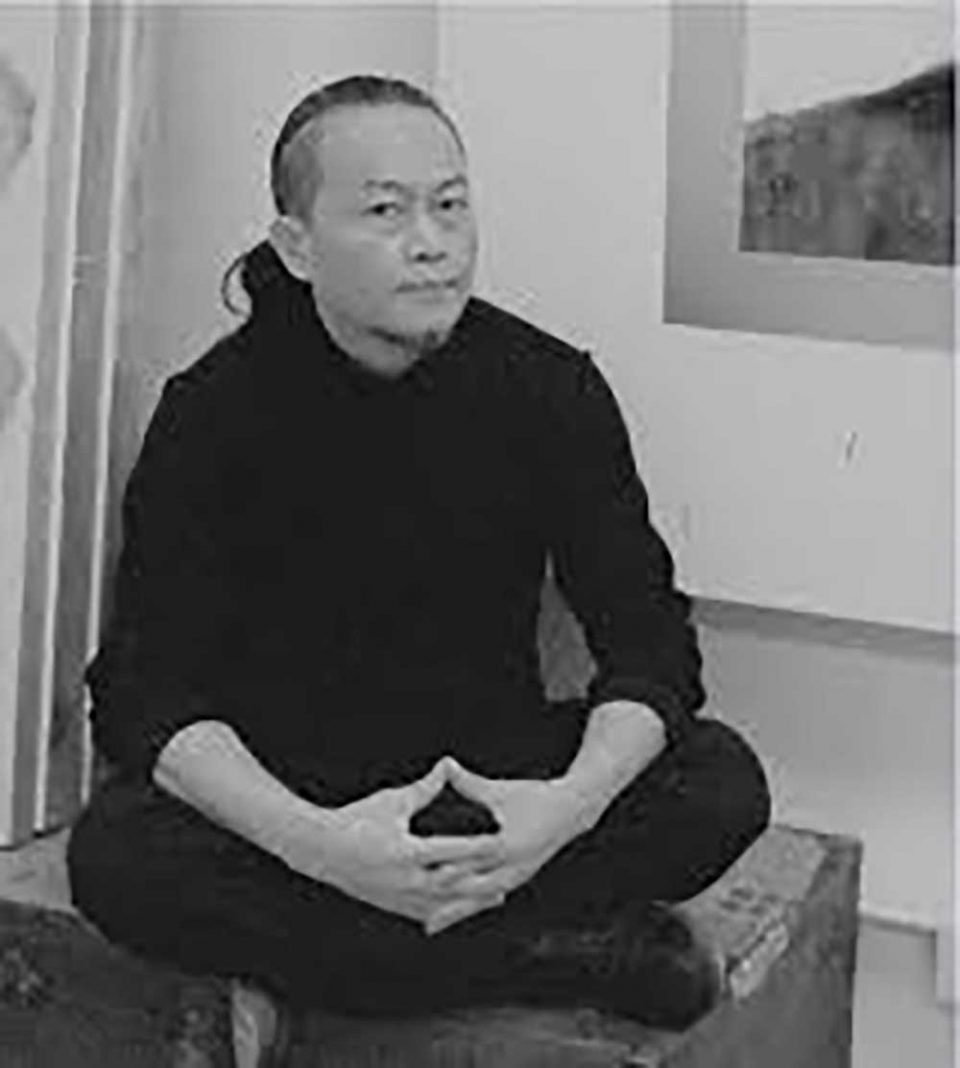
Dai Guangyu is a self-taught artist born and raised in 1955 in a family of scholars in Chengdu, Sichuan Province, China.


Since childhood Dai Guangyu has studied calligraphy, painting and literature and his career as a contemporary artist includes his long experience as a visual and performative artist, curator and cultural critic, and poet.

Dai GuanYu

His work involves the history of Chinese art, the culture of ink painting, as well as Chinese poetry and politics.


In 1985, Dai Guangyu became part of the revolutionary movement New Wave, soon becoming the leader of what develops in Southwest China, after becoming a leader of the Sichuan artistic avant-garde scene, which proves to be very stimulating and perfect for the development of its creative purpose.

Dai Guangyu – White is not necessarily good

During this period he took part in several exhibitions including, in 1986, “Red Yellow Blue – Young Artists of Sichuan”, the first modern art exhibition in the Sichuan province, at the Sichuan Art Gallery.


In 1989 he participated in the historic China Avant-Garde exhibition at the National Art Museum of China in Beijing and after the end of the 1989 student movement protests, when Chinese art entered a depressed and withdrawn state, Dai Guangyu continued his active interventionist work, curating exhibitions and public performance interventions far from the capital.

Dai Guangyu – Untitled

In the 1990s, Dai Guangyu discovered artistic performance, which employs the body as a key artistic medium.
The artist has found this artistic medium very interesting and very suitable for expressing himself, artistically speaking, as it allows him to be powerful in movement, incisive in meaning, radical and transitory.

Dai Guangyu – Absorbing – being absorbed

With Dai Guangyu, performance and artistic activities such as conceptual art had found their mentor.
In 2003, the artist moved permanently to Beijing where, during these years, he developed a body of art and a strong conceptual approach in cultural references, rich in poetry and symbolism, and beautiful in form, which has aroused continuous criticism.

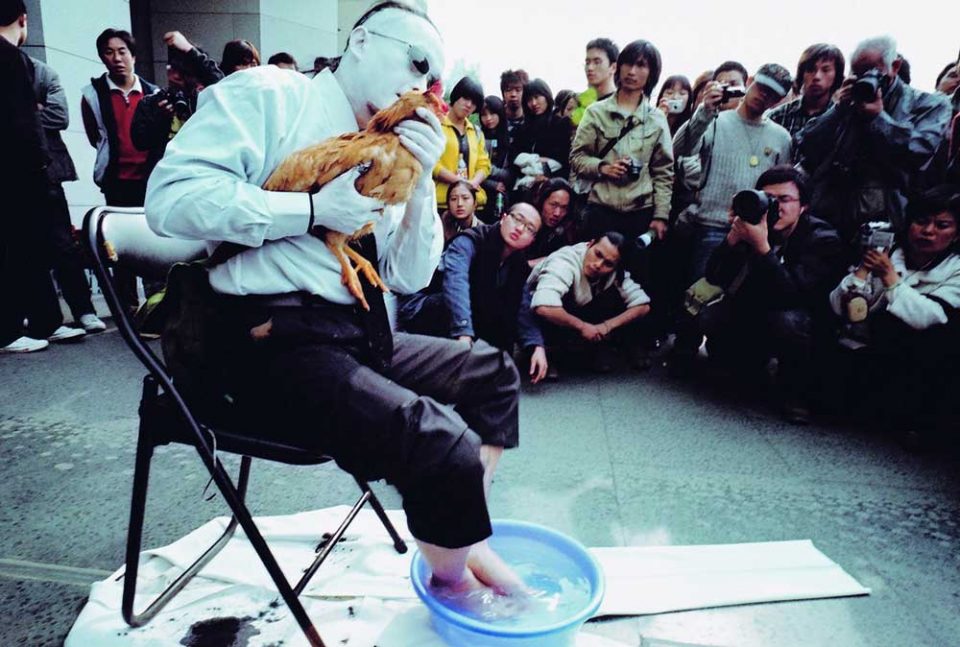
Dai Guangyu – To identify a chicken artistic image of a dead rabbit is difficult

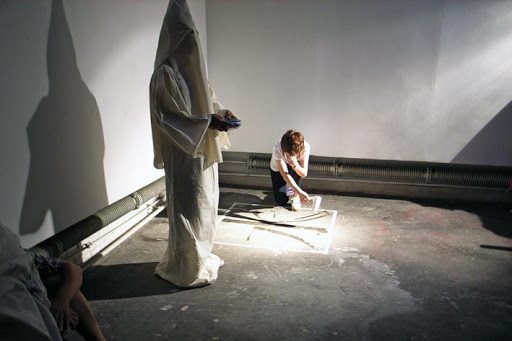
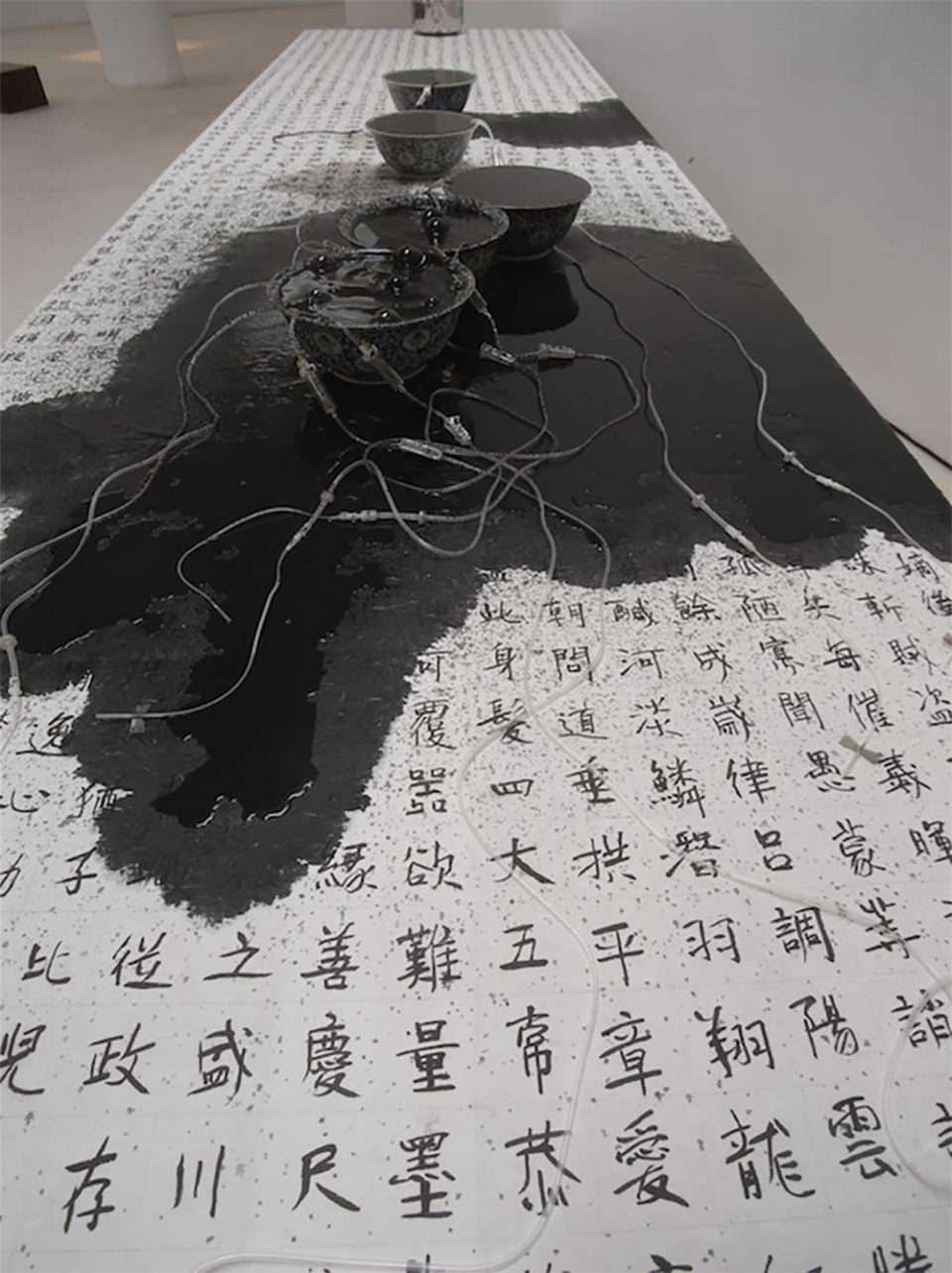
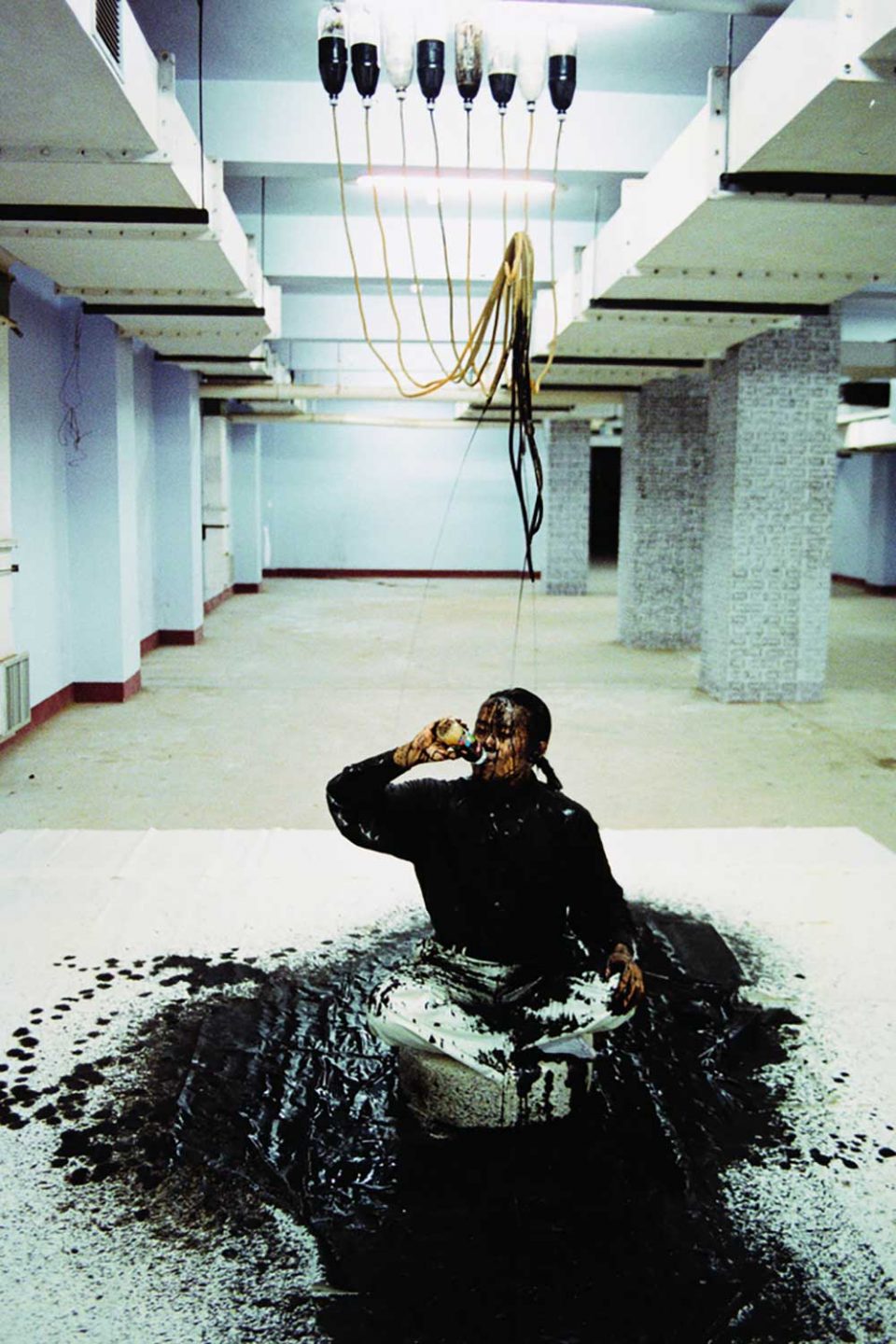
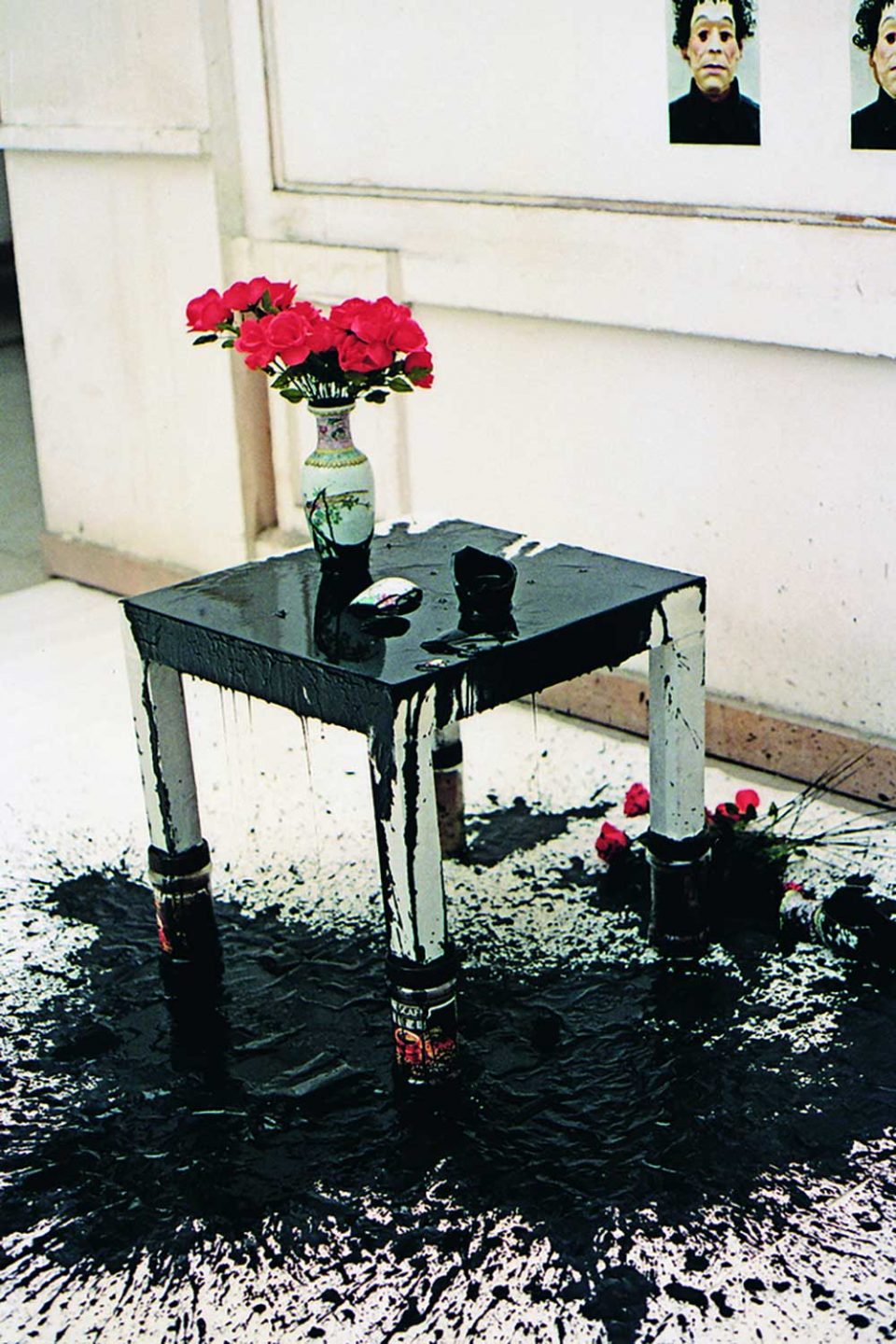
Dai Guangyu, he has created a system of codes and symbols that has intensified along with the progress of his installations and performances. For example, it uses black Chinese ink pots or porcelain, symbols of the complexity of Chinese culture, flour to evoke the basic food of the community and finally also men with faces painted in white and gold as metaphors of Westernization or the pursuit of wealth.

Dai Guangyu – Auction

He argues that through the act of performance, a temporary action that passes from one state to another, all solid forms belong to a single moment and that all circumstances are in the process of transformation.
His installations and his photographs maintain a trace of this “state of procreation” which is the essence of the performance and gives a poetic intonation to the forms.

Dai Guangyu – Shooting at myself

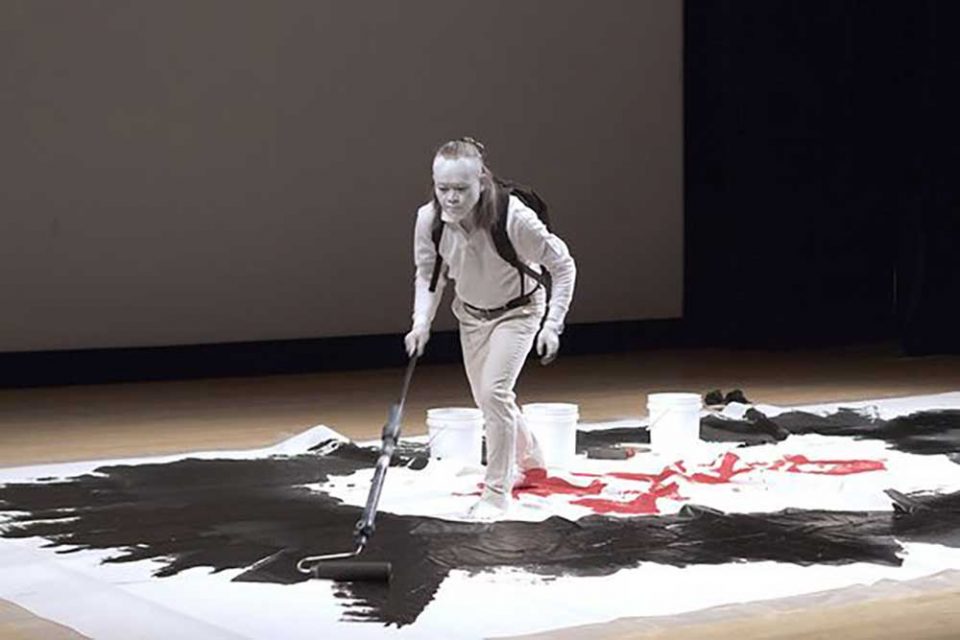
In 2017 the artist realizes the performance The Failure of Defense-America, 2017.

During the performance he expresses his personal struggles against having to live under a repressive political regime. Dai Guangyu through the performance of the performance wants to move the focus, which originally is based on the ideological and class division in China, to the forces that threaten the American nation.

Dai Guangyu – “The Failure of Defense America 2017”

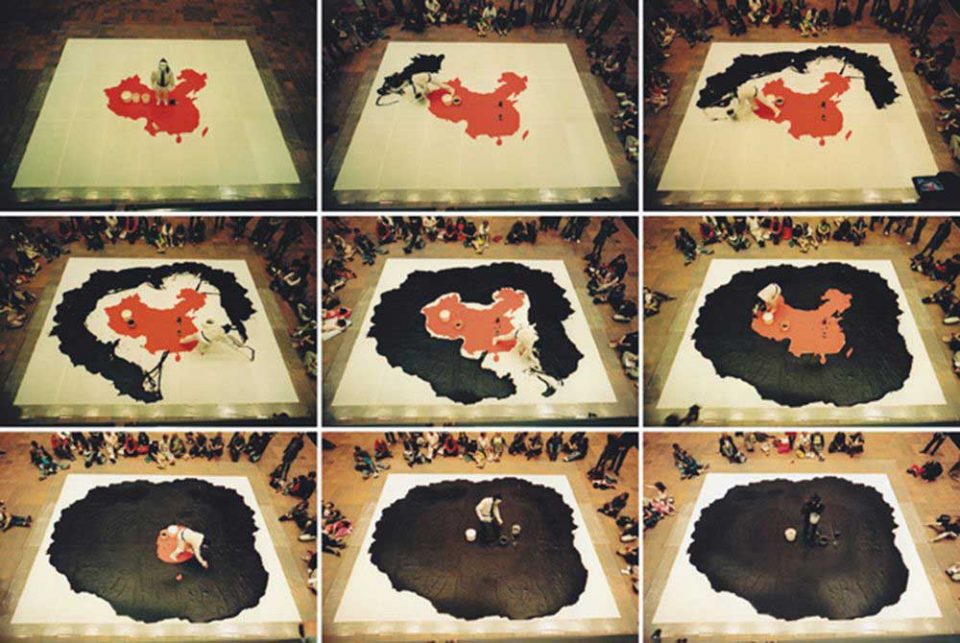
By painting the seemingly empty white paper that covered the stage with black and red ink, the outlines of a series of critical and consequential relationships emerged, asking questions about where we are all in relation to the character and inclusiveness of today’s nation.

Dai Guangyu – “The Failure of Defense America 2017”

Dai Guangyu is now recognized as an important and original figure in the Chinese art scene. His interdisciplinary practice is written within a socially engaged trajectory.

Through his performances, photographs, paintings or calligraphy, he stages his body and the symbolism of Chinese society until the end of their resistance or their disappearance.

Dai Guangyu – Untitled

Exhibitions:
2005 Artists in Action – Performance Art Project, HongKong, China
2005 Inward Gazes – Performance Art in China Exhibition by Invitation, Macau Art Museum, Macau
2005 In Honour of ‘85, Duolun Modern Art Museum, Shanghai, China
2005 Transborder Language: Performance Art /Language Art, Tokyo Art Projects, 798 Factory, Beijing, China
2004 Double Happiness Festival, Tokyo Art Projects, 798 Factory, Beijing, China
2004 Matchmaking, Eastlink Gallery, Shanghai, China
2003 NIPAF: Asia Central Europe, Performance Art Meeting 2003, Slovakia, Hungary, Poland
2003 Chinese Ink in Contemporary Art, National Gallery, Kualalumpur, Malaysia
2003 China – Japan Performance Art Exchange Project / 2003, Chengdu, Xian, Chongqing, China
2002 Fruitfulness – Contemporary Art Exhibition, Beijing Agriculture Hall, Beijing, China
2002 Food and Words, Performance, Chengdu, China (solo)
2002 Shooting at Myself, Installation and Performance, Duisburg University, Germany (solo)
2001 Physical Resources and Objects, Hong Kong, China
2001 Dialogo – Other, Chinese Contemporary Art Exhibition, Chiesa Santa Teresa dei Maschi, Bari, Italy
2001 Chinese Festival – Touring Art Exhibition, Faust Museum, Hannover, Germany
2001 First Chengdu Biennale, Chengdu Museum of Modern Art, Chengdu, China
2000 Heaven Stonehenge, Hannover, Duisburg, Düsseldorf, Germany
2000 Turn of the Century – 1979-1999 – Chinese Contemporary Art, Museum of Modern Art Chengdu, China
2000 Chinese Glamours – Conceptual Images, East Link Gallery, Shanghai, China
1997 How a Frog in a Well Sees the Sky, Open Exhibit, 152B Studio, Chengdu, China (solo)
1996 Resurrection in Chengdu ‘96, Installation, Sichuan University, China (solo)
1995 Scenery Inside and Outside a Red Room, Installation, Chengdu, China (solo)
1994 Chinese Landscape, Installation, Chengdu, China (solo)
1993 Dai GuangYu – Exhibition of Paintings, Lallouzet Waterson, Montreal, Canada

References:
http://ifa-gallery.com/artists/dai-guangyu/
https://www.inkstudio.com.cn/artists/64-dai-guangyu/overview/
https://www.artsy.net/artist/dai-guangyu-dai-guang-yu?page=1&sort=-partner_updated_at
https://ocula.com/artists/dai-guangyu/
http://www.artnet.com/artists/dai-guangyu/biography
http://www.artlinkart.com/en/artist/overview/3f8iy
https://www.youtube.com/watch?v=qqznqeoCfRU

Categories
LAVORATO 对话 当代

Contemporary | Artist Xia Yan: Hometown of Heart

Xia Yan, born in 1975 in Guizhou, is a famous contemporary artist. He graduated from the Fine Arts Department of Guizhou Normal University in 1998 and is now an associate professor at the Fine Arts College of Guizhou Normal University. In recent years, his works have gradually been recognized by collectors at home and abroad. K11 Art Space, Chengdu Contemporary Art Museum, Chengdu Blue Top Art Museum, Singapore Simin Art Garden and other important institutions have exhibited and collected their works.
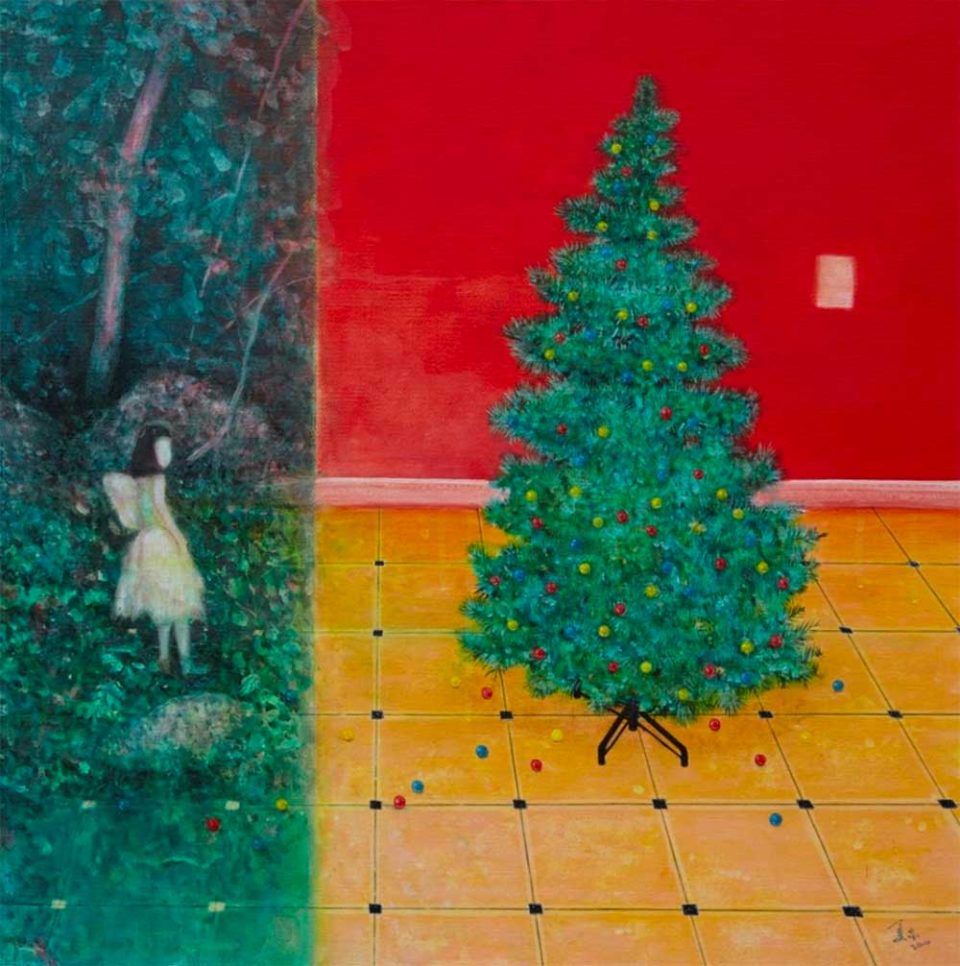
Xia Yan’s works revolve around the relationship between human beings, nature and festivals. His painting style has some fairy tales, giving a sense of dreams and innocence, but also revealing reflections on the environment.

Artistic introduction
Born in Guizhou in 1975.
In 1998, he graduated from the Fine Arts Department of Guizhou Normal University (now the Academy of Fine Arts) and stayed at the school until now.
In 2005, he graduated from the Department of Painting, Department of Painting, Central Academy of Fine Arts.
2006 Entered Guiyang “Urban Parts” Contemporary Art Studio
2012 Graduated from the Digital Media Department of Xiamen University Software College with a master’s degree

Afforestation 150x250cm oil on canvas 2012

ARTbaiguan: How do you balance teaching work and personal artistic creation with so many years of coaching career?
Xia Yan: Teaching and creation seem to conflict with working time and space, but in fact, the two are complementary to each other. Teaching and creative practice are the best knowledge-transforming relationship;

In the same festival 60x60cm oil on canvas 2014

ARTbaiguan: We see some characters appear on your screen. Does this have anything to do with your life or your relationships?
Xia Yan: Some are related, some are fragments of images I downloaded from the web. The current works pay more attention to things in the public environment, and all the roles are almost irrelevant to their own life circle;

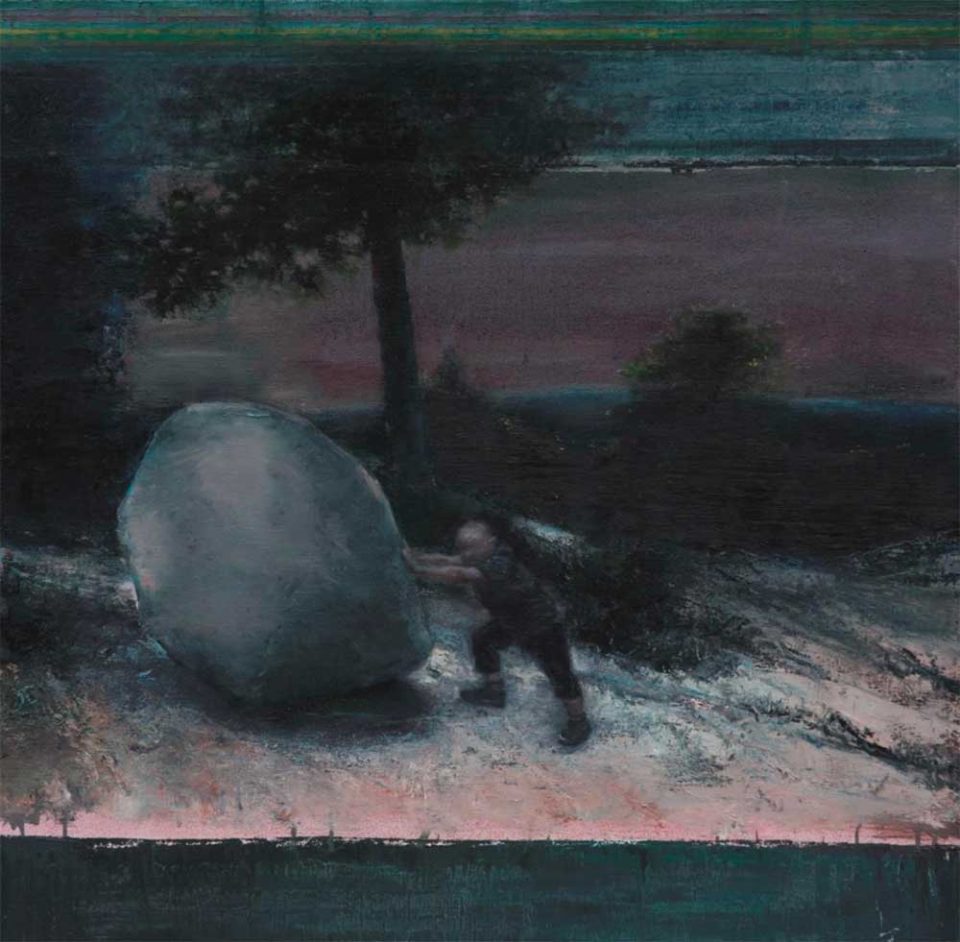
Mr. Pushing Stone 90x90cm 2016

ARTbaiguan: There are many people who like your Soshan series. What is your creative inspiration?
Xia Yan: Childhood memories, it is a nostalgic homesickness.

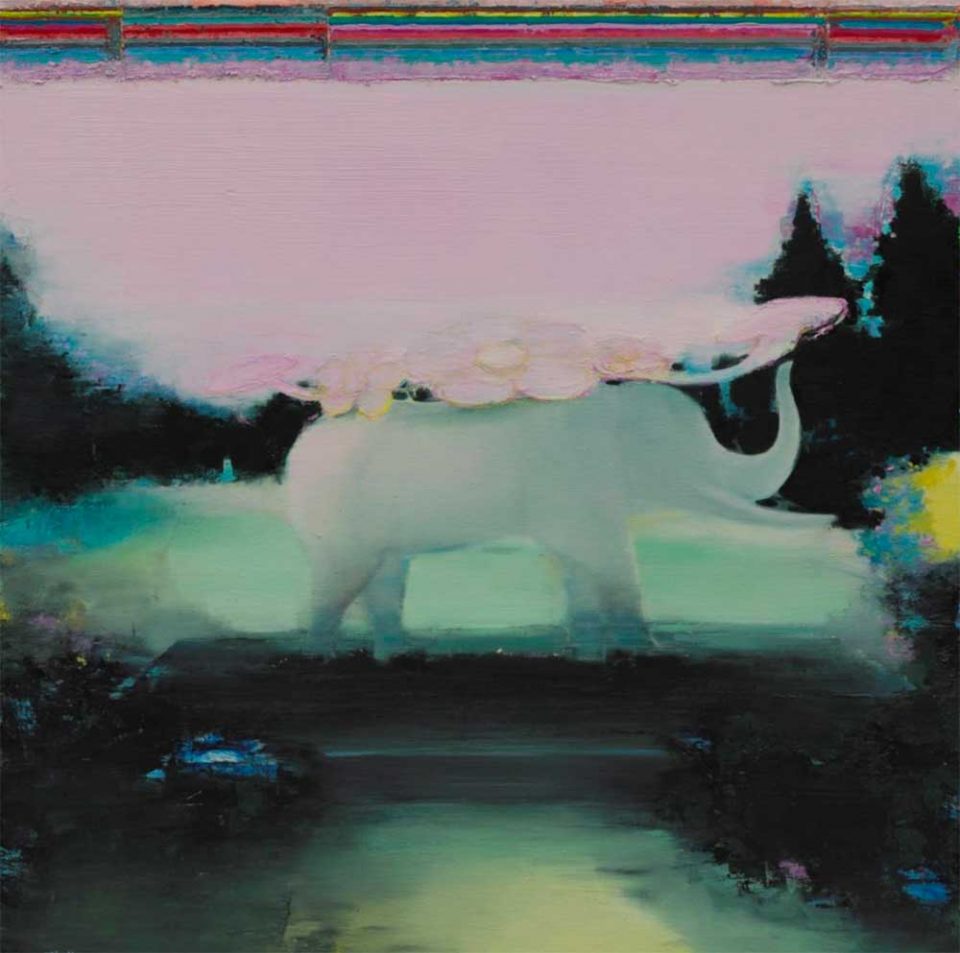
Four or five white stone 100x150cm cloth oil paint 2013

ARTbaiguan: Which period of art or artistic activity has the most influence on you? What is reflected in your work?
Xia Yan: After the Second World War in Europe, I really liked the works of art with realistic criticism. The forms and language of the works of artists such as Kiefer, Richter, and Tuymans have influenced the establishment of my value judgment and creation system.

Obedient 90x60cm 2016

ARTbaiguan: How do you choose new ideas derived from the creative process?
Xia Yan: The new idea is more to take, not to be…

ARTbaiguan: Do you think that a work that combines traditional culture is more meaningful than a purely contemporary work?
Xia Yan:  It depends on the context in which the works are displayed. Some people use a good license to play the game. The works must not be simple binary opposition. The problems of tradition and contemporary, conservative and open, black and white are not directly comparable to right and wrong, good and bad. They are a rich complex of dimensions that are interpenetrated;
Support wall 90x90cm cloth oil color 2016

ARTbaiguan: Many people now believe that painting on the shelf is bound to die, and that installation art and new media art are the future development trends. What do you think of their views?
Xia Yan: This is the law of development. As for the assumptions about the future, I can’t play the role of the prophet.

Cai Wei’s beautiful scenery 90x90cm oil on canvas 2015

ARTbaiguan: Whether it is painting or other art media, you will face the problem of effective expression between language and thought. How do you think about solving these problems?
Xia Yan: Thought is the first. Language is more of a service for the mind. Of course, the validity of the expression of the purely linguistic form cannot be ruled out. I think that the development of society needs more truth than beauty. Therefore, in the current works, I am more and more inclined to intervene in thoughts, rather than the shaping of pure form aesthetics;

“Yu Hang-1” Linseed Oil Color 150x150cm 2010

ARTbaiguan: How do you think about the impact of the social behavior of “circles” on artistic creation? Does the advantage outweigh the disadvantages or do more harm than good?
Xia Yan:Many problems cannot be treated with advantages and disadvantages. The WeChat circle of friends is the most effective way to spread today. This is also a kind of “circle”. It is difficult for us to reject this highly efficient way of communication. As for the interpersonal circle of reality, what I want to say is that if we have no way to circumvent it, then we should use it well. After all, the circle is an effective way of communication.

ARTbaiguan: As an artist, what do you most want to tell the general public?
Xia Yan: Hello! I am Xia Yan

Solo exhibition:
Painted Visual Personal Works Exhibition (Guiyang)
2007 Unknown Mountain – Xia Yan Solo Exhibition (Jinse Gallery, Chongqing)
Group exhibition:
2011 broke into Taiwan (An Desheng Art, Taipei)
Suddenly (Wafu Gallery, Shanghai)
Mixed-up image–China Contemporary Oil Painting Invitational Exhibition (Xi’an Art Museum, Shijiazhuang Museum of Contemporary Art, Hubei Art Museum)
2010 Field Spread (Celebrity Art Institute, Shanghai)
Mixed-up image–China Contemporary Oil Painting Invitational Exhibition (Shenzhen Art Museum, Shenzhen)
Field Spread (Blue Top Art Museum, Chengdu)
Varied landscape (Moon Lake Art Museum, Shanghai)
Vipassana (798 St. Space, Beijing)
Leading in 2009–Nomination Exhibition of Chinese Art Critics (Beijing)
The Theme Exhibition of the First Chongqing Young Artist Biennale “Cultural Imagination of Contemporary Art” (Chongqing Convention and Exhibition Center, Chongqing)
Chinese Situation–Contemporary Art Exhibition (501 Art District, Chongqing)
2008 Desire Reality (Sin Yi Yuan, Singapore)
Southwest Power – Contemporary Art Invitation (Roving) Exhibition (Shenzhen, Shanghai, Chengdu)
The Waves Program – Sino-German Contemporary Art Exchange Exhibition (Sichuan University Art Museum, Chengdu)
The 4th Youth Art Exhibition of Guizhou Province (Silver Award) (Guiyang Art Museum, Guiyang)
Landscape – Seven People Exhibition, 800 Art Museum (Shanghai)
Post-Pioneer China Contemporary Art Exhibition (Hong Kong)
Shanghai Spring Art Salon (Shanghai)
“Art is a kind of work” Southwestern Contemporary Art Studio Invitational Exhibition (Shanghai Mengnali Art Center)
“Animal Carnival” Chinese Youth Artists Exhibition (Chengdu Sichuan University Art Museum)
“The Quartet of the Oral Voice” The 3rd Guiyang Oil Painting Biennale Guiyang Art Museum)
2006 “New Power—China” Contemporary Art Biennale Beijing Invitational Exhibition (Beijing TS1 Contemporary Art Center)
Urban Parts—Contemporary Art from the Summer Capital (Chongqing Jinser Gallery)
“New Power—China” Biennale of Contemporary Art (Shanghai Yuangong Art Museum)
Urban Parts Contemporary Art Studio Works Exhibition (Guiyang Taste Space)
“Playing in the 60s and 70s” Art Exhibition (Guiyang)
“Lan Yi” Oil Painting Exhibition (Guiyang)
2005 The “Baihong Imagery” Theme Exhibition of the Central Academy of Fine Arts Academy (Beijing)
2004 “China’s New Vision”—Chinese Youth Artists’ Works Exhibition (Shanghai)
2003 The First Shanghai Spring Art Salon Exhibition “Joint Exhibition of Young Artists” (Shanghai)

Categories
古代

The Brillante And Great Tang Dynasty

Dates:7.4.2018-8.11.2018
Opening hours: 10:00-18:00 (closed on Mondays)
Location: Shenzhen museum
Address: District A, Citizen Center, Fuzhong Road, Futian District, Shenzhen, China
Ticket Price: free

%5

Categories
当代 艺术家

Contemporary | “Stubborn and Enduring Illusion” Surrealist Artist-Liu Di

Surrealist artist- Liudi

Self Weight
Self Weight

Liu Di is a Chinese artist born in 1985 in the province of Shanxi, China.
In 2009 he graduated from the Department of Professional Photography of the Central Academy of Fine Arts in Beijing and just one year later, in 2010, he won the Lacoste Elysee Award for his series entitled “Animal Regulations”.

Liu Di - Animal Regulation IV No. 4
Liu Di – Animal Regulation IV No. 4

Liu Di is an artist who, to create his works, uses digitally manipulated photographs to investigate the friction between the natural world and the inhabitants of cities in China.
Use digital tools like Photoshop to relate human and animal figures and the landscape, changing its proportions. In fact, the distortion of the proportions of his subjects places them within the urban and natural landscapes of his land, China.

In 2012 he created one of his most famous and important series playing with the juxtaposition between the disproportionate human nudes and the natural environment.

Exhibition
Exhibition

“By violating the rules of common sense, we can break the hypnotic trance induced by the family reality”

Liu Di - The Weigh of Oneself No.1
Liu Di – The Weigh of Oneself No.1

In 2013 he creates one of his most recent series, evolving to the previous series, “Animal Regulations”.
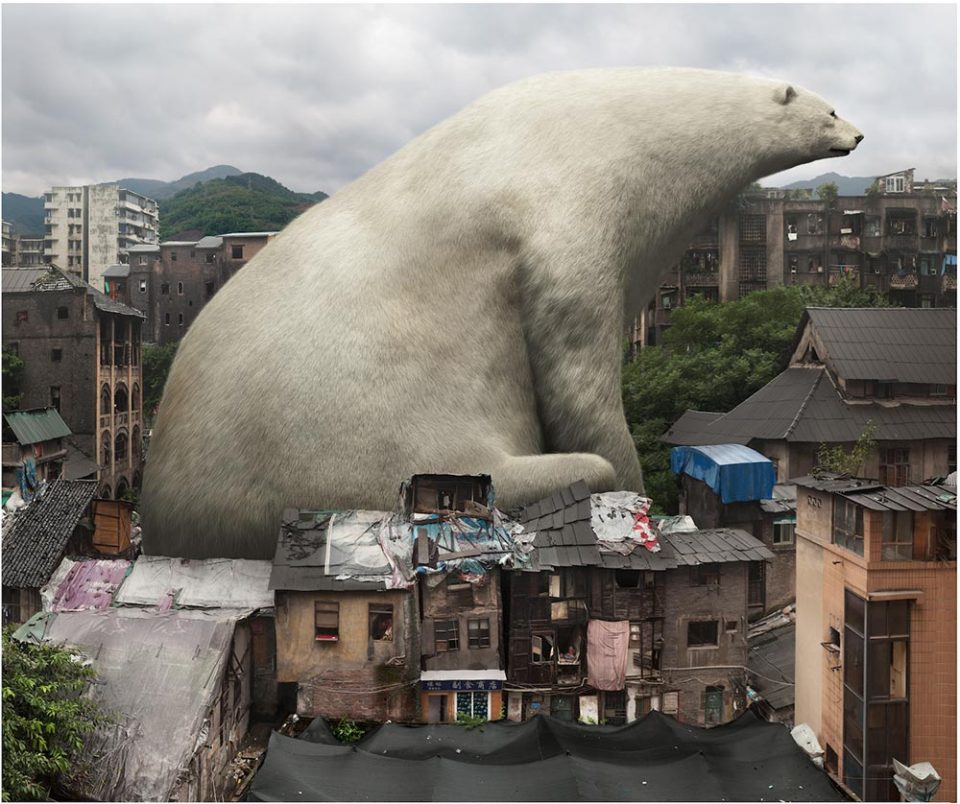
The series features a series of exaggeratedly large, cartoon-like wild animals, such as the giant rabbit in Animal Regulation No. 7, sitting amidst the destroyed landscapes of residential neighborhoods. Their heads are disproportionately small in relation to their massive bodies giving them a caricatural comic effect.

Liu Di - Animal Regulation No.7
Liu Di – Animal Regulation No.7

Liu Di conceived the project for the first time while walking through the crowded outskirts of Beijing, a city that was very familiar to him.
“Looking at the decrepit living blocks, I had the vague but strong feeling that something was missing between the ground and the sky”

Liu Di - Animal Regulation IV No. 18
Liu Di – Animal Regulation IV No. 18

“I felt the urge to add something that would push people to look at familiar scenes with a new and long look”

“Something powerful and impossible to ignore, but not something that would make people panic. … In the end I decided it was supposed to be a huge animal”

Liu Di - Animal Regulation IV
Liu Di – Animal Regulation IV

Thus, using Photoshop, she re-proportioned a panda, a rhino, a monkey and a frog and placed them in gigantic dimensions in squalid urban contexts. By making these heavy-bottomed beasts locked up in the back streets, in the yards and in the courtyards of social housing, she highlights the relationship between nature and human society.

Liu Di – Animal Regulation No.17

These works look at a mutually destructive relationship through the ruins of both human and animal life spaces. Her photographs distort the banality of reality to provoke the viewer to review her urban surroundings.

Stubborn and persistent hallucinations

Through the images, composed of over-sized subjects set in suburbs, settings like residential complexes, Hutong neighborhoods and scenes of demolished houses, transforms the urban landscape into a surreal playground on which towering massive inflated animals, but confined by the surrounding environment.

Stubborn and persistent hallucinations

Exhibitions:
2010–2015 reGeneration2: Tomorrow’s Photographers Today – A Travelling Exhibition, the Musee de I’Elysee, Lausanne, Switzerland
2010 History Lessons, Pein Fine Arts, Beijing, China
2009 Niubi Newbie Kids II Exhibition, Schoeni Art Gallery, Hong Kong, China
2009 Journey of A Thousand Miles–2009 CAFA Excellent Graduation Works Exhibition, CAFA Art Museum, Beijing, China
2009 Young Artists Promotional Exhibition — 2009 Beijing 798 Festival , Beijing 798 Art Zone, Beijing, China
2009 CAFA Graduation Works Exhibition, China Central Academy of Fine Arts, Beijing, China
2009 Cograda Word Design Congress 2009 Beijing , CAFA Art Museum, Beijing, China

References:
https://www.artsy.net/artist/liu-di?page=1&sort=-partner_updated_at
https://www.widewalls.ch/artist/liu-di/
http://www.whiterabbitcollection.org/artists/liu-di-%E6%9F%B3%E8%BF%AA/
http://www.artnet.com/artists/liu-huaishan/biography
http://pekinfinearts.com/en/artist/liu-di/
https://www.mutualart.com/Artist/Liu-Di/37510B7EED388BD6
http://www.artlinkart.com/en/artist/overview/0faazArj

Categories
Museums 头条 当代

Museum | Shanghai Museum of Contemporary Art: China’s first public museum dedicated to contemporary art

POWER STATION OF ART

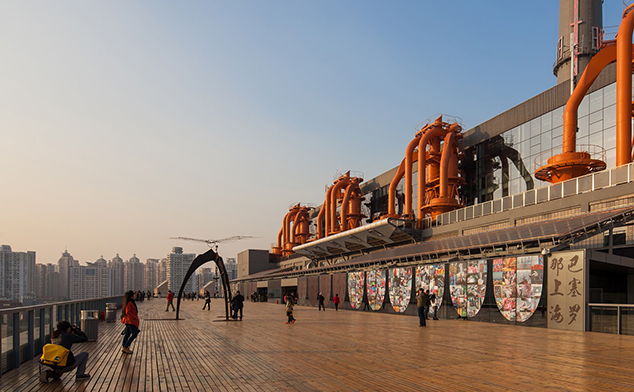
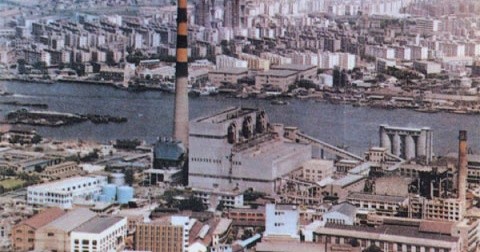
As well as being the first state museum dedicated to contemporary art in mainland China, the Power Station of Art is also home to the Shanghai Biennale. The building was formerly the Nanshi power plant, built in 1985, and then became the Pavilion of the Future in 2010 during the Shanghai World Expo. Following a renewal and expansion project, the PSA officially opened its doors on 1 October 2012 as a public platform that promotes culture and art.

Shanghai, Power Station of Art – Terrace view

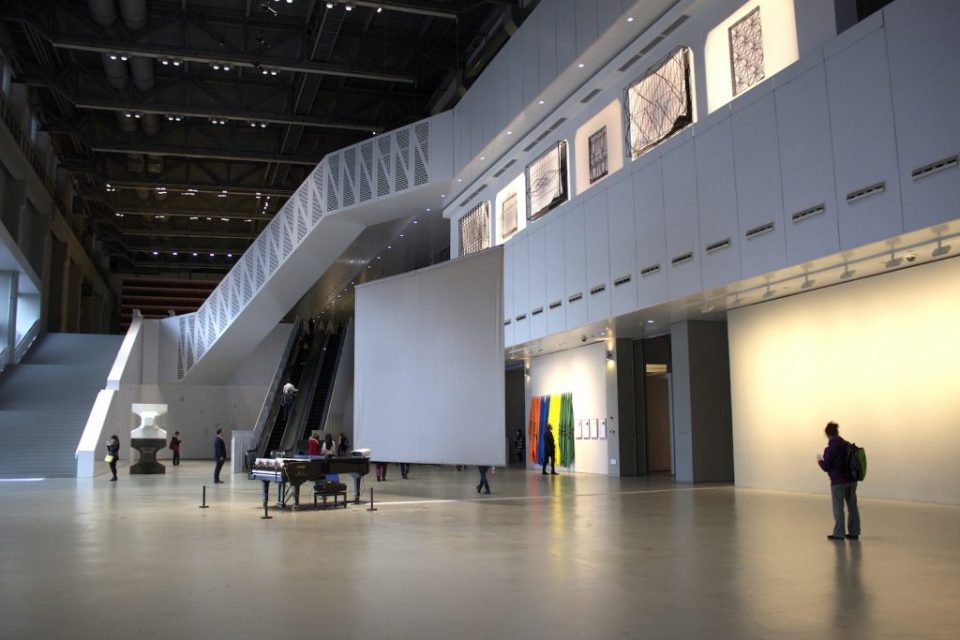
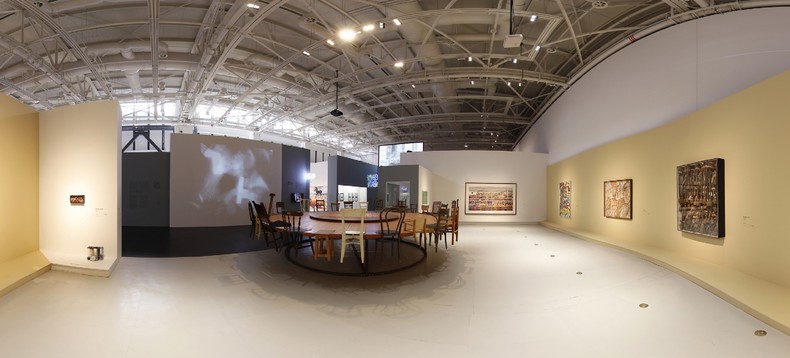
Located on the left bank of the Huangpu River, the PSA occupies an area of 42 thousand square meters and can host exhibition sections that reach 15 thousand square meters. The renovation project, which cost about sixty-four million dollars, wanted to keep the vast spaces of the previous building and its industrial features with the addition of contemporary elements. The aim of the museum is to break down the barrier that separates the exhibition space from the space for “free time” by creating a profound relationship between man and art. In addition, the visit breaks the traditional single-track system to create many possibilities for artistic exploration.

Power Station of Art – Interior design

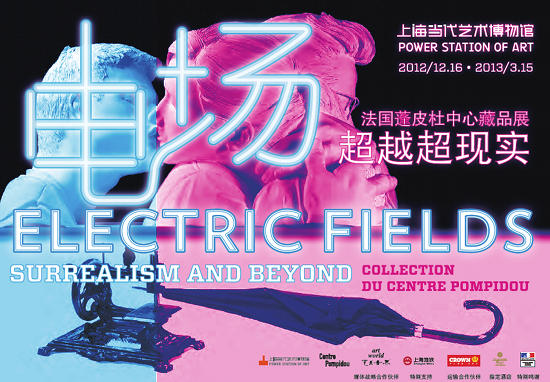
Not having permanent collections the museum hosts temporary Chinese and international exhibitions. The first exhibition organized for the inauguration of the museum in 2012 presented more than 100 pieces from the Parisian Center Pompidou gallery entitled “Portrait of the Times”, which focuses on the surrealist avant-garde. The title of the exhibition was inspired by the first Surrealist collaboration in 1919 by Andre Breton and Philippe Souhault, “Magnetic Fields”. The works, from Renè Magritte to Ed Ruscha, included drawings, sculptures, installations, videos, photographs, prototype constructions and drafts that helped to examine the poetic character of surrealism. This event was of paramount importance as it constituted the first collaboration between a Chinese museum and the Pompidou.

Electric Fields: Surrealism and beyond”- First exhibition, 2012
“Electric Fields: Surrealism and beyond”- First exhibition, 2012

Gong Yan (1977-), from 2013 director of the PSA, graduated from the Ecole National Supérieure des Beaux-Arts, in Paris. In 2005, she founded the “O Art Center” focusing on unstable multimedia art and the city’s research by providing a dynamic platform for young talents and curators. Curator and artist, her works have been exhibited at the Shanghai Biennial in 2002 and 2006 and she is also at the helm of the influential Chinese magazine “Art World”. Her mission is to look to the future but at the same time to understand and incorporate the past of the city which is a unique trajectory that reaches the present day.

Gong Yan – Director of Power Station of Art

“I wish the Power Station was not just a box to be filled with this or that exhibition, but a creative and dynamic container, open to different experiments. And I would like visitors to be not just a distant and silent audience » (Gong Yan)

Nanshi Power Plant in 1985

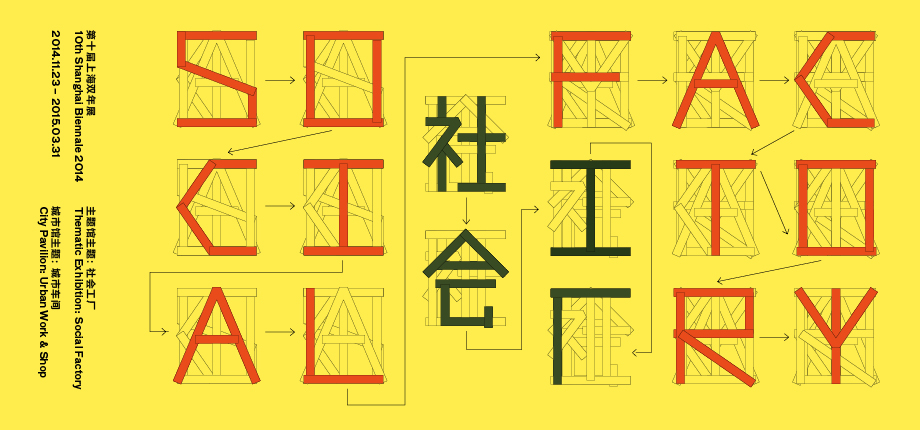
Before the opening of the Power Station, the Shanghai Biennials were held in the rooms of the Shanghai Art Museum. Since its opening in 2012, the PSA has already hosted three editions of the Biennale, the ninth, the tenth and the eleventh. The tenth organized in 2014 and entitled “Social Factory”, questioned what characterizes the production of the social and on how the “social facts” are constituted starting from the year 1978, a turning point in the modernization of China. According to Chris Dercon, director of the Tate Modern in London, he represented an “epochal turning point” for contemporary art in China.

“Social Factoy” – The 10th Shanghai Biennale, 2014

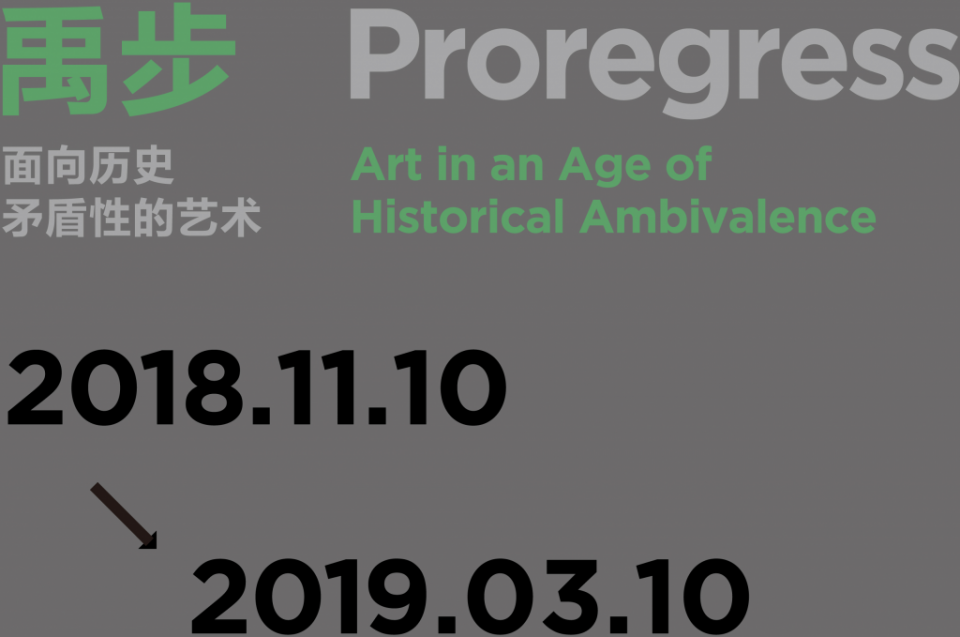
The twelfth Biennale will be inaugurated on 10 November 2018 with the title “Proregress: Art in an Age of Historical Ambivalence” whose works will try to sensitize the public about the contradictions that characterize our time.

“Proregress: Art in Age of Historical Ambivalence” – The 12th, Shaghai Biennale, 2018

The Power Station often resorts to private sponsorships like most contemporary Chinese museums: thanks to them it has set up important exhibitions such as the personal exhibition of Cai Guo-Qiang named “The Ninth Wave”, in 2014, and, in 2012, the already mentioned “Electric Fields: Surrealism and Beyond.” The exhibitions that are set up touch different fields of contemporary art such as architecture, photography, performances, graphic design, product design and bio art.

“Cai Guo-Qiang: The Ninth Wave” – Solo exhibition, 2014

VISIT

Address: 200 Huayuangang Road, Huangpu District, Shanghai
Hours: 11:00 – 19:00 from Tuesday to Sunday, closed on Mondays; open on all national holidays. Last admission at 18:00.
Admission is free except for special exhibitions.

CONTACTS

Telephone: 021-31108550
Website: http://www.powerstationofart.com/en/
E-mail: info@powerstationofart.com

Credits:

http://www.powerstationofart.com/en/https://www.archdaily.com/293515/power-station-of-art-original-design-studiohttp://www.vogue.it/people-are-talking-about/vogue-arts/2015/06/gong-yan

Photo credits:

http://www.timeoutshanghai.com/venue/Galleries/8072/Power-Station-of-Art.htmlhttp://www.artribune.comhttp://www.powerstationofart.com/en/https://dreamofacity.com

Categories
LAVORATO 当代

He Juan is a young artist born in 1985 in Qinghai, a territory from which the Yellow River is born and which occupies the north-eastern part of the Tibetan Plateau, in China.
In 2003 he studied at the Academy of Fine Arts in Sichuan where in 2007 he graduated.

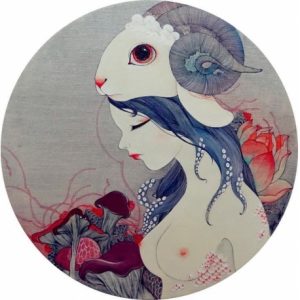
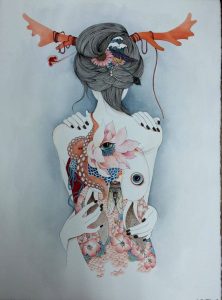
He Juan is a girl with a calm and calm temperament, a very simple woman who manages to express all her delicacy and sensitivity through her works. In fact these become a real mirror through which we can observe and recognize the romantic personality of the artist. In fact, the works of He Juan are the perfect reflection of the woman who conceived them in all her simplicity and beauty.

These are shapes developed through soft lines and curves that give life to simple figures but full of details.
He Juan manages to create very poetic images full of romantic fantasy.

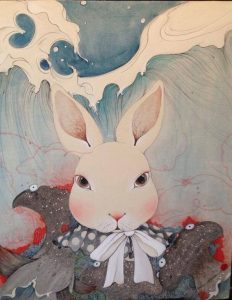
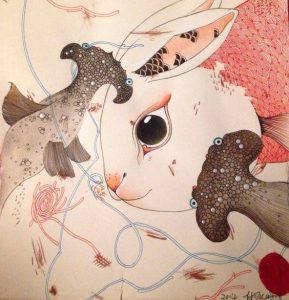
The main subjects within his works are very linked to nature and therefore her works can not be separated from the theme of “animals” because they like to consider the creatures that grow on this earth as protagonists of the photo.

He Juan – Untitled

Through the language of painting, she models her subjects with skill, sometimes with exaggerated and bizarre deformation techniques. This type of artistic treatment makes sure that from the animals represented by her, various types of “personality” emerge, succeeding in this way also in capturing the attention of the public.

He Juan – Untitled

Exhibitions:
2005    Exhibition of Sichuan Academy of Fine Arts in scenery. (Chongqing Art Museum)
2005    The 13th Annual Exhibition of the Student Works of the Oil Painting of the Sichuan Academy of Fine Arts. (Chongqing Museum of Art)
2006    Sichuan Fine Arts Institute of fundamental teaching Exhibition (Chongqing Art Museum)
2006    Dragonair fly shows Chinese Art Award and won the “most beloved audience award” Shanghai
2007    The Sichuan Academy eleventh Fine Arts Student Exhibition (Chongqing Art Museum)
2007    United Kingdom “Art education and creativity” Teaching exhibition (Chongqing Museum of Art)
2007    Sichuan Academy of Fine Arts Exhibition graduate and won the “Extraordinary Degree Award” (Chongqing Museum of Art)
2007    “never set foot on the road” – “project X” youth art exhibition (Shanghai)
2007    Chongqing avant-garde contemporary art exhibition (Chongqing Planning Exhibition Hall)
2007    Art Basel Miami Beach (Basel)
2008    Third women artists Invitational of Contemporary young (Chongqing Art Museum)
2008    Shanghai Art Exposition (Shanghai)
2008    Art Beijing (Beijing)
2008    Singapore Art Exposition (Singapore)
2008    Shanghai Contemporary Art Exposition (Shanghai)
2008    Taipei Art Fair (Taipei)
2009    Fahrenheit Gallery SE Juan Solo Exhibition (Shanghai)
2009    “we” Huangjueping First Exposure (Chongqing) Annual
2009    Hong Kong Art Fair (Hong Kong)
2009    11th Chongqing National Art (Chongqing)
2009    Shanghai Art Fair (Shanghai)
2010    Chongqing First Biennial (Chongqing)
2010    Hong Kong Art Fair (Hong Kong)
2010    Shanghai Art Expo (Shanghai)
2010    (Taipei Art Center, Taipei) “One Heart and One German” Blue Top and Era Exposure Cooperative Outlets (Chengdu Times Outlet)
2011    Sichuan Fine Arts Academy 70th Anniversary Series of “Huang Bingzhan” (Chongqing)
2011    Shanghai Art Fair (Shanghai)

References:
http://www.artlinkart.com/cn/artist/exh_tp/476bzxs/570asBll
http://www.xlysauc.com/auction5_det.php?id=23876&ccid=248&n=707
https://www.artsy.net/artist/he-juan-he-juan?page=1&sort=-partner_updated_at
http://artand.cn/artid/128311