Categories
Museums 在博物馆 传统 典藏故事 古代

Hunan Provincial Museum | Mawangdui Han Tomb

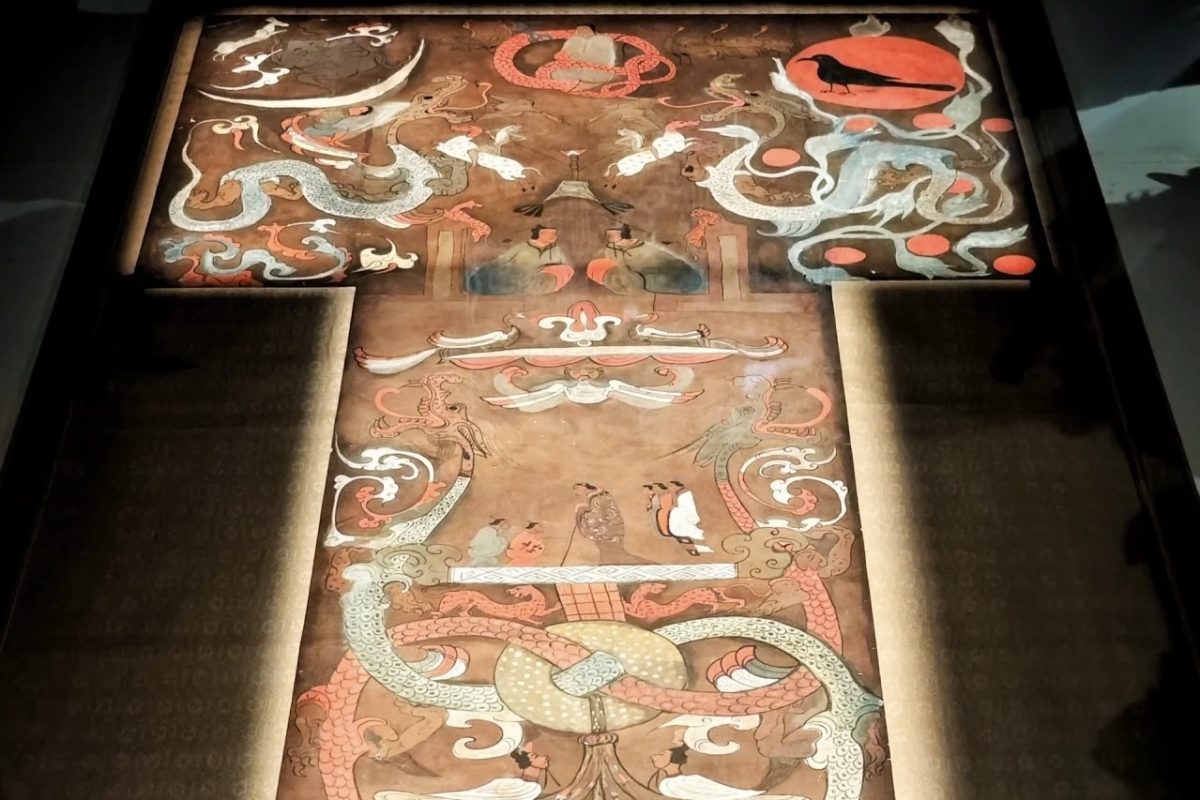
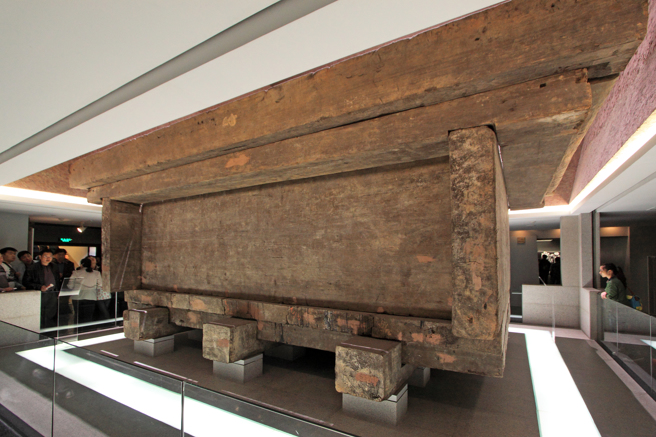
Mawangdui Han Tomb [Tomb of the Western Han Dynasty (202-8 B.C)] unearthed in Changsha, Hunan Province in 1972. Mawangdui Han Tomb is one of the Chinese cultural relics not allowed to leave the country for exhibition. It is now in the Hunan Provincial Museum and is one of the treasures of the Hunan Provincial Museum.
Mawangdui Han Tomb
Hunan Provincial Museum
Madam XinZhui

Introduction to the painting

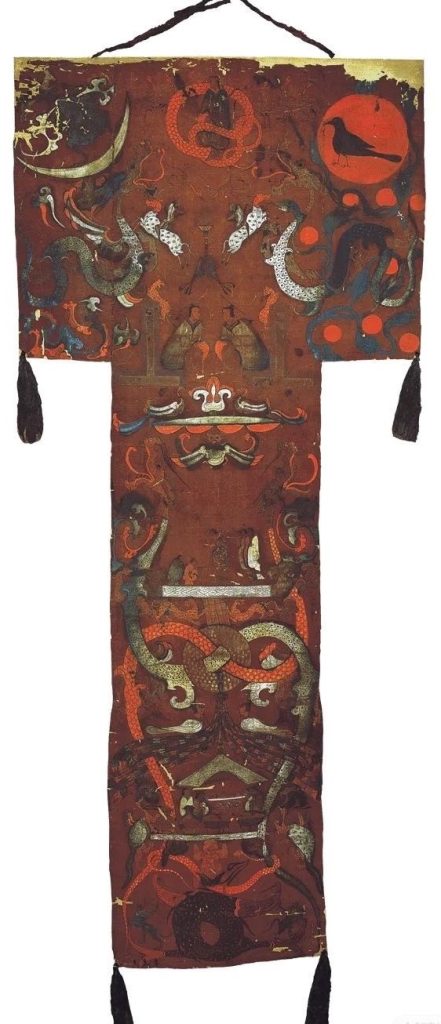
There are three tombs in the Mawangdui Han Tomb. Today we are mainly talking about Tomb One. Tomb One is the tomb of Madam XinZhui(a Chinese noblewoman. She was the wife of Li Cang.(the Chancellor of the Changsha kingdom, during the western Han Dynasty of ancient China) And this painting is on the inner coffin of Madam XinZhui.
Mawangdui Han Tomb
Hunan Provincial Museum
Madam XinZhui

The painting is 92cm wide at the top, 47.7cm wide at the bottom, and
205cm long, in the shape of “ T”. It is divided into three sections from
top to bottom: heaven, the human world and underworld.
Mawangdui Han Tomb
Hunan Provincial Museum
Madam XinZhui

Heaven

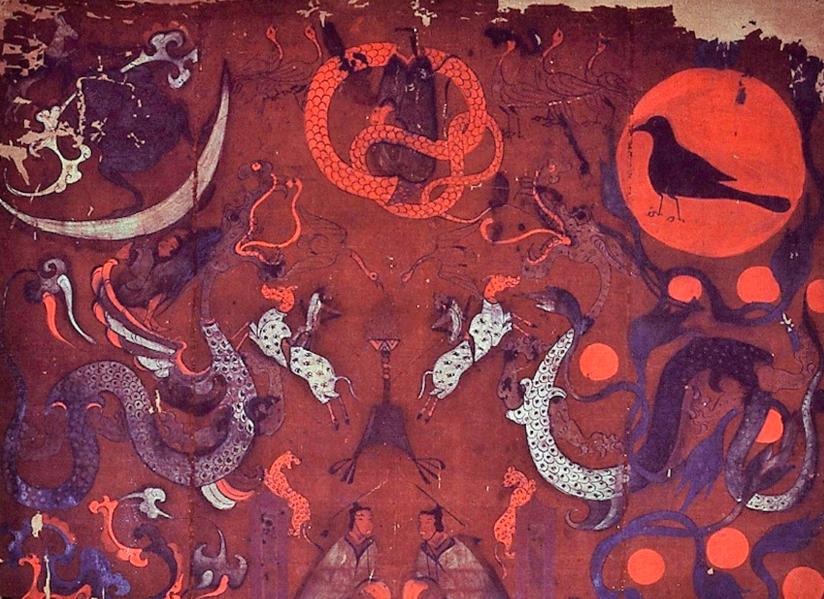
Upper right corner: there is a sun with a golden crow (Chinese mythological bird capable of driving a sun chariot) surrounded by eight other suns (Chinese myth: there were once 10 suns in the sky that shone on the earth and brought drought to the earth, so in order to save the earth a man named HouYi shot the remaining nine suns with an arrow).

Upper left corner: a woman holding the moon rising slowly, which is
related to the story of Chang’e Running to the Moon (Chinese legend: a woman named Chang’e, who ate an elixir of immortality and then ascended to become a god).

Right in the middle: in the middle of the sun and the moon, there sits a heavenly god with a human head and a snake’s body, surrounded by
cranes (a symbol of auspiciousness). This is to show that the god in the
sky takes care of Madam XinZhui.
Mawangdui Han Tomb
Hunan Provincial Museum
Madam XinZhui

The human world

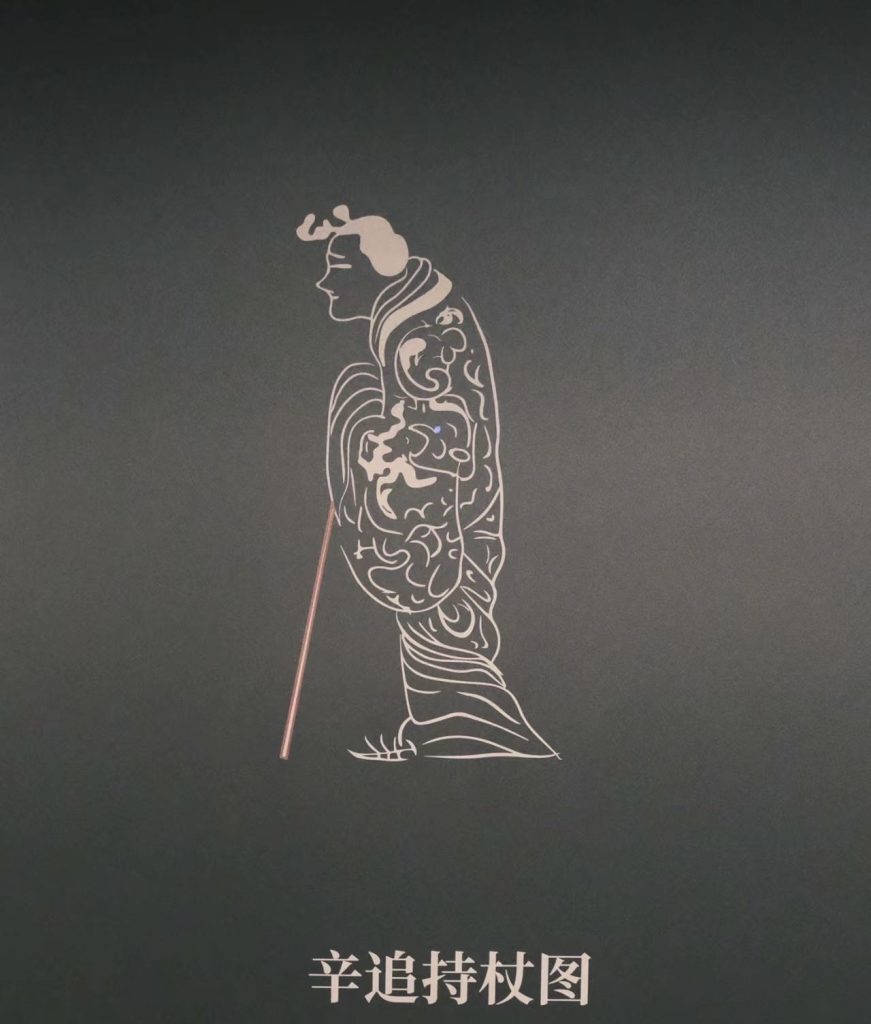
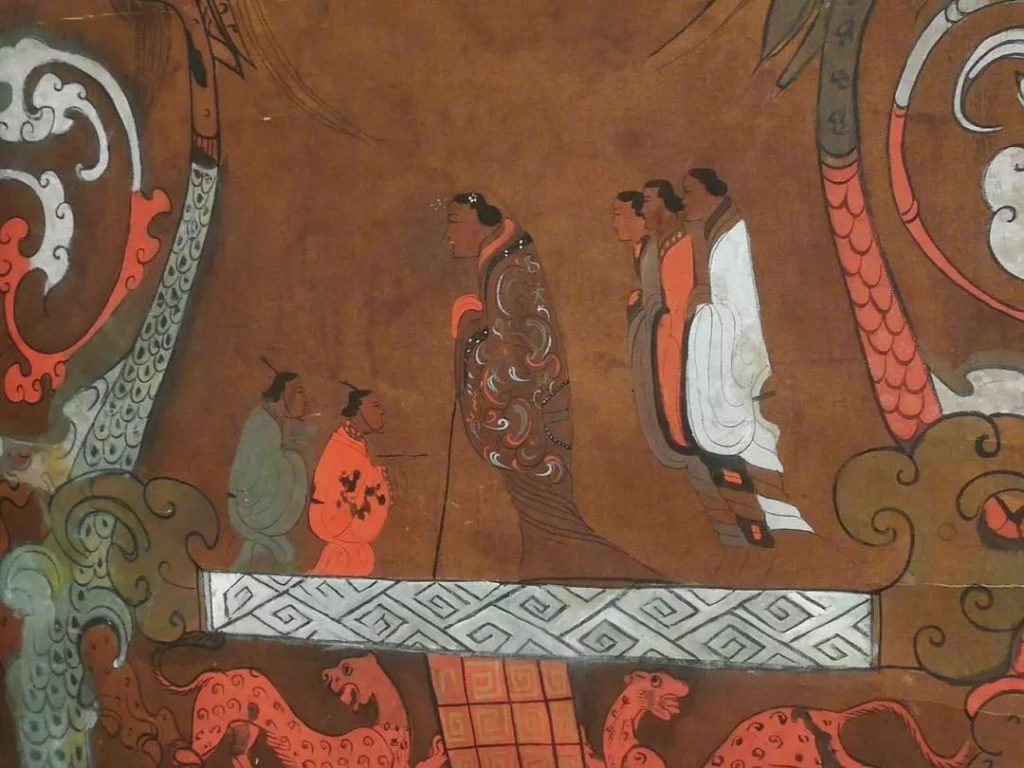
Here is a profile of an old woman walking slowly on crutches, with two
people kneeling in front of her, followed by three attendants. Judging
from the dress, this should be the owner of the tomb, Madam XinZhui.
Mawangdui Han Tomb
Hunan Provincial Museum
Madam XinZhui

Underworld

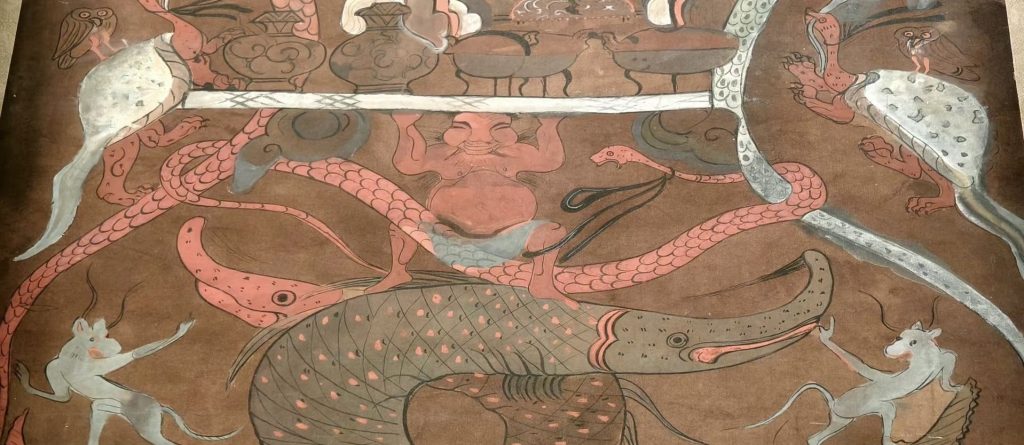
A naked man (someone thinks he is the earth god Gun) was holding a white flat object symbolizing the earth, with two huge fishes “Ao” under his feet. Legend has it that god Gun is the only one who can stabilize the fish “Ao”.
Mawangdui Han Tomb
Hunan Provincial Museum
Madam XinZhui

Cosmology in the Han Dynasty

According to historical records, the T-shaped painting is called “Fei Yi”. The so-called “Fei Yi” has two meanings: one is like clothing but not clothing. A special person held it in front of the funeral procession and used to lead the soul to heaven; the second is that “非 Fei” equals “飞 Fei”, so “Fei Yi” also means that the deceased can fly up to heaven by wearing the Fei Yi. No matter what the interpretation is, the purpose is to fly into the heavenly realm.

The threefold division of heaven, the human world and underworld in this silk painting also reflects the cosmology of the people during the HanDynasty. They observed the sun rising in the east and setting in the west, the four seasons of spring, summer, autumn and winter, and so on, so they also believed that the universe ran in cycles. Since the universe runs in cycles, human life should also run in cycles. That being the case, death was not the end of human life, but another continuation of life, and they hoped that their souls would be reborn in heaven.

Source

Hunan Provincial Museum

Interview

Mawangdui Han Tomb

Categories
LAVORATO 传统 艺术家

Tradition | Master of Chinese Painting “Qiao Weiming”


The master of Chinese painting Qiao Weiming

Chinese painting emphasizes him as an excellent artist, who needs to learn from the outside world and get the source from his heart, in order to have the wonderful feeling of creating the gods, mountains and rivers at the same time. Helping artists understand the true meaning and essence of art.
Canzone d’autunno
Chinese art requires saving the intention with the pen first, when the painting is finished the existence of the intention is still here. Emphasize the dissolution of things, create an artistic conception, arrive at drawing mien with form, form and spirit that must be established together.
Silenzio

And him, he did it. He is the outstanding Chinese artists – Qiao Weiming, born in 1961 in Luo yang Xiaolangdi. He is the member of China artists association. The researcher at the Chinese poem calligraphy institute of fine arts. The visiting professor of Lu Xun Academy of Fine Arts. Hebei Academy of Fine Arts and PLA Information Engineering University, the expert of cultural relics appreciation.the member of Luoyang CPPCC. The dean of Luoyang University Painting and Calligraphy Institute, and the art teacher of Luoyang Institute of Technology.

Chinese painting

Untitle

His material comes from the flowers and birds in his hometown. The composition of painting is a concrete embodiment of years of experience. For example, the basket series of paintings. All of which are mainly composed of baskets, are composed in the middle. However, the most annoying part of the composition of Chinese painting is that the main body is placed in the middle. which is precisely because the basket series is placed in the middle, which makes it very comfortable to look at. It breaks the limitation of the traditional painting composition from Song dynasty to modern times, which also forms its personal characteristics.

Fish Basket
Childhood Fun

In 1982, the work “Underestimating the wealth”, won the first prize of the Army Art Exhibition.

Red and fragrant peony

In October 1988, he held his solo exhibition in the Cultural Center in Tainan City, Taiwan.

In 1992, the work “Red and fragrant peony ” won the bronze medal in the International Chinese Painting Grand Prix.

In July 1993, he was graduated from the Fine Arts Department of Xinjiang Normal University.

From September 1993 to July 1994. he studied master’s degree in flower and bird painting at the Chinese Painting Department of Guangzhou Academy of Fine Arts. His creation “Red Kaki” was collected by the college.

In October 1994, his work “Reminiscences of Childhood” was selected for the 8th National Art Exhibition and won the first prize of Henan Art Exhibition.

In July 1997, his work “People in the Country” was selected by the China Artists Association, which held the Exhibition of  welcoming Hong Kong return to the Chinese artists .

In November 1997, the work “The Nest” won the second prize of contemporary Chinese meticulous paintings organized by the Ministry of Culture.

In August 1999, the work “Return” was selected by the China Artists Association which held the “welcome Macao to return to China’s calligraphy and painting exhibition.”

In October 1999, the work “Homeland” was awarded the Achievement Award by the China Artists Association for. “Celebrating the 50th Anniversary of the Founding of the Republic of China”.

In November 1999, the work “Bumper Harvest” was selected into the National Second Flower and Bird Painting Exhibition organized by the China Artists Association.

In February 2001, he participated in a joint exhibition of eight paintings and calligraphy organized by the Ministry of Culture of the People’s Republic of China to Egypt, Britain, France and Italy.

Hometown
Flowers

SEE FOR DETAILS:http://qiaoweiming.orgcc.com/works/v3710.html