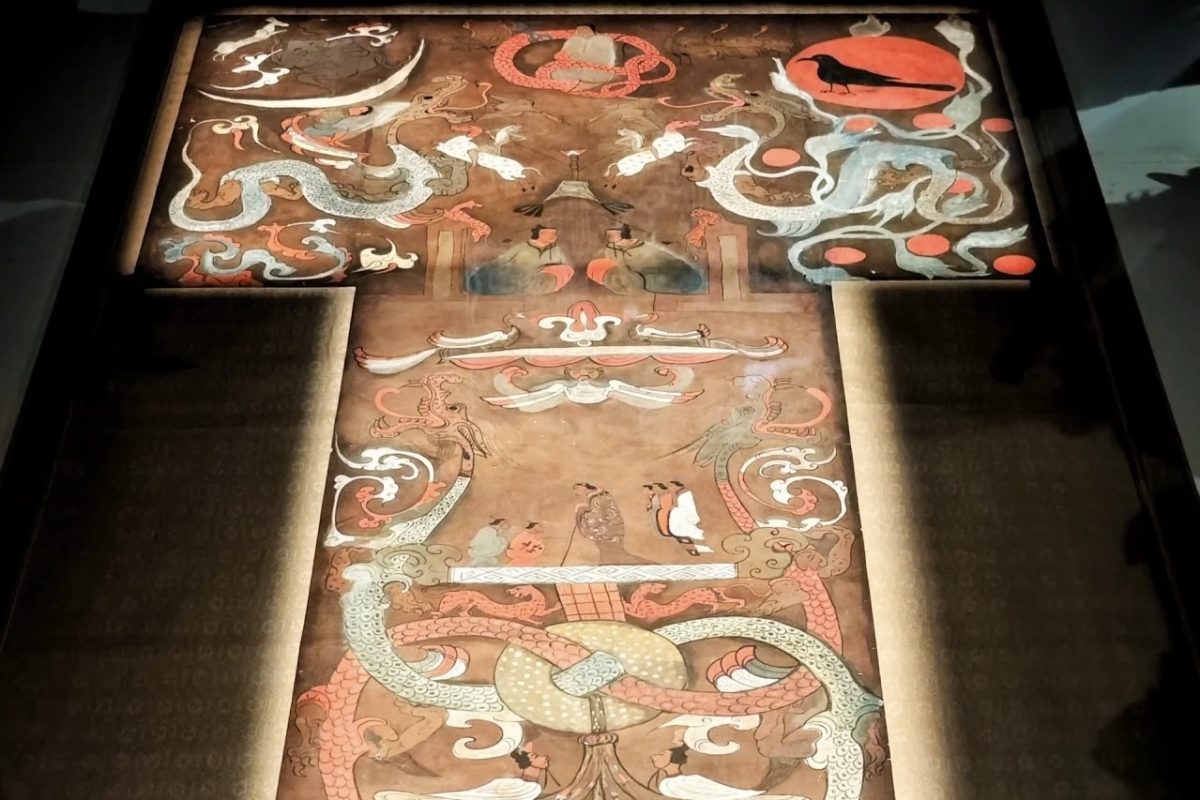
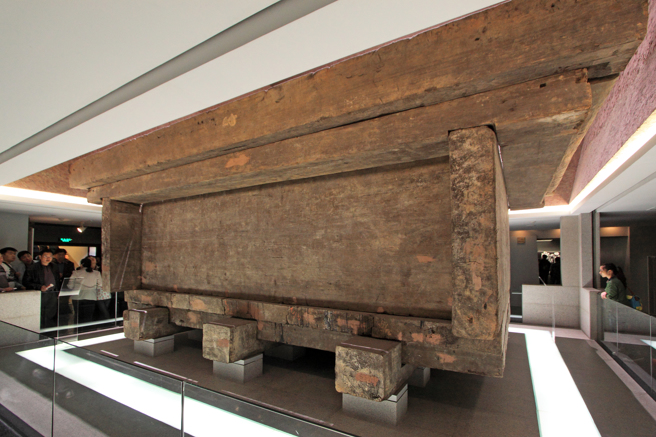
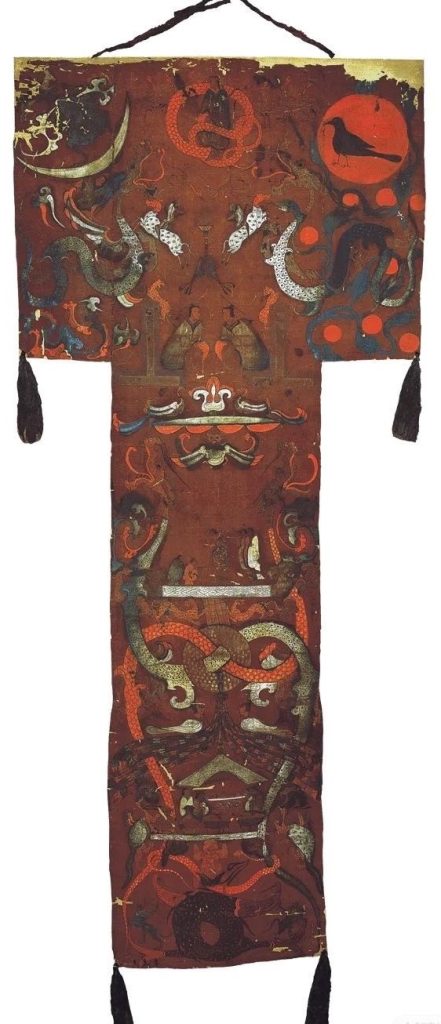
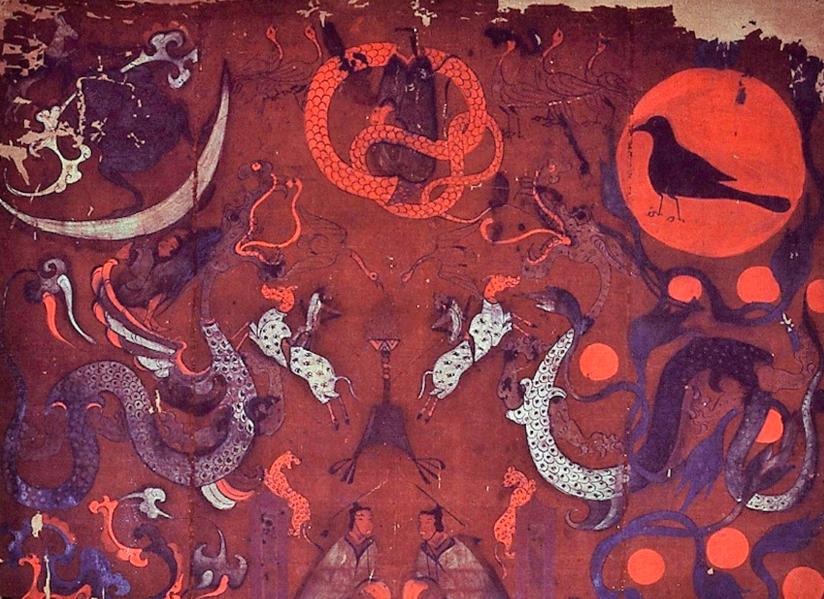
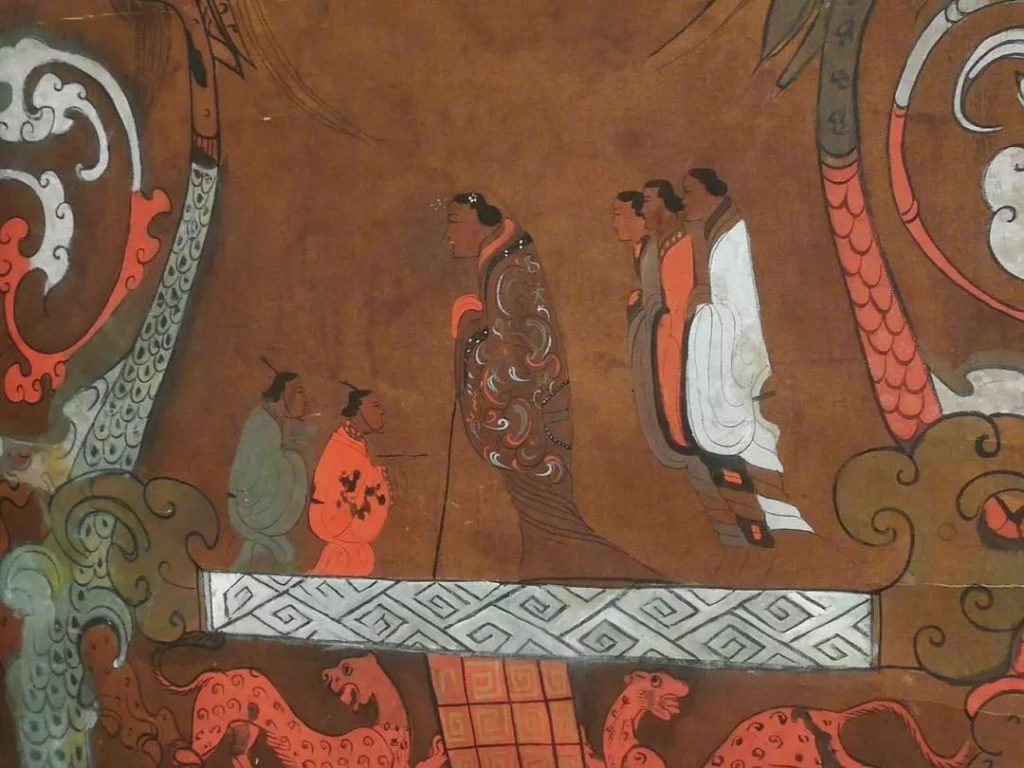
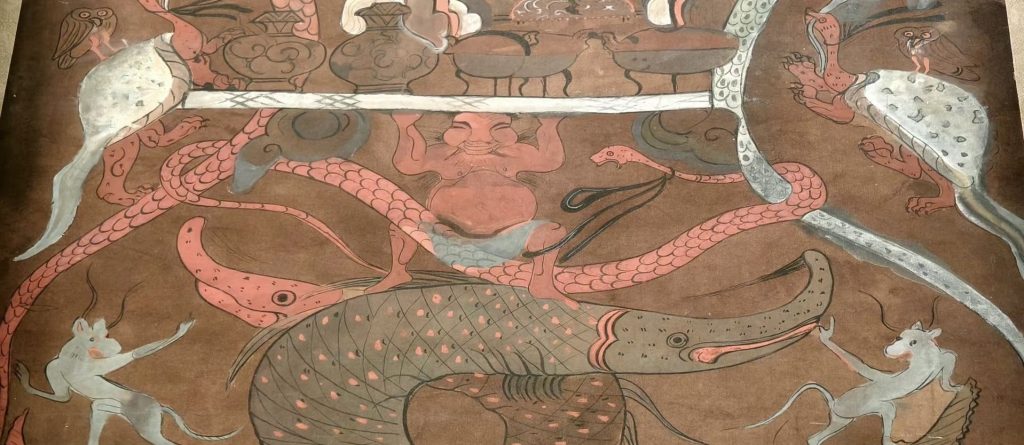
Mawangdui Han Tomb [Tomb of the Western Han Dynasty (202-8 B.C)] unearthed in Changsha, Hunan Province in 1972. Mawangdui Han Tomb is one of the Chinese cultural relics not allowed to leave the country for exhibition. It is now in the Hunan Provincial Museum and is one of the treasures of the Hunan Provincial Museum.
Introduction to the painting
There are three tombs in the Mawangdui Han Tomb. Today we are mainly talking about Tomb One. Tomb One is the tomb of Madam XinZhui(a Chinese noblewoman. She was the wife of Li Cang.(the Chancellor of the Changsha kingdom, during the western Han Dynasty of ancient China) And this painting is on the inner coffin of Madam XinZhui.
The painting is 92cm wide at the top, 47.7cm wide at the bottom, and 205cm long, in the shape of “ T”. It is divided into three sections from top to bottom: heaven, the human world and underworld.
Heaven
Upper right corner: there is a sun with a golden crow (Chinese mythological bird capable of driving a sun chariot) surrounded by eight other suns (Chinese myth: there were once 10 suns in the sky that shone on the earth and brought drought to the earth, so in order to save the earth a man named HouYi shot the remaining nine suns with an arrow).
Upper left corner: a woman holding the moon rising slowly, which is related to the story of Chang’e Running to the Moon (Chinese legend: a woman named Chang’e, who ate an elixir of immortality and then ascended to become a god).
Right in the middle: in the middle of the sun and the moon, there sits a heavenly god with a human head and a snake’s body, surrounded by cranes (a symbol of auspiciousness). This is to show that the god in the sky takes care of Madam XinZhui.
The human world
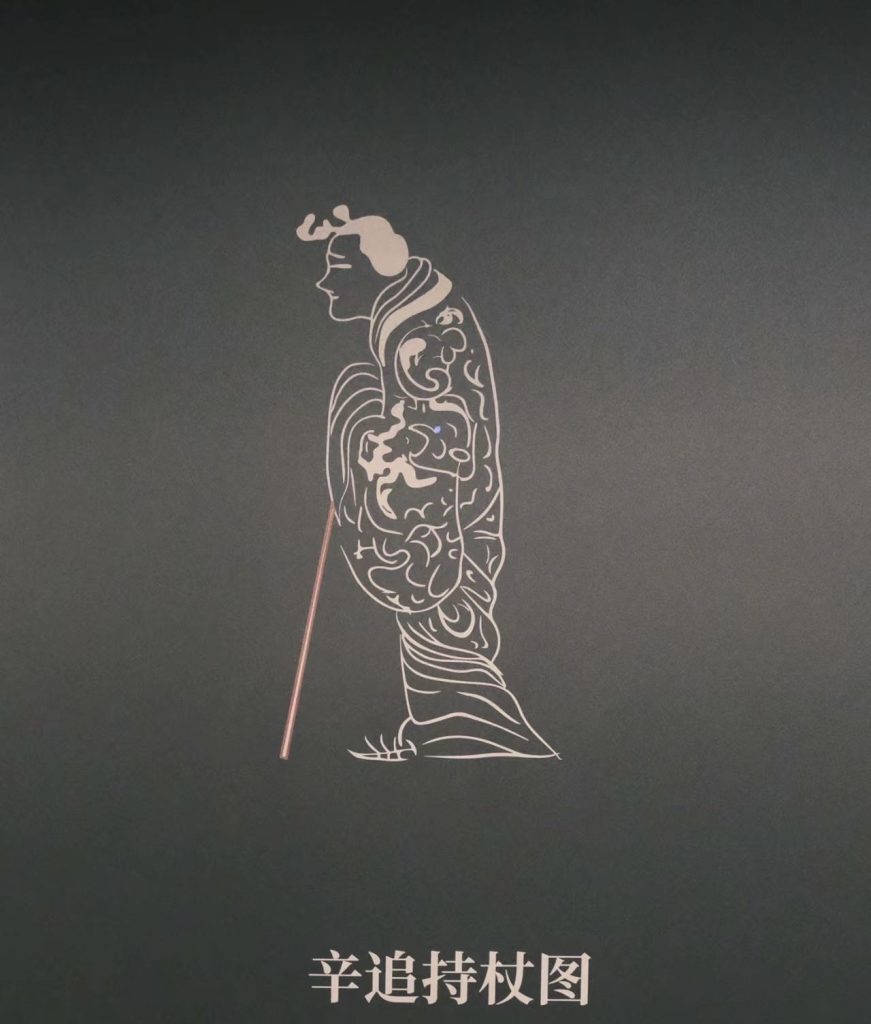
Here is a profile of an old woman walking slowly on crutches, with two people kneeling in front of her, followed by three attendants. Judging from the dress, this should be the owner of the tomb, Madam XinZhui.
Underworld
A naked man (someone thinks he is the earth god Gun) was holding a white flat object symbolizing the earth, with two huge fishes “Ao” under his feet. Legend has it that god Gun is the only one who can stabilize the fish “Ao”.
Cosmology in the Han Dynasty
According to historical records, the T-shaped painting is called “Fei Yi”. The so-called “Fei Yi” has two meanings: one is like clothing but not clothing. A special person held it in front of the funeral procession and used to lead the soul to heaven; the second is that “非 Fei” equals “飞 Fei”, so “Fei Yi” also means that the deceased can fly up to heaven by wearing the Fei Yi. No matter what the interpretation is, the purpose is to fly into the heavenly realm.
The threefold division of heaven, the human world and underworld in this silk painting also reflects the cosmology of the people during the HanDynasty. They observed the sun rising in the east and setting in the west, the four seasons of spring, summer, autumn and winter, and so on, so they also believed that the universe ran in cycles. Since the universe runs in cycles, human life should also run in cycles. That being the case, death was not the end of human life, but another continuation of life, and they hoped that their souls would be reborn in heaven.
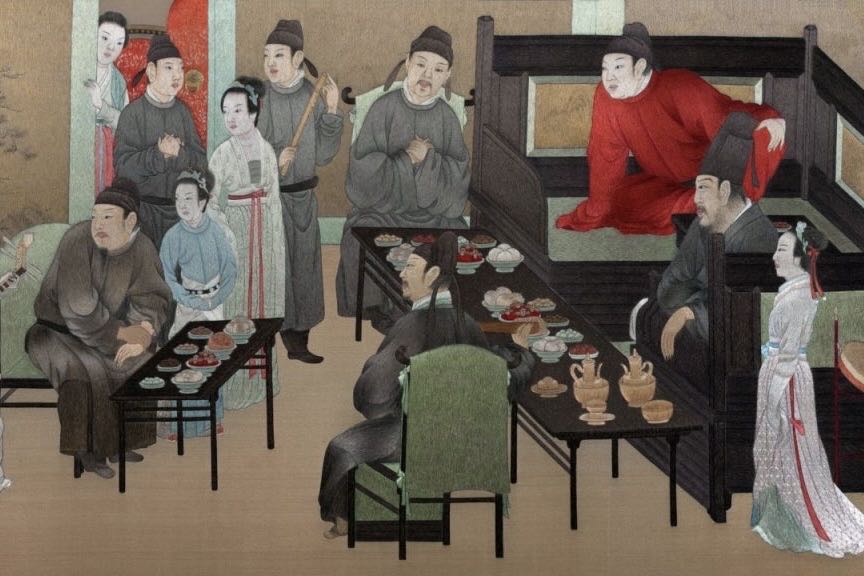
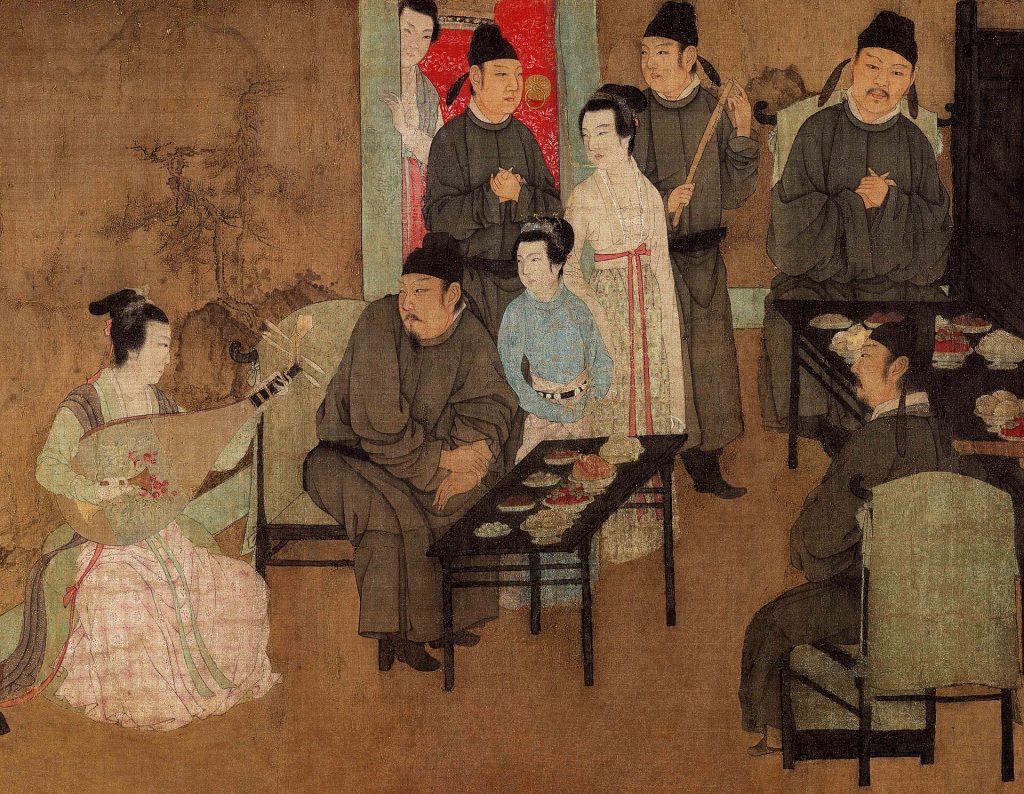
The Night Revels of Han Xizai is a work by Gu Hongzhong (910-980). He was a painter of the Southern Tang Dynasty (937-975). This painting has two copies. A reproduction from the Song Dynasty(960-1279), currently housed in the Palace Museum at Beijing. The another one replica from the Ming Dynasty(1368-1644), under the collection of the Three Gorges Museum at Chongqing. This painting is one of China’s masterpieces.
Background of The Night Revels of Han Xizai
According to the history, Han Xizai was born into a noble family and had excellent ability. He worked as an official in the Southern Tang Dynasty. However, seeing that the politics of the Southern Tang Dynasty was deteriorating. But he knthat could not do anything about it, so Han Xizai indulged himself. Li Yu was the later lord of the Southern Tang Dynasty. He wanted to reuse Han Xizai. So he sent his painter Gu Hongzhong to Han Xizai’s home to record the scene of Han Xizai’s feasts and invitations to his guests. He wanted to observe whether Han Xizai was really unrestrained, but also wanted to use this painting to advise Han Xizai to stop his debauchery. Gu Hongzhong painted this painting through his own imagination and observation.
Content of The Night Revels of Han Xizai
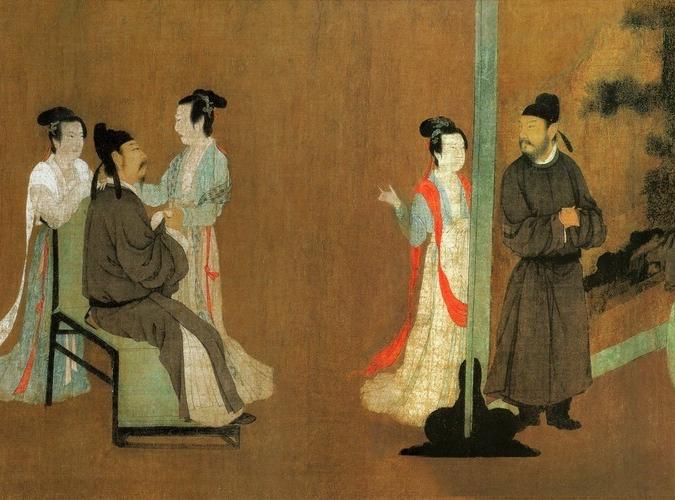
The painting has five segments. Gu Hongzhong used folding screens、beds and orchestral music to separate the images. This way breaked the traditional notion of composition and unifying the sequential events in a single image.
Paragraph 1: Listening to Music.
Han Xizai and zhuangyuan are sitting on a couch, listening to Li Jiaming’s sister play the pipa . Li Jiaming is on her left and looks at her, listening intently and always concerned about the technique she plays.
Paragraph 2: Watch the dance.
The people are watching Wang Wushan jump ‘Liu Yao ’dance (It’s a traditional dance from ancient China). Han Xizai played ‘Jiegu’ (It was a drum used in ancient china) to help the celebrate, his friend De Ming monk unexpectedly met this scene, awkwardly arched back stand.
Paragraph 3: A nap between feasts.
This depicts Han Xizai sitting on a couch, washing his hands and talking to his maids. At this point, the pipa and flute are both being carried inside by a woman, followed by a woman carrying cups and saucers. The two women seemed to still be talking about tonight’s banquet, adding to the relaxed atmosphere. Red candles have been lit and pillows have been placed so that people can lie down and rest at any time. At this time we can easily associate the banquet scene with the ancients, they cover the window and drink at night, singing and dancing, tired to rest for a while, often forgetting the change of day and night.
Paragraph 4: Wind and Music Ensemble.
Han Xizai changed out of his formal attire and sits cross-legged in a chair, waving a fan while commanding something to an attendant.
Paragraph 5: Guests talked each other.
This paragraph depicts the end of the banquet and the departure of the guests.
Significance of The Night Revels of Han Xizai
The main character in this painting is Han Xizai. We observe that he listened to the music, beated the drum by himself, and enjoyed the dance. But even in this joyful atmosphere, Han Xizai was preoccupied and his brows were locked, which contrasted sharply with the joyful atmosphere. At that time, the politics of the Southern Tang Dynasty was in turmoil, and through the image of Han Xizai in this painting, we can also understand Han Xizai’s hardship. The painting details the intense psychological struggle of the protagonist under the complexity of the time, revealing the contradictions within the political class.
In summary ,The Night Revels of Han Xizai is not only an extremely valuable painting in China, but also an important document for us to study the society, culture and art in the Southern Tang Dynasty.
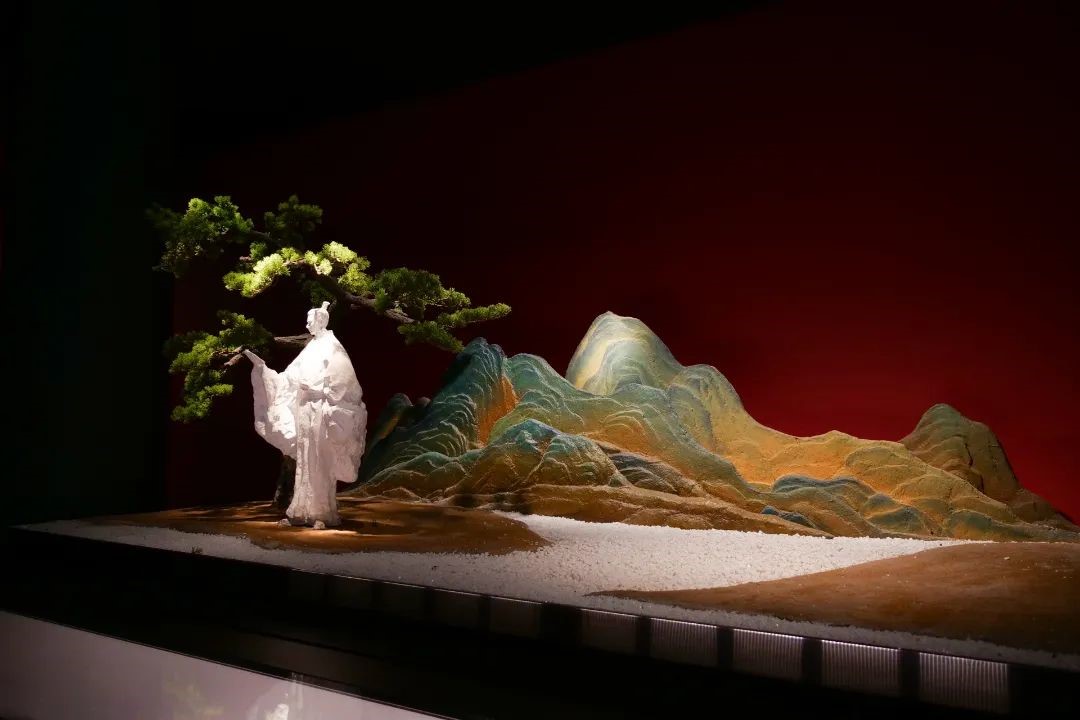
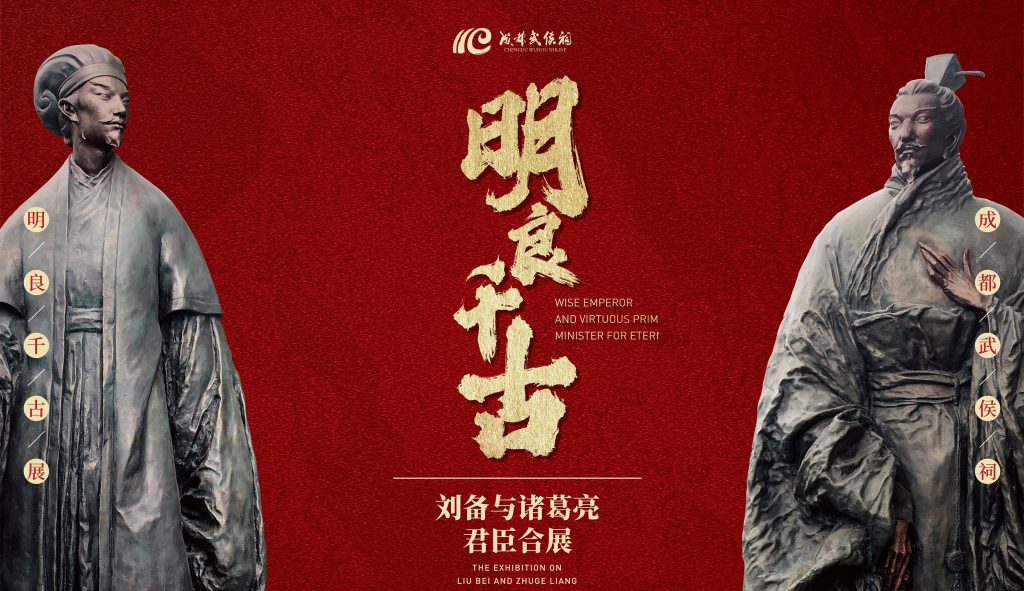
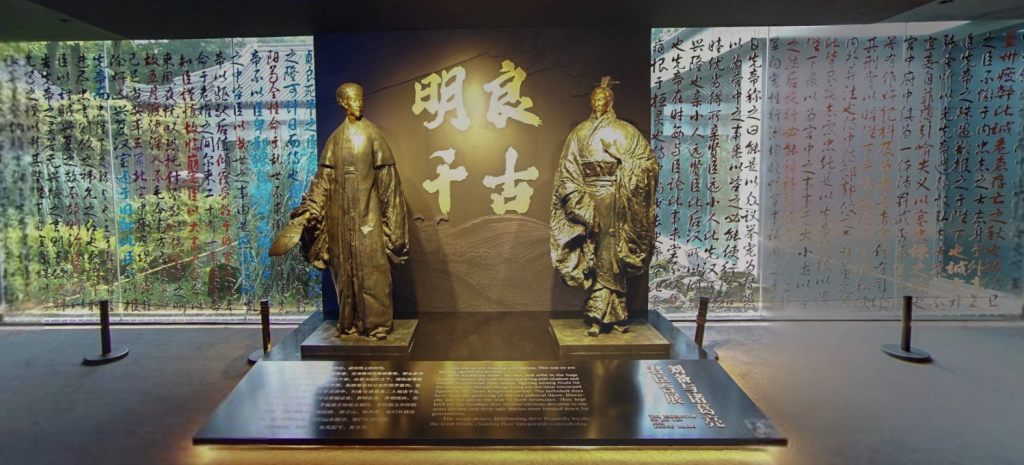
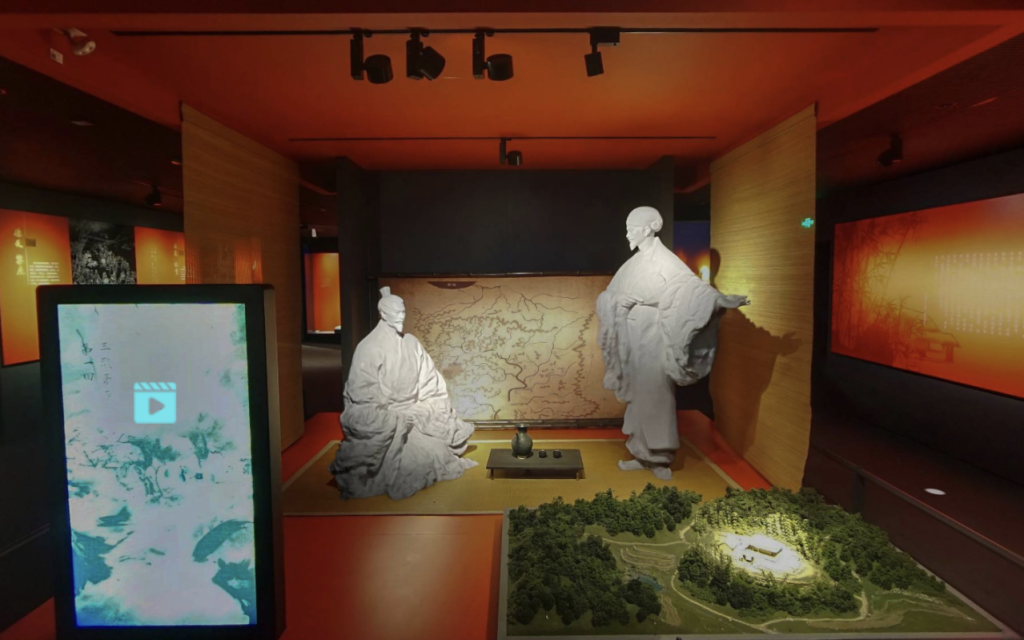
Liu Bei and Zhuge Liang Joint Exhibition is on display at the Wuhou Shrine in Chengdu. This exhibition is based on the historical facts of the Three Kingdoms , and recreates the legend of 1800 years ago.
Preface
In China, when we were young, we would know that there is a famous book called ‘Romance of the Three Kingdoms’. This book mainly depicts wars and tells the history of nearly a hundred years. It is from the end of the Eastern Han Dynasty to the early years of the Western Jin Dynasty. When we grow up and read ‘Romance of the Three Kingdoms’,we can better appreciate that in that period of the flood waves in the river of history, Zhuge Liang and Liu Bei two people in times of crisis trust each other, in the danger of obstacles in the liver and gall. They wielded their swords together to point to the enemies. They also trekked through the mountains together, which is how impassioned, and how heroic. This exhibition tells us the story of the two heroes’ acquaintance and trust.
Contents of the Liu Bei and Zhuge Liang
This exhibition is not only offline but also online 3D exhibition. In addition, it places the excavated artefacts in the corresponding period. So it not only tells a story, but is also supported by historical facts.
This exhibition is divided into three main sections: ‘Floating and Sinking in a Time of Troubles’, ‘The Gentlemen and Ministers Working Together’, and ‘Restoring the Han Dynasty’.These three sections contain about 10 stories about the life of Liu Bei and Zhuge Liang . Among them, the three Visits to a thatched cottage and entrustment a child with an orphan in city Baidi are not only familiar stories, but also important elements of this exhibition.
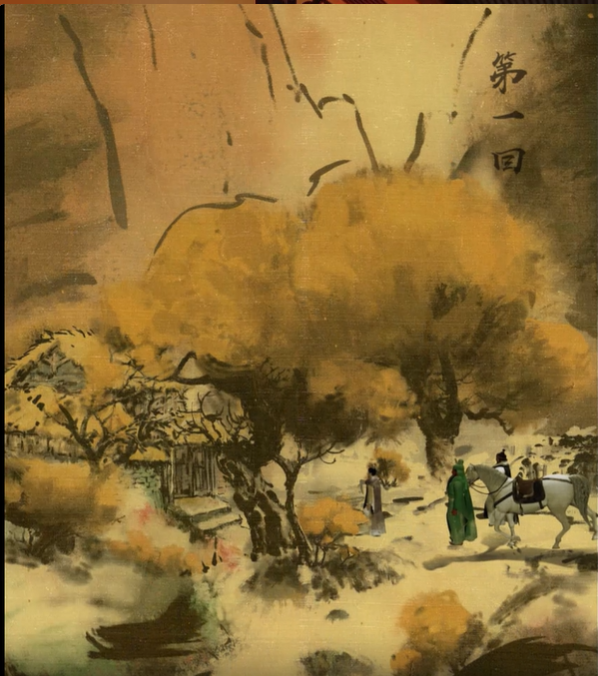
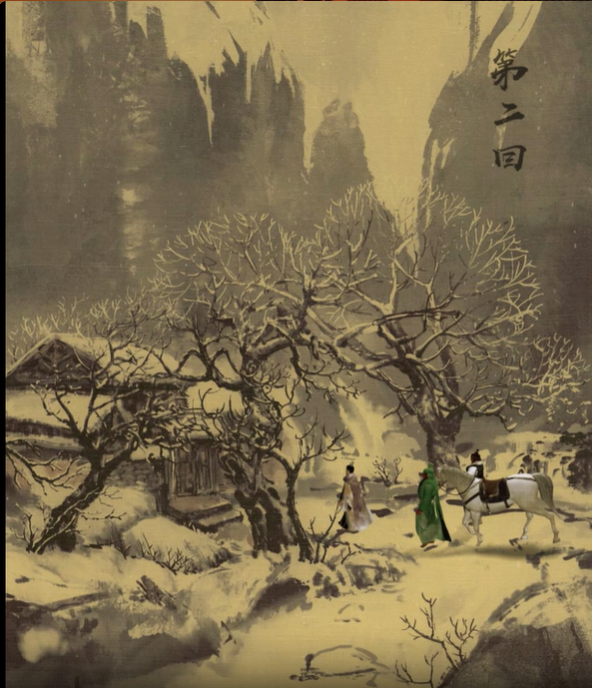
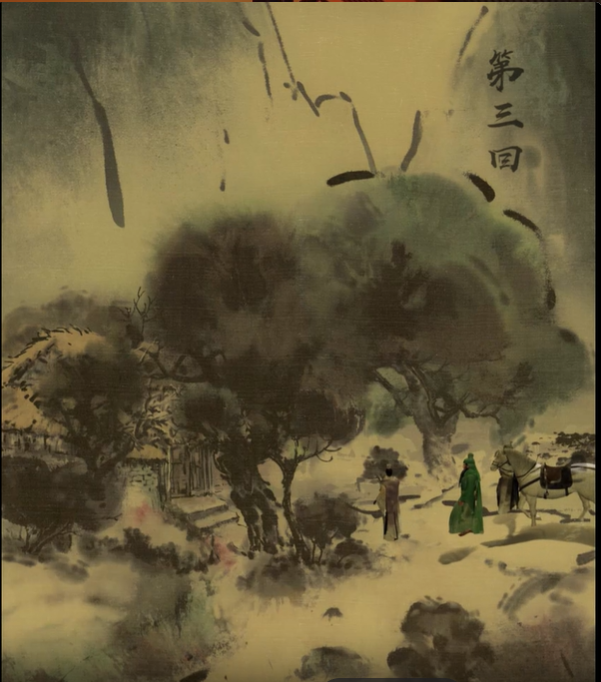
1. Liu Bei’s three visits to a thatched cottage
Although Zhuge Liang was talented, he lived in a thatched cottage in Longzhong. Liu Bei heard about his talent, and in order to restore the Han Dynasty and take over the world, he made a special trip to visit. It so happened that Zhuge Liang went out that day, Liu Bei had to turn back in disappointment.
Soon, Liu Bei and Guan Yu, Zhang Fei and braved the blizzard for a second time to invite. Unexpectedly, Zhuge Liang went out again. Zhang Fei was not willing to come again, see Zhuge Liang is not at home, urge to go back. Liu Bei could only leave a letter to express his admiration for Zhuge Liang and his intention to invite him to come out to help him save the country from a dangerous situation.
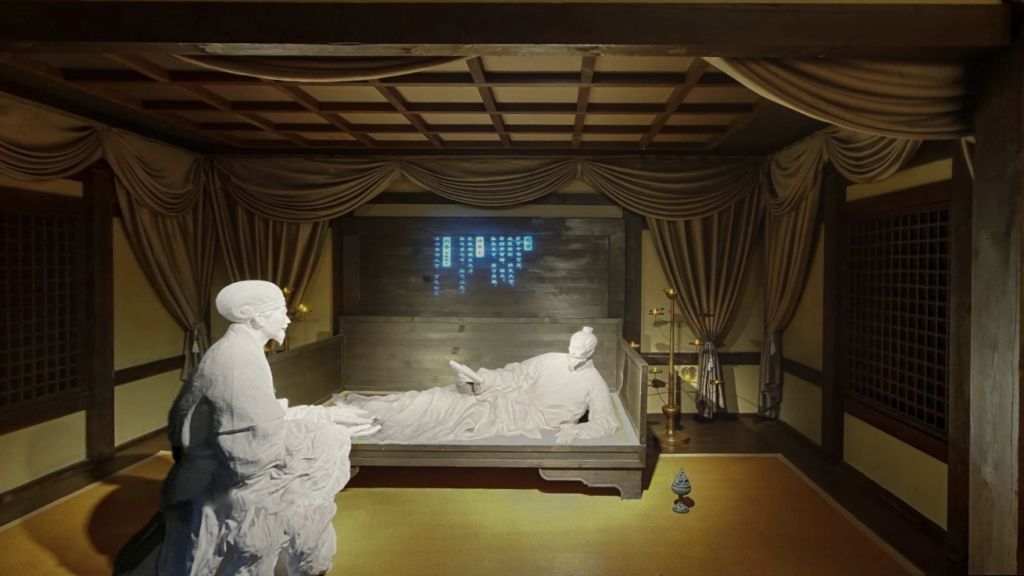
After some time, Liu Bei had eaten vegetarian for three days and was ready to invite Zhuge Liang again. Zhang Fei, however, advocated that he should be the only one to do so, and if he did not come, he should be tied up with a rope. Liu Bei chastised Zhang Fei and visited Zhuge Liang for the third time with both of them. When they arrived, Zhuge Liang was sleeping. Liu Bei did not dare to startle him. So he stood until Zhuge Liang woke up, only to sit down and talk with each other.
After some exchanges, Liu Bei very much agree with Zhuge Liang’s military plan. He would like to worship Zhuge Liang as a military adviser, ask him to come out to help themselves to take over the world. Zhuge Liang was moved by Liu Bei’s ‘three visits to a cottage’ of a piece of sincerity. So he left Longzhong to help Liu Bei.
2.Liu Bei entrust a child with an orphan in city Baidi
The loss of the strategic Jingzhou, the defeat of Guan Yu and Zhang Fei, the defeat at the Battle of Xiaoting, and Liu Bei’s serious illness at this time made the whole country’s power shaky. Liu Bei dying, in the City Baidi will entrusted son AhDou to Zhuge Liang. He said to Zhuge Liang: ‘If you think AhDou is the material to be the emperor, then you will assist him. If he is not, up to you.” Zhuge Liang did not fail Liu Bei. He spent his life assisting Ah Dou until he fell ill and died in the army.
‘I have Kongming as a fish has water.’ A wise ruler, a good minister, swimming against the current in the midst of difficulties and obstacles, entrusting the far-reaching ambitions of the family and the country in the midst of storms.
Information
Date: 2021.10.1-2031.10.1 Location: Mingliang Qiangu Exhibition Hall, Chengdu Wuhou Shrine Address: Located at No. 231, Wuhouci Street, Wuhou District, Chengdu, Sichuan, China
Exhibition Opening Hours Tuesday to Sunday: 9:00am-18:00pm Closing time: Every Monday (except holidays)
“Zhenguan – Li Shimin and His great Tang dynasty” is on view from May 1, in the National Museum of Classic Books. A total of 15 museums were selected to exhibit 249 exhibits in 140 groups.
The exhibition presents to the public the reign of Emperor Taizong Tang, the second emperor of the Tang dynasty. The Tang Dynasty (618-690, 705-907) was one of the most powerful countries in the world at that time. It had a strong state and a prosperous economy. It also had an active open-door policy, and you could see many Western faces on the roads.
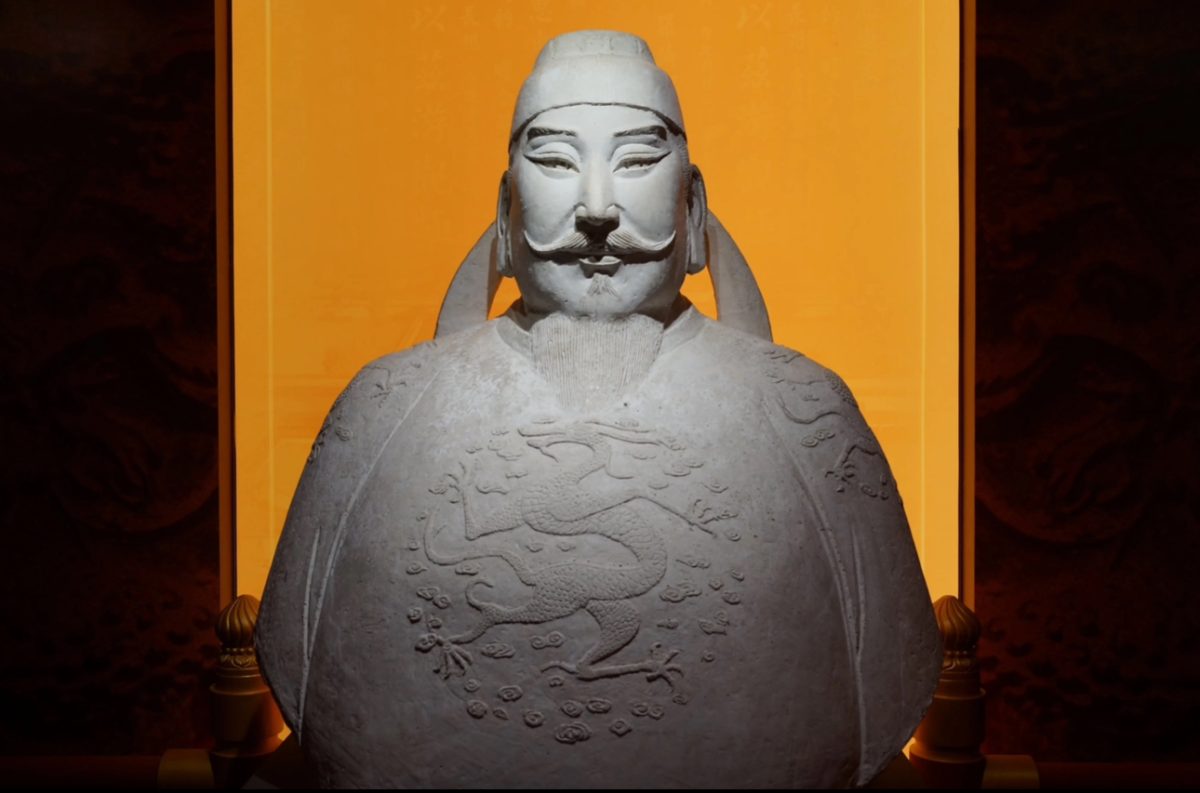
Emperor Li Shimin, considered the founder of the Tang Dynasty along with his father, was one of the greatest emperors in Chinese history. During his reign, there was unprecedented political, economic and cultural development.
He took advice with an open mind, appointed wise ministers, knew people well, implemented new policies, and thought of danger in times of peace. And laid a solid foundation for the later flourishing Tang Dynasty. As a result, this created the “Reign of Zhenguan”, the famous peaceful era in Chinese history.
This exhibition takes Li Shimin’s growth path as the baseline, and shows the public his way of governance and an aesthetic feast that belongs to the great Tang dynasty.
In this exhibition, we can see many artifacts from the canonical collection.
Stone-carved Sogdian Whirl Dance Tomb Gate
The stone carvings of the Sogdian Whirl Dance Tomb Doors were discovered in 1985 and collected in the Ningxia Museum. And the front of these two stone doors is very smooth. In addition, each of their surfaces there is a shallow carving of a male dancer who is dancing.
The Tang Dynasty was the heyday of music and dance culture, many artifacts related to music and dance were unearthed. On this set, two male dancers are characterized by curly hair, beard, deep eyes and high nose, and both holding a long scarf to dance. In other words, they are very obvious “Hu”(people).
From this set of artifacts, we can get a glimpse of the openness of the society and cultural tolerance at that time. Moreover, Sogdian Whirl Dance is a famous dance of the Northwest ethnic minorities. It vividly demonstrates the image of the Hoho dance that flourished in the Tang Dynasty 1300 years ago. And it also shows the great integration of ethnic groups in the Tang Dynasty.
Gilt silver jar
The Gilt-silver jar was discovered in the tomb of Prince Zhanghuai and his wife, the grandchildren of Li Shimin. The gilt-silver jar is 37.5 centimeters high, with a maximum belly and neck of 12.8 centimeters, and weighs 1.5 kilograms. Further, the handle of the jar is cast as a deep-eyed, high nose with helmet-shaped cap of the human head, the body of the jar is decorated with mainly relief images of figures. These images of figures form a serialized story in the Greek style.
Gilt-silver jar originally belonged to the Persian dynasty of drinking vessels, made in the Bactria region of Central Asia during the Sassanian era. Therefore, the shape of the jar is completely in the style of Sassanid gold and silver. However, the figure of a human head on the handle of the jar is different from the Sasanian Persian figure, which belongs to the Bactrian region of Central Asia.
This Sasanian style piece is a strong evidence to show the world the cultural exchanges between China and the West through the Silk Road. In Chinese ancient texts, the term “Hu bottles” is used to refer to artifacts that came from Western countries. Overall, the Gilt-silver jar is the most representative of the “Hu bottles”.
The tombstone of Yuchi Jingde
The tombstone is now collected in Zhaoling museum. Its body stone color crystal, detailed carving, square, each side 1.2 meters wide, 0.25 meters thick. And this is the mausoleum excavation of the mausoleum of zhaoling garden in the largest one.
The carving on it for lonicera multi-branched lotus trailing grass and twelve zodiac statues. It is carved on all four sides of the Baoxiang flower pattern. And engraved with five lines of white calligraphy, five characters in line.
The text is “the late Datang Situ and the state governor on the pillar state Eguo Zhongwu Gong Yuchi Fujun epitaph of the tomb”.
Yuchi Jingde was a famous general of the Tang Dynasty and one of the archetypes of the Gate God in later times. He followed Emperor Taizong of the Tang to fight in the four directions. During the reign of Zhenguan, he defended the borders and expanded the territory and made great achievements in battle.
During the Xuanwumen Incident, Yuchi Jingde saved Li Shimin from the bamboo forest. Since then, Li Shimin trusted Yuchi Jingde. Above all, he was an important part of the “the reign of Zhenguan”, which, together with Tang Taizong Li Shimin and other rulers and officials, ushered in the heyday of Chinese feudal society.
Information
Date: 01 May to 25 August 2024
Location: National Museum of Classic Books
Address: No. 33 Zhongguancun South Street, Haidian District, Beijing
This is a paid exhibition, so tickets can be purchased through the WeChat public number “National Museum of Canonical Books”.
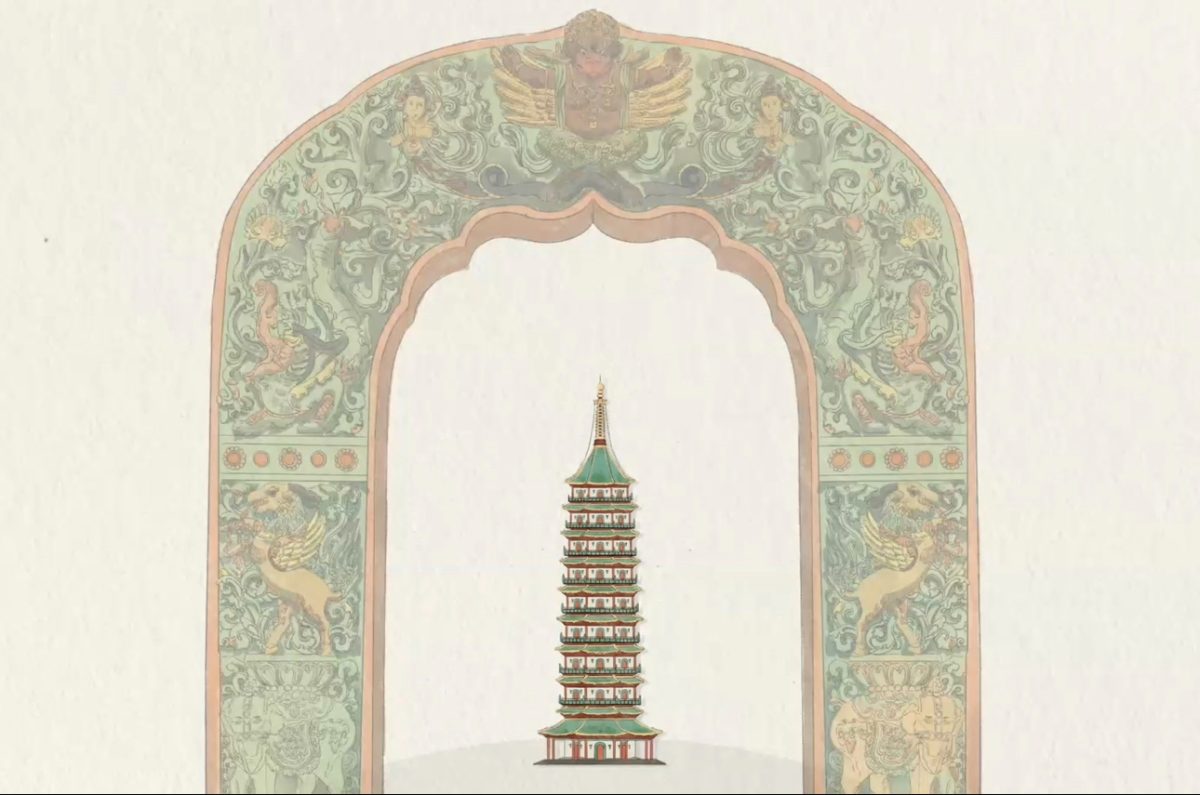
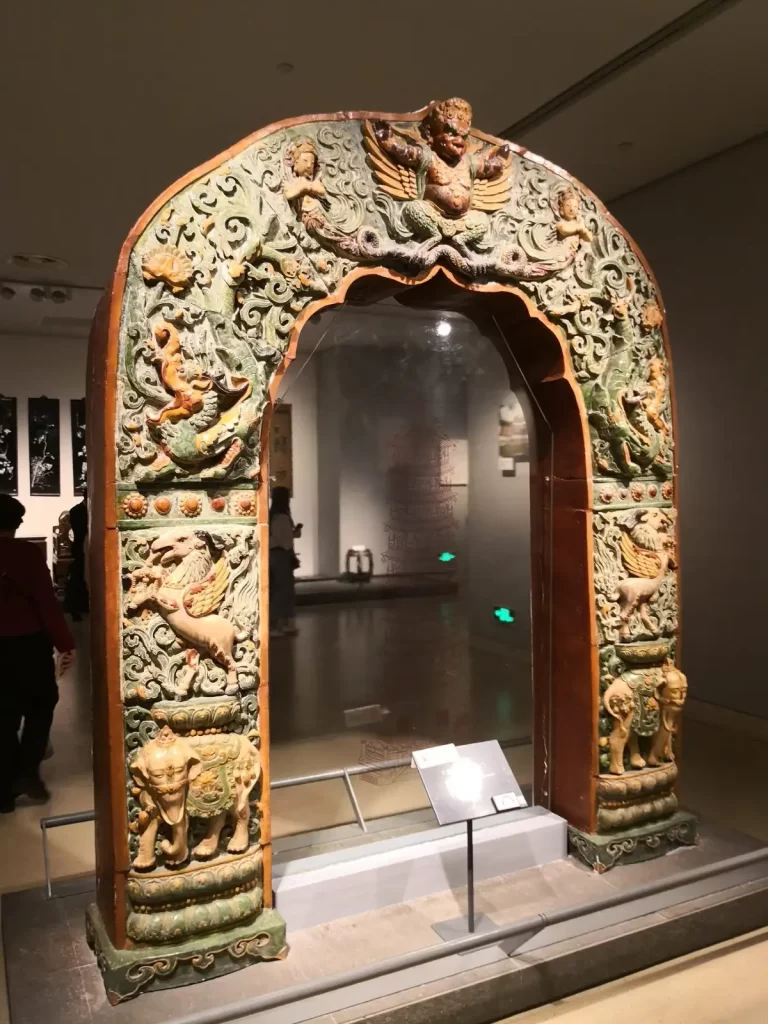
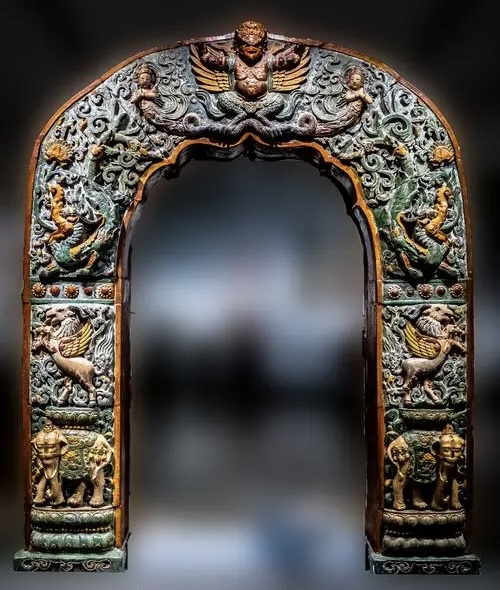
The Porcelain archof Nanjing is an important architectural component of the Porcelain Tower of Nanjing in the Great Bao’en Temple. Which represents the royal temple architecture of the Ming Dynasty (from 1368 to 1644).
The Porcelain Tower of Nanjing was built in the early Ming Dynasty (mid-15th century). And destroyed in the late Qing Dynasty (late 19th century). The Porcelain Tower was designed and built by The Yongle Emperor Zhu Di (reigned 1402-1424) in order to repay his parents for their kindness.
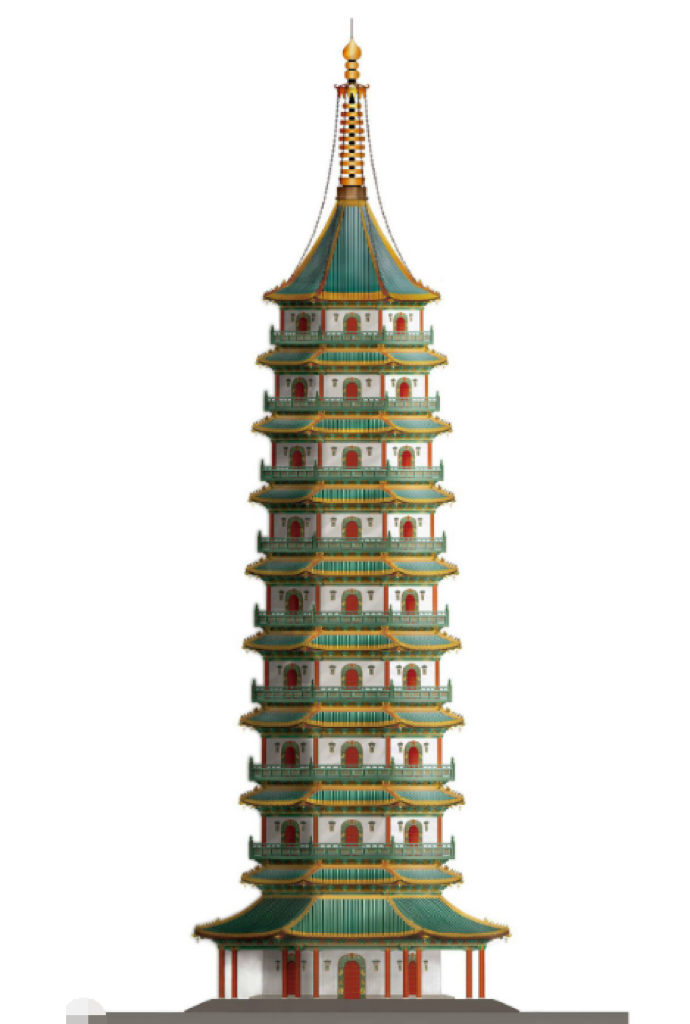
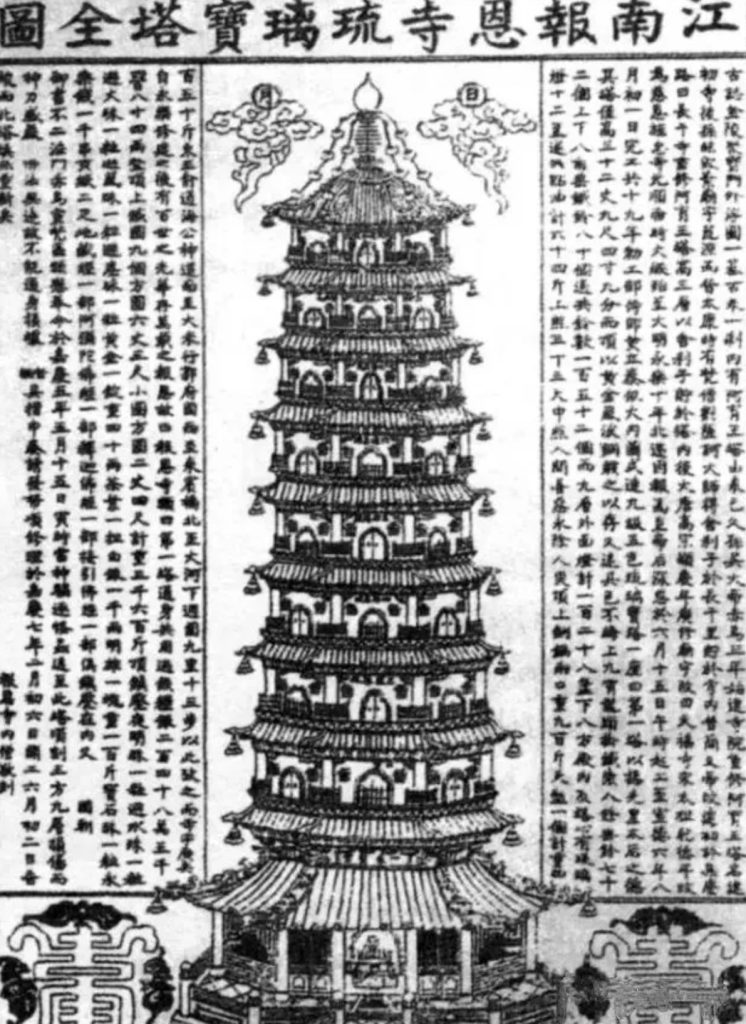
The Tower, which took nearly 20 years to build, is 78.2 meters high and has 9 floors and 8 sides. It is also one of the tallest buildings in ancient China with exact records. Due to the infighting of the Taiping Heavenly Kingdom in Nanjing during the late Qing Dynasty, the glazed tower collapsed. Due to the infighting of the Taiping Heavenly Kingdom in Nanjing at the end of the 19th century (1864), the glazed pagoda collapsed. Nowadays, only one set of Porcelain arches is left in the world for us to visit. This set is currently being collected in the Nanjing Museum as a town treasure.
The Porcelain arch
Unearthed in 1958 at the former site of the glazed kiln outside the Zhonghua Gate in Nanjing. At the time of excavation, it was only a batch of defective glazed bricks with mottled glaze, which were later assembled and restored according to the data. The colorful glazed were made through a special process, which can be found on the surviving Porcelain arch.
The tower was built with white porcelain bricks that were said to reflect the sun’s rays during the day, and at night as many as 140 lamps were hung from the building to illuminate the tower.
Digital restoration of the Porcelain tower
Why didn’t the surviving set of Porcelain arche disappear with the Porcelain Tower of Nanjing?
This is because during the construction of the Porcelain tower, three complete sets of tower builds were fired in order to facilitate subsequent repair work. One set was damaged together with the collapsed glazed tower at that time. While the remaining two sets were buried in the ground. The remaining set was found underground.
Designs on the arch
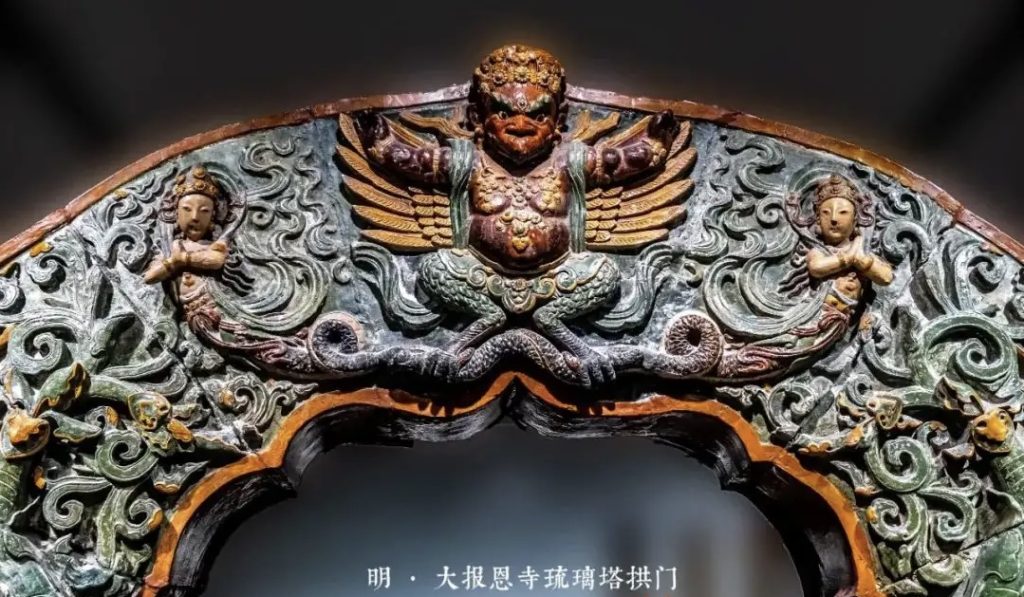
The image on the archway is the dharma decoration (six apparatuses) unique to Tibetan Buddhism Tantric Buddhism. During the reign of Ming Yongle (1402-1424), the Ming government organized several visits to Tibet by Chinese Buddhist monks, and some monks went to Nanjing for exchanges. At that time, the Nanjing Dajianen Temple was still under construction, so it was influenced by Tibetan Tantric Buddhism.
Story between The Porcelain Tower and the West
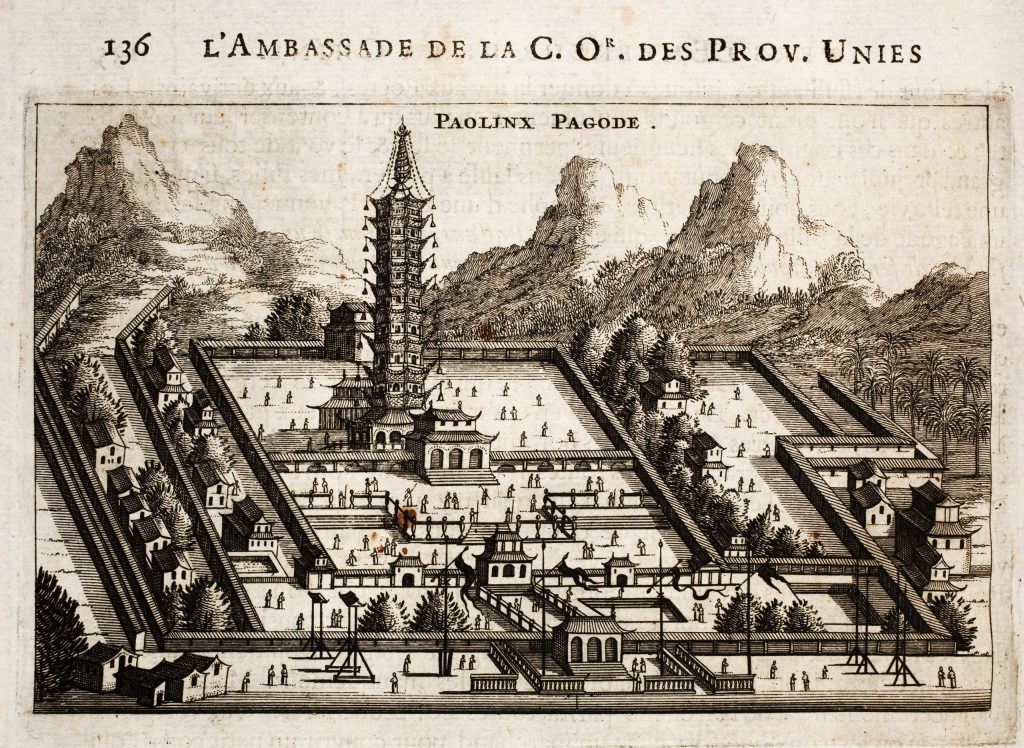
In the 17th century, the European traveler Johan Nieuhof discovered The Porcelain Tower of Nanjing in the Great Bao’en Temple, and made a painting of it, which he brought back to Europe.
The Painting of The Porcelain Tower of Nanjing, Johan Nieuhof
This had a grand impact on Western architecture at the time. The design of the Trianon Palace in Paris, and the Kew Gardens Tower in London, were heavily influenced by this.
There is also a particularly interesting story: in ancient Chinese architecture, the number of stories of a tower is basically singular, whereas the imitation towers built in the West are all ten-story. This is because Johan Nieuhof made a mistake and painted the tower with ten stories.
Hand-drawn drawings of Porcelain Tower
Nowadays, Nanjing Dajian’en Temple has rebuilt the glazed tower. However, it was not rebuilt using glazed material. This is to protect the underground palace beneath the ruins of the glazed pagoda, in which precious relics such as the Buddha’s relics and the Ashoka Pagoda have been unearthed.
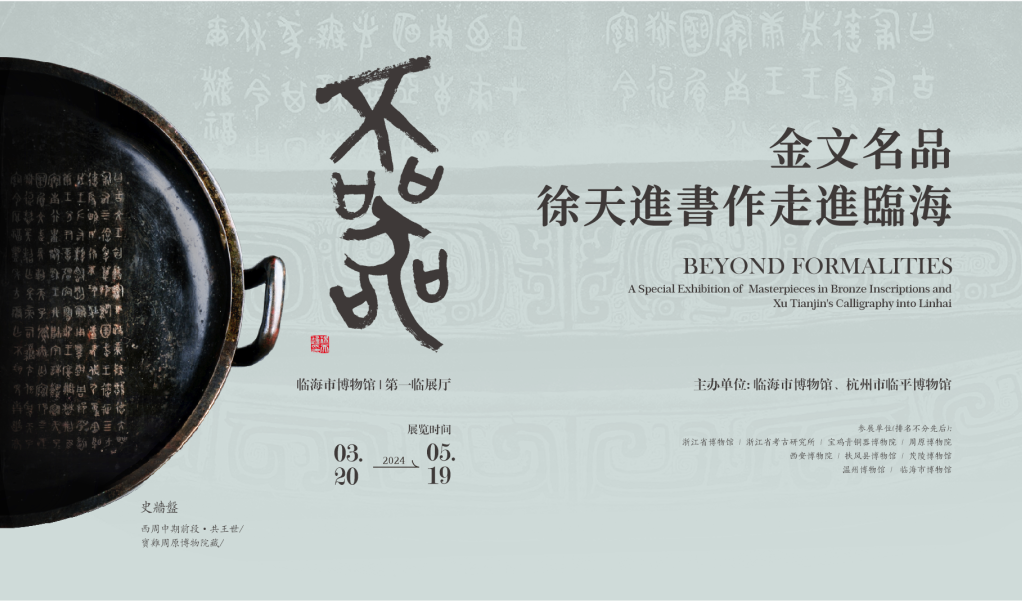
On 20 March 2024, the temporary exhibition “BU QI” opened at the Linhai Museum. Artefacts from more than 10 museums across China, including the Baoji Bronze Museum, Zhouyuan Museum, Xi’an Museum, Fufeng County Museum, Maoling Museum and others.
Jinwen, which includes Chinese writing from the Shang Dynasty to the Zhou Dynasty, has recently been quietly converging in Linhai. The exhibition aims to show the charm of ancient Chinese writing through inscriptions on bronzes.
JINWEN: the name of a Chinese character script that refers to inscriptions cast on bronzes from the Shang Dynasty (ca. 1600 B.C. – 1046 B.C.) and the Zhou Dynasty (ca. 1046 B.C. – 256 B.C.)
Preface
Cultural relics are not only the products of history, but also the channels of dialogue with history. In the exhibition “BU QI”, through the shape and craftsmanship of the bronzes and the inscriptions on the vessels, the world can discover the long history of China’s ancient ancestors. These artefacts have fallen from the altar of kingship over thousands of years and have demonstrated an extraordinary fascination.
In China there is a group of precious artefacts, for instance, among which the Shi Qiang Pan, the Qin Gong Bo and other bronzes are more famous. These bronzes not only show us the level of craftsmanship and political culture of the time, but they also contain an important artistic heritage: Jinwen. This exhibition tells us the story of the nearly 3,000-year history of the Chinese character through bronze vessels.
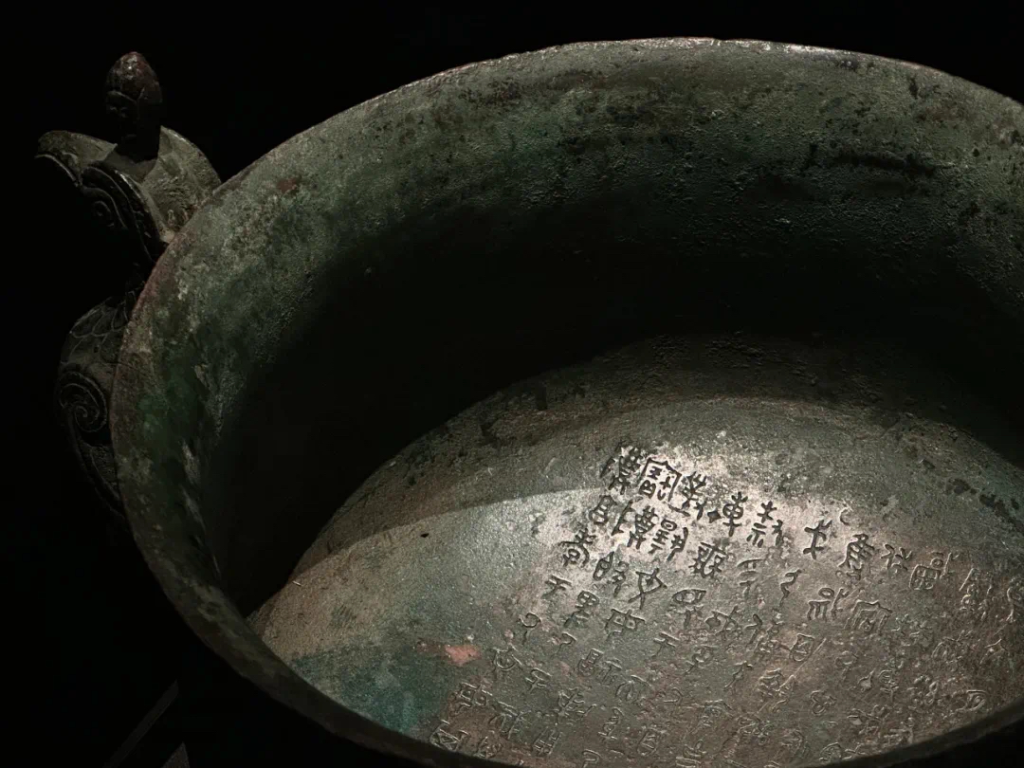
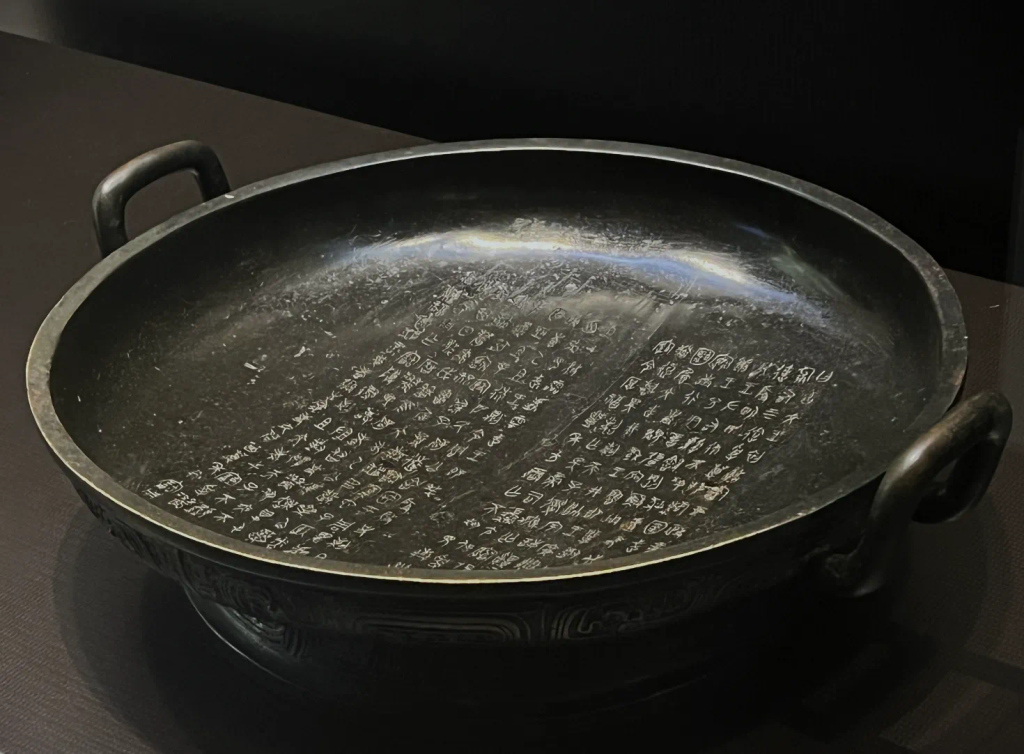
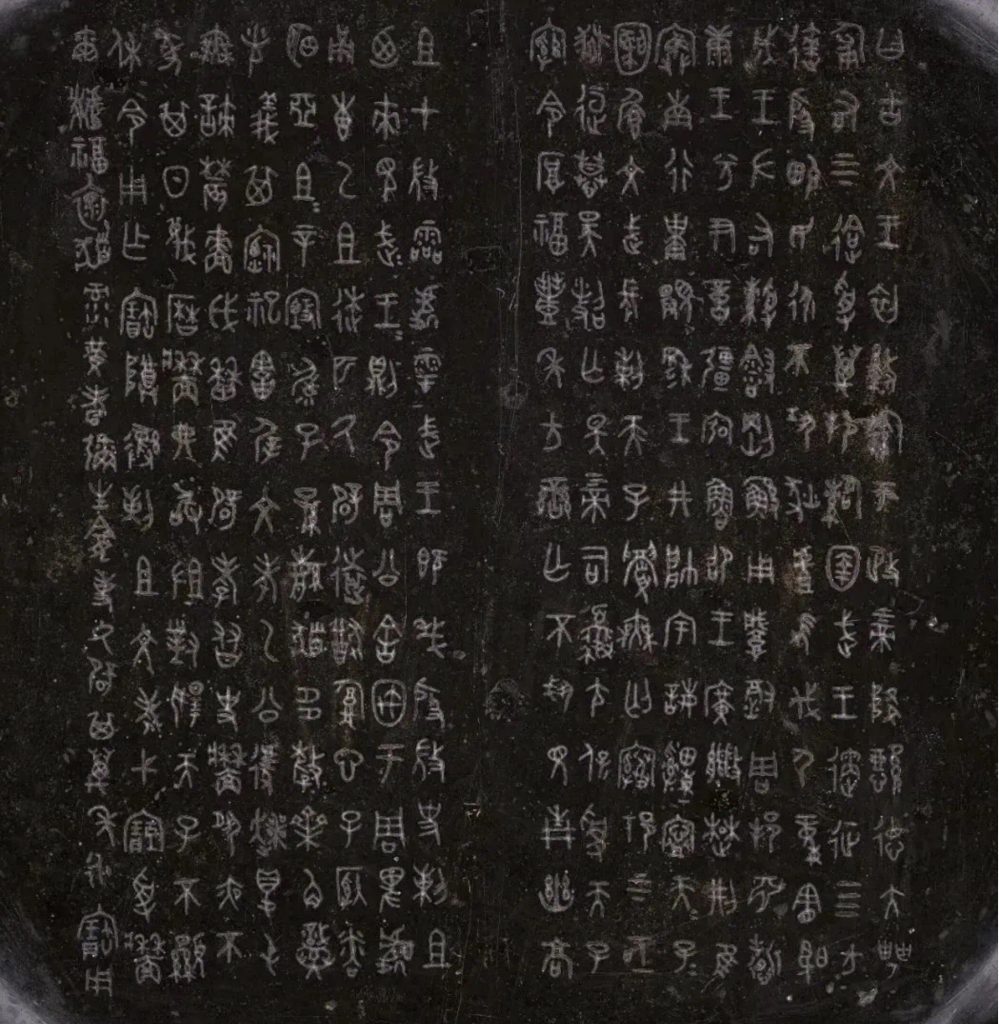
Inscription – Shi Qiang Pan (史墙盘)
Shi Qiang Pan: a historian whose name was Qiang that cast a plate. It is worth noting that this is a dish set used as a ceremonial vessel, and is also a national first-class cultural relic of China and one of the cultural relics prohibited from being exhibited abroad.
It was only during the Western Zhou period (c. 1046 to 771 BC) that the aristocracy was able to cast bronzes. So what was the status of Qiang?
Qiang is from the Wei family. There was a famous tyrant in China, the last king of the Shang dynasty, Zhou (c.1105BC-1046BC). And the ancestor of the Wei, Ziqi, was the elder brother of King Zhou of Shang. After the Zhou Dynasty destroyed the Shang Dynasty, Wei Ziqi joined the Zhou Dynasty as an official. The Wei family of the Zhou Dynasty became a great family after several generations. Thus came the appearance of Shi Qiang Pan.
The first half of the text of the Shi Qiang Pan mainly tells about the achievements of seven generations of emperors of the Zhou Dynasty, and the second half mainly tells about the deeds of six generations of the Wei family. It is not only a testimony of the change of Chinese characters, but also a glimpse of the social structure of the Western Zhou Dynasty.
In later times, the Zhou Dynasty fell apart. At the beginning of the Spring and Autumn period, the kingship gradually collapsed. Instead of focusing on the royal nobility, the gold texts of this period began to reflect local features such as the social activities of the vassals and other nobles.
Bronze – Qin Gong Bo (秦公镈)
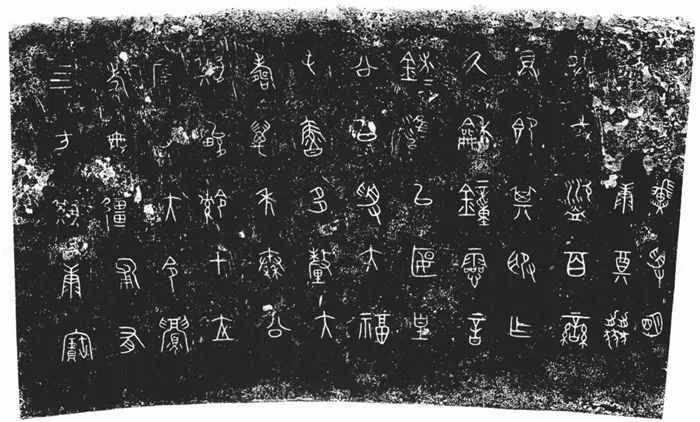
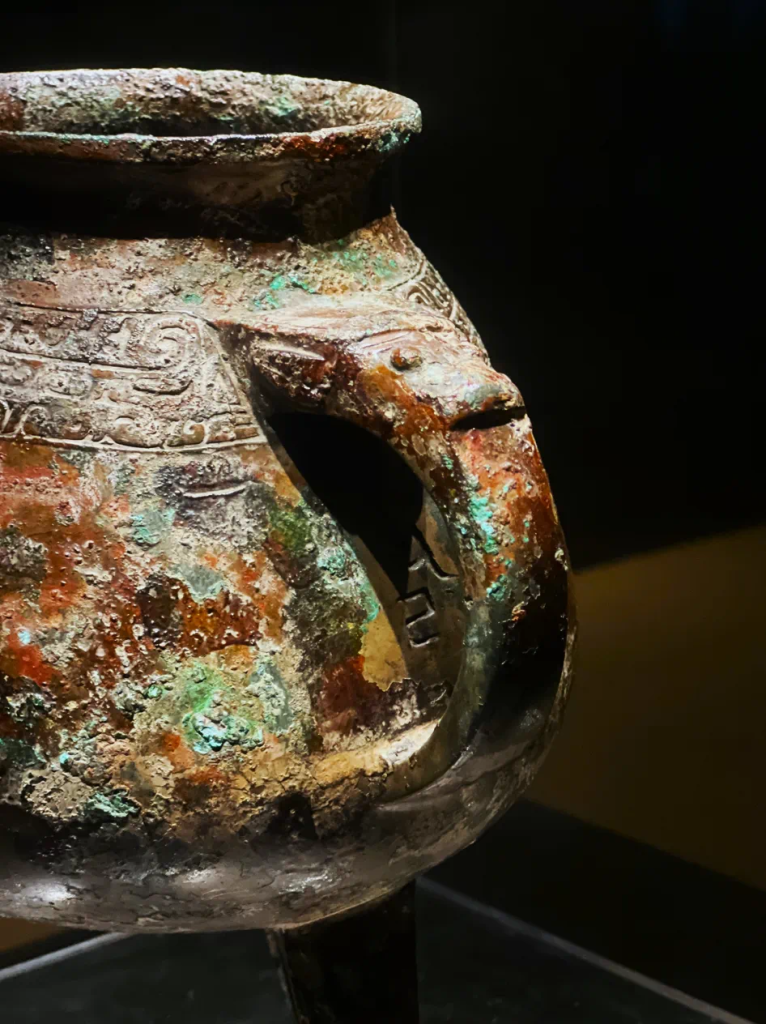
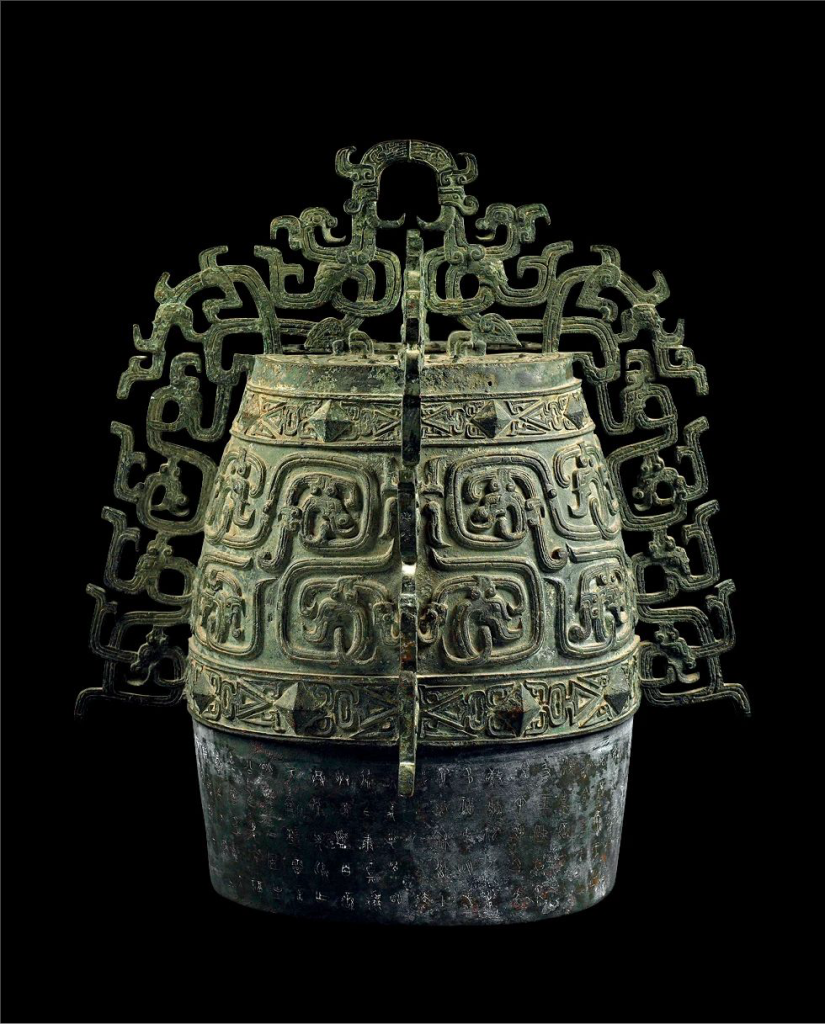
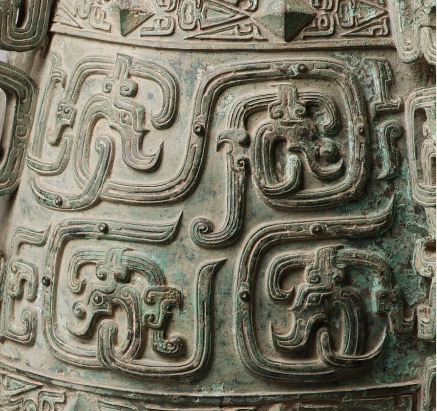
Qin Gong Bo (秦公镈) is an early Spring and Autumn bronze (770 B.C – 695 B.C) from the Baoji Bronze Museum in Shanxi province, and is an ancient Chinese musical instrument that was struck with the body of a hoe.
Qin Gong Bo is a new archaeological discovery made in Baoji in 1978, when villagers accidentally discovered eight bronze pieces in a cellar, of which Qin Gong Bo is the largest found, with a height of 75.1 cm, a weight of 62.5 kg and a very majestic shape.
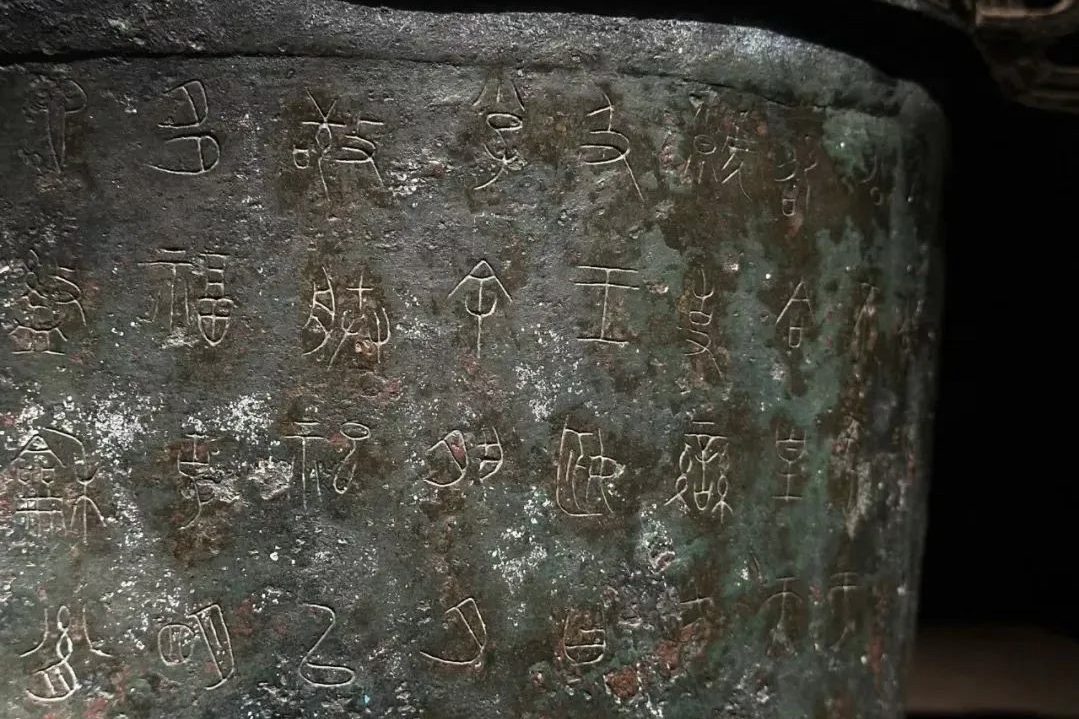
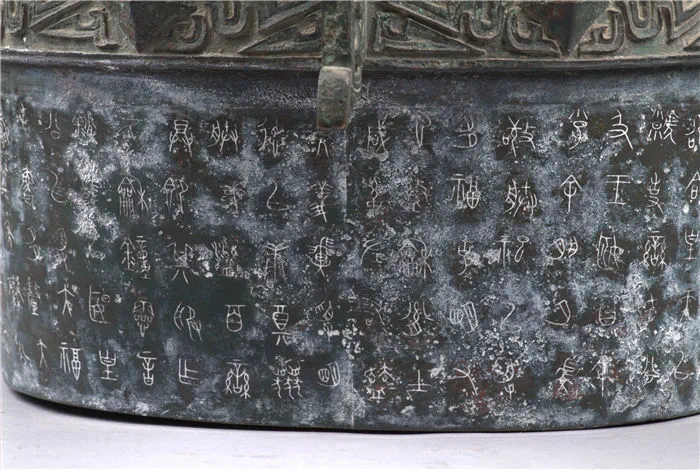
The Inscription of Qin Gong bo
Historical research suggests that the Bo was used as a musical instrument to Hegemony of Qin state temple rituals. Often used together with the ancient Chinese musical instruments Carillon (Bian Zhong). The instrument’s sound was very loud, so historians have speculated that it was usually used to conduct the orchestra and control the overall rhythm.
In addition to its exquisite modelling and musical function, the Qin Gongbo bears an inscription of 135 characters. It’s an important historical reference for the study of the Qin dynasty and its predecessor, Hegemony of Qin.
The storia of the inscription
The inscription records the Hegemony of Qin as a vassal state of the Zhou dynasty at the time. And the first-person view of the descendant, Duke Wu of Qin, records that his ancestor, Duke Xiang of Qin, was rewarded with a house and a kingdom for saving the king of the Zhou, receiving land, subjects and prestige. Above all, the descendants of Duke Xiang of Qin were not afraid to work hard. Meanwhile he carefully managed relations with vassal states and surrounding tribes.
In Chinese history, the Qin Hegemony lasted for almost 700 years until the fall of the Qin dynasty. The Qin Hegemony had many capitals and, since Duke Xiang of Qin granted the title of hegemony to Duke Wu of Qin, the owner of Qin Kung Bo, the Qin Hegemony moved its capitals four times in the short space of 140 years.
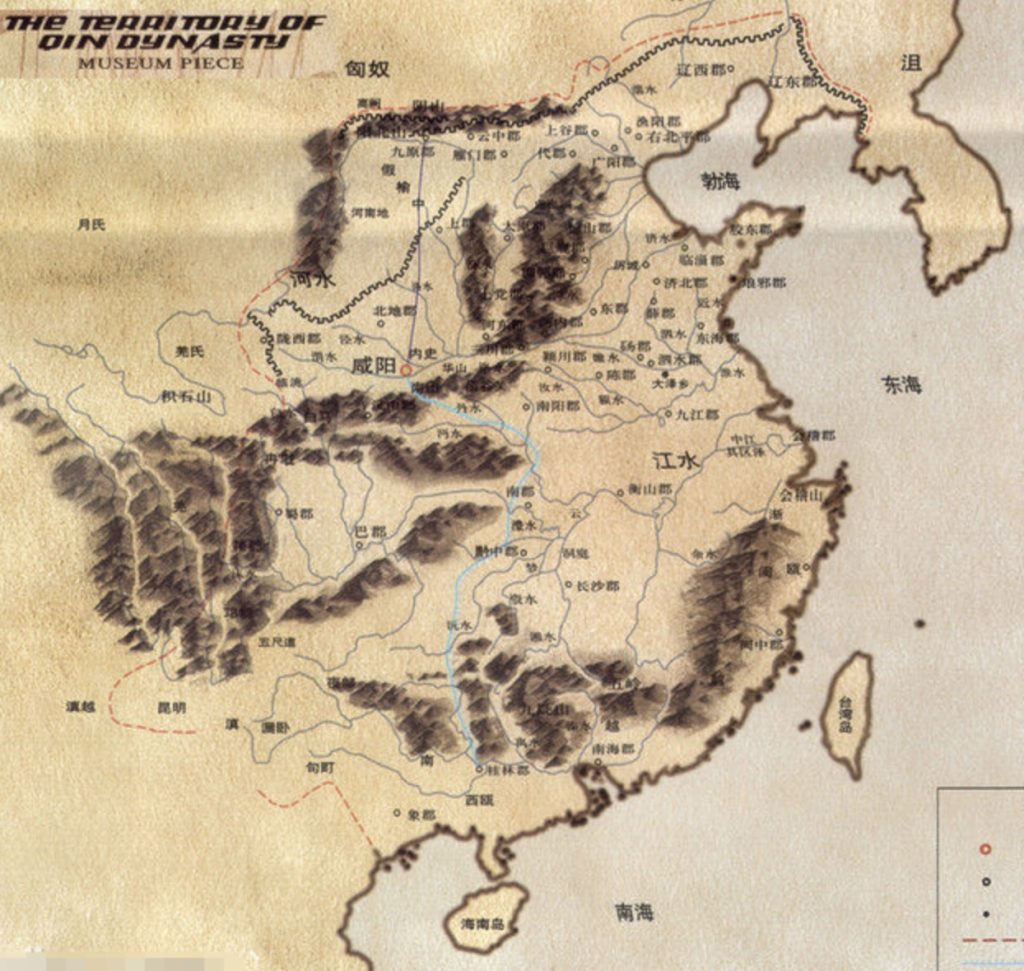
In the long history of Qin, Duke Wu of Qin learnt from the experience of his ancestors. He strengthened his territorial control, and he eventually unified the Guanzhong region of China, which is today the central part of Shaanxi Province in China.
And the Guanzhong region was surrounded by the Qinling Mountains to the south and the Wei River running through it, and was surrounded by mountains on all sides, which made it a natural land barrier. The possession of this entire region also laid the foundation for the Qin Shi Huang (the first Chinese emperor).
Therefore, this inscription embodies the spirit of the Qin people and the determination of the Qin state to become strong. Eventually, in 221 B.C., under the reign of Qin Shi Huang, China was unified.
The “BU QI” temporary exhibition
This exhibition features bronzes from the Shang Dynasty to the Western Han Dynasty (1675 BC – 8). It includes eight national treasures with inscriptions of more than 110 characters and a complete presentation of bronze inscriptions with more than 3,000 characters. You will be able to see the details of the inscriptions up close in high definition.
Information
Date: 20 March to 19 May 2024
Location: Linhai Museum, 1st floor, 1st temporary exhibition hall
Address: Linhai Museum, No.288 Linhai Avenue, Linhai City, Taizhou, Zhejiang, China
Free admission with compulsory booking on the Linhai Museum’s WeChat app.
The exhibition is open according to the following schedule
Recently, the new building of Yinxu Museum was officially opened. This is the first large-scale museum in China to present to the public a national archaeological theme in the form of a panoramic view of the famous Shang Dynasty (1600 bc.-1046 bc.). The museum exhibits nearly 4,000 pieces/sets of bronzes, jade, and oracle bones the earliest writing carriers in China.
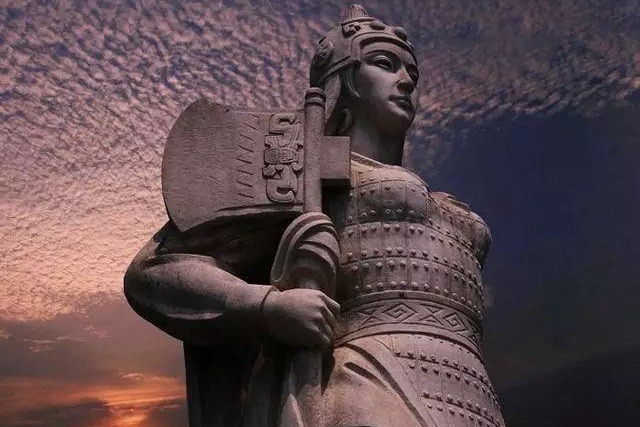
When it comes to the Yinxu Museum, we have to mention an outstanding female historical figure: Fu Hao, also known as Simuxin.
She was the first female general in Chinese history, was also the first wife of King Wuding of the Shang Dynasty (1600 bc.-1046 bc.). Meanwhile a priestess who was trusted by the king for her expertise in divination. She was an amazing woman with multiple identities!
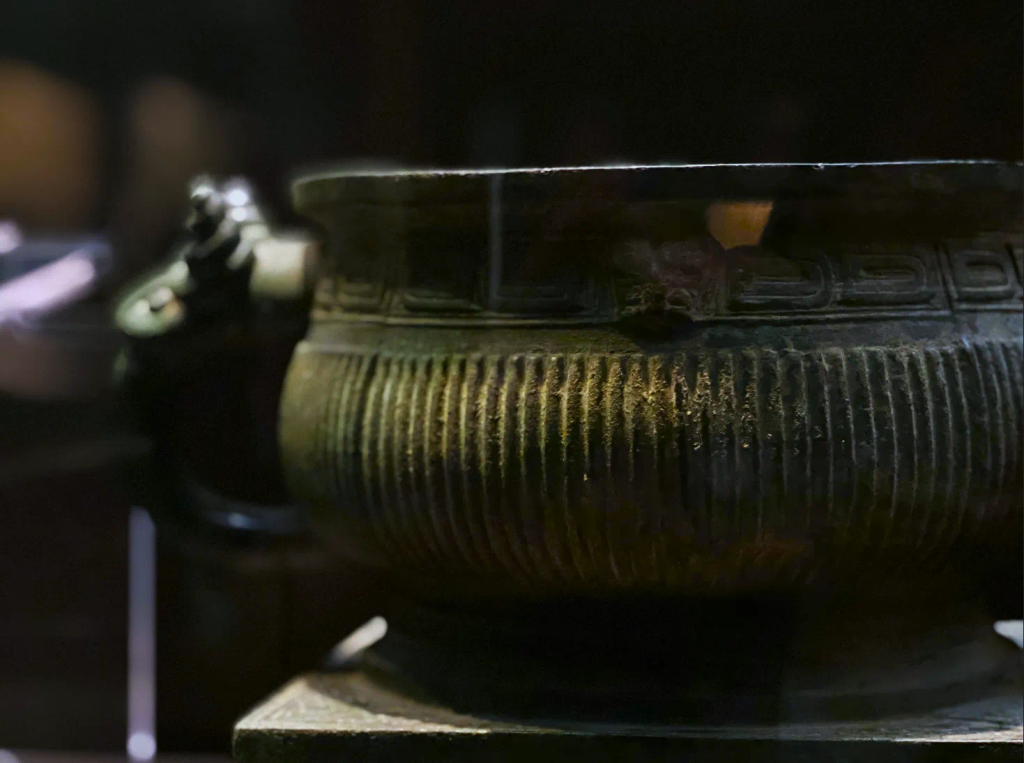
Bronze sacrificial vessel — Simuxin ding
In 1976, the tomb of Fuhao was unearthed in Anyang. Its name derives from an inscription on the burial objects in the tomb.
The tomb is the only one known to have preserved in its entirety a tomb of a member of the royal family of the Shang Dynasty (1600 bc.-1046 bc.). Also, the burials and material in this tomb are relatively complete.
Fuhao and Simuxin ding
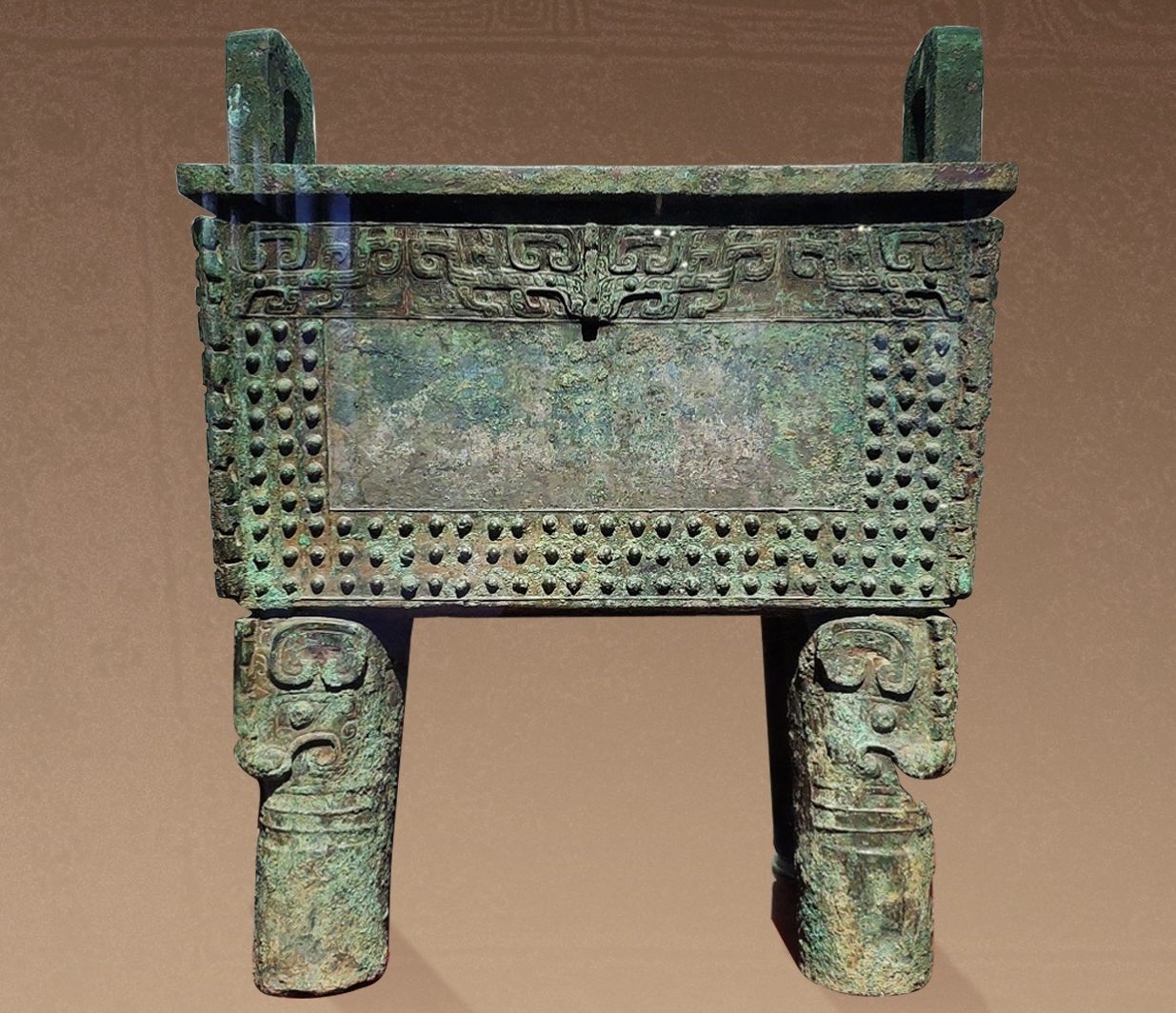
The “Simuxin ding” found in the tomb of Fu Hao is another major archaeological discovery of the Shang Dynasty. It is another major archaeological discovery after the “Houmuwu ding” (or Simuwu ding).
After that into the Bronze Age, “Ding” from the ordinary food utensils into a heavy and gorgeous bronze ritual. It became the status symbol of the noble ruling class at that time.
In addition, as the town treasure of Yinxu Museum, Simuxin ding has a high research value and artistic value.
The name “Simuxin” comes from the inscription of bronze, which is used as a signature. The name “xin” is the temple name of Fuhao, the wife of King Wuding of the Shang Dynasty. “mu xin” is the name given by the son to his mother. It can be seen that the Simuxin ding was a ritual vessel made by the son of Fuhao to commemorate her.
Archaeology allows the world to study artefacts and history to discover the different social. Also the life experiences of our ancestors thousands of years ago.
In the tomb of Fuhao, a large number of oracle bones and written records of Fuhao’s life have been unearthed. The person in charge of the Yinxu Museum said, “Fuhao was the famous queen of Wuding and also the first female general in history.” She made great achievements for the Shang dynasty. Also was one of the important and indelible figures in history.
Ornamentation on the Bronze ding
The Simuxin ding is 80,1 cm high, with a 64,0 cm long and 48,0 cm wide rectangular mouth. The body of the vessel is intricately decorated.
The lower four sides of the mouth and the corners are decorated with animal-face motifs, with cloud and thunder motifs on the base, studs on the bottom of the waist, and a striking animal face on the upper part of the foot.
Most importantly, the ancient Chinese beasts “Taotie” and “Kui Long” are used as decorations, suggesting majesty and power. And with the cloud and thunder pattern as a backing, it adds a sense of mystery to the vessel.
Anyang Yinxu Ruins
Tracing the archaeological history of China, it can be found that the Shang Dynasty (1600 bc.-1046 bc.) is the earliest dynasty in China supported by archaeological evidence. Moreover, the archaeological site of Yinxu in Anyang, an important site of the Shang Dynasty, is of great significance.
On 25 February 2023, the Smithsonian’s centennial celebration of the National Museum of Asian Art in the United States featured an exhibition on Anyang: China’s Ancient City of Kings.
To sum up, it is one of China’s oldest and largest archeological sites. And is the birthplace of Chinese archaeology, while the earliest Chinese writing was found here. Further, it was selected as a UNESCO World Heritage Site in 2006.
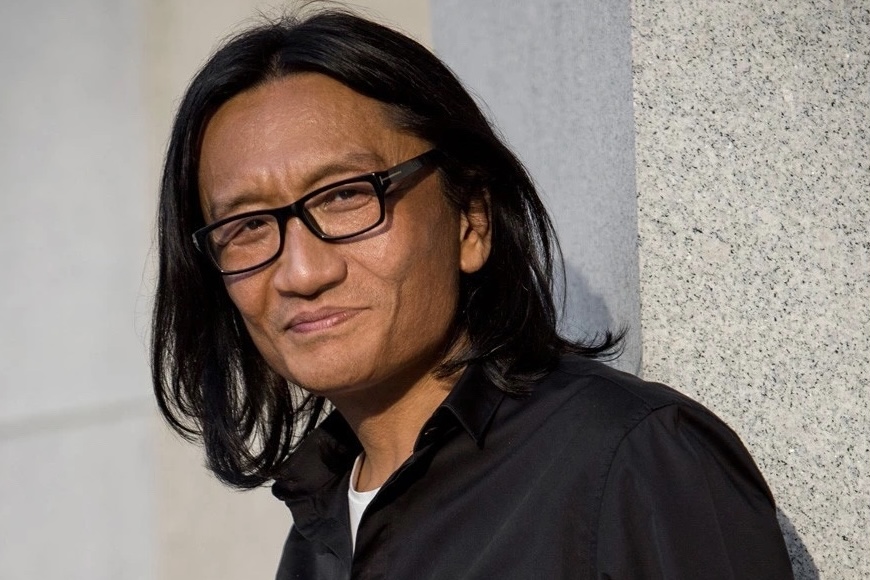
zhao qi Born in Jin County, Liaoning Province in 1954 He currently works and lives in Beijing
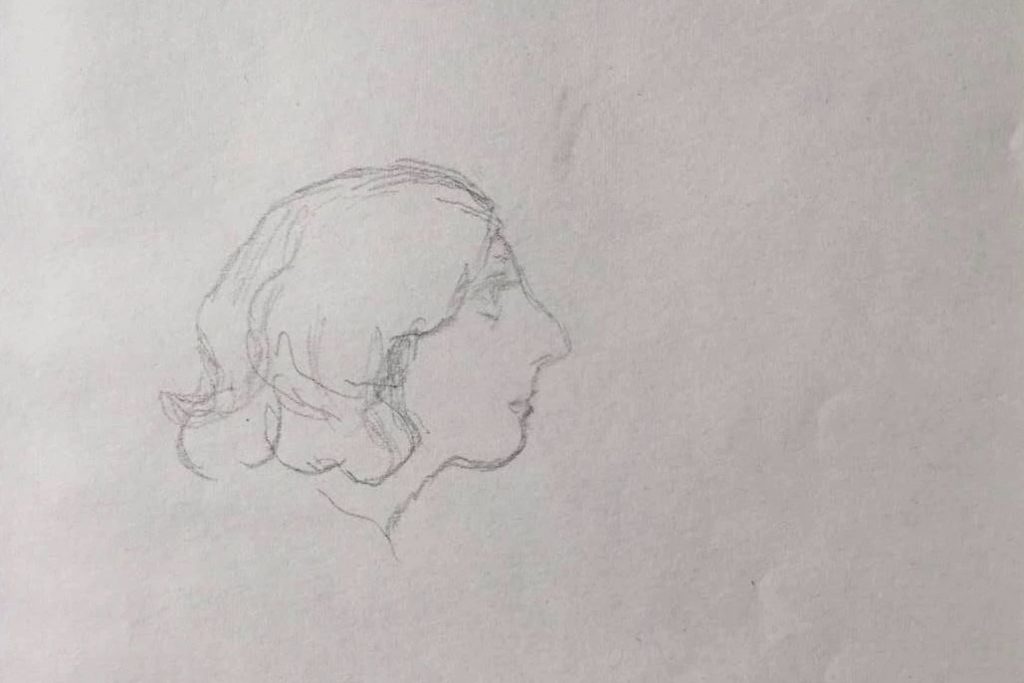
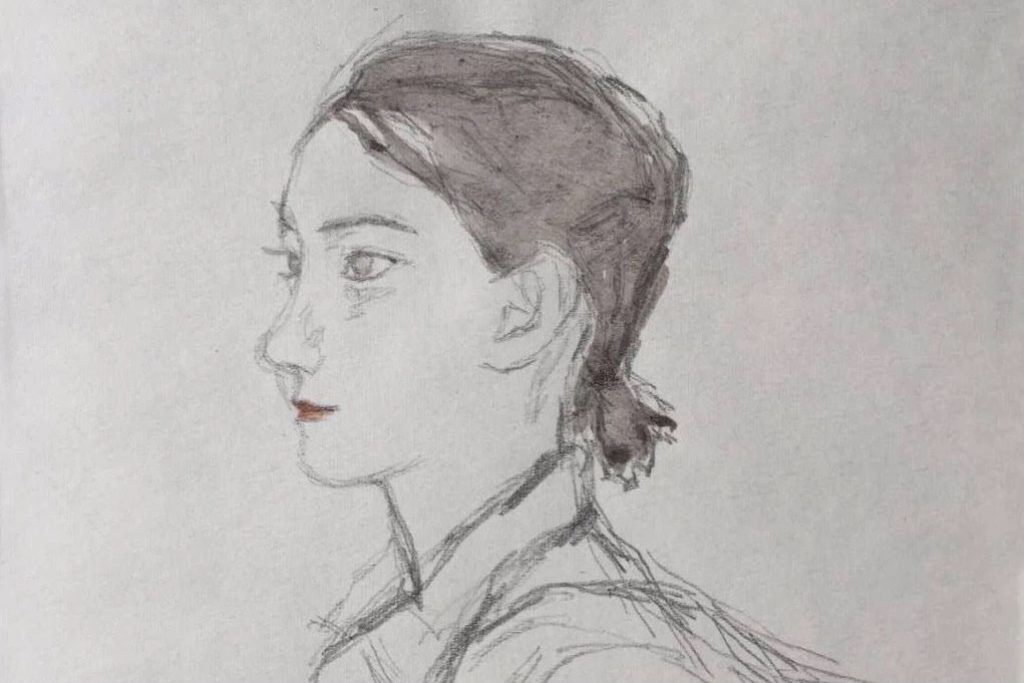
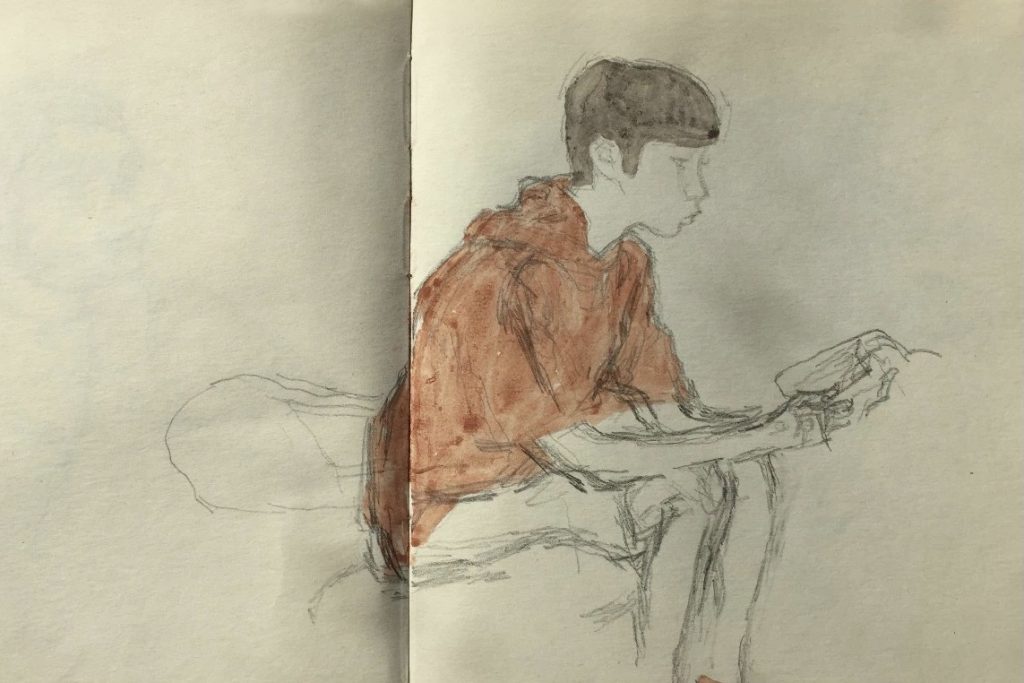
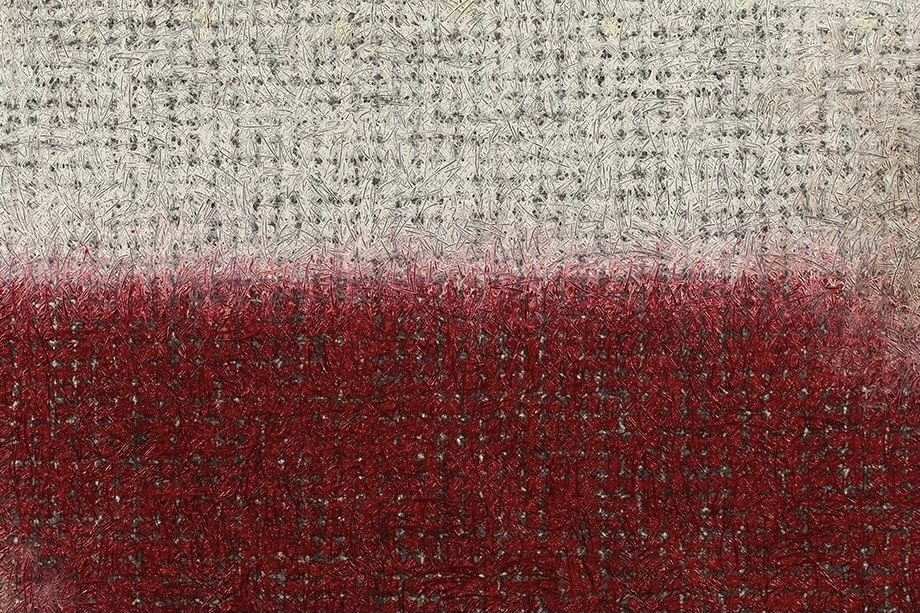
zhao qi would like to call these paintings on small notebooks works. Therefore, this point is emphasized because according to custom. We often call this type of painting “studio”, or shorthand or something like that. What zhao qi don’t understand is, why can’t sketches and sketches be placed in the exhibition halls of art museums such as Chinese paintings, oil paintings and prints?
Zhao Qi work
Outside of zhao qi understanding of painting, I think the work is a kind of narrative and the painter expresses his ideas through the painting. Although these paintings on small books are not “formal” like the works on display, their essence is still something thoughtful.
These paintings are random, sometimes standing, sometimes sitting, sometimes leaning against where. This way, I can see that when I painted. I must have been moved by the image in front of me. Yes, these images are painted in front of the object, it is not an imagination from nothing. ——This is different from other jobs, right?
——All the works are sent with feelings. suddenly I feel wrong to tell this fact. Because some images are also boring when I hold a pen and first draw carelessly. When painting, the picture looks interesting. Painting is indeed a very magical act, we cannot know where the end of the brush is attached.
Contemporary art usually refers to art that has innovated and subverted existing norms in the fields of oil painting, sculpture, and printmaking since China implemented economic reforms in 1979 and opened to the outside world, including photography. Installation.Concept.Performance. Video. Multimedia and other new art forms . The Chinese art circle regards an art exhibition in 1979 as the beginning of Chinese contemporary art history.
Life is a general summary of human beings living in nature and from the past to the present to the future, emphasizing practical effectiveness on the issue of survival. It is precisely because of this practicality that it rejects the essence of art, because the thoughts of art is ineffective in the practicality of life.
The effectiveness of life has established a common sense of normality for us, so that our thoughts and actions are within this clear range of normal consciousness. Practicality and effectiveness are brought into full play in this range. However, the essence of art does not belong to this range.
This kind of normality consciousness will find that we have to give up those normal consciousnesses in the process of fully pursuing ambitious, practical and intelligent goals.
Abandoning the thoughts of normalcy is the beginning of discovering art and also the beginning of artistic creation. In fact, art is the art of perception.
The original intention of art
The original intention of art is to allow perception to regain new perception. It is the perception that is difficult to perceive. It is about the perception method, about the perception outside the existing perspective, about the perception of small accidents in the existing experience, and it emphasizes the methodology.
There are many reasons that hinder our in-depth creation, one of the main ones is too many ideas, too selfish, and too arbitrary.
Art is not a microphone and foil of ideas. Art will shine only when ideas serve art. It is not that art needs to match ideas, but ideas need to match art.
Don’t expect to put your own ideas into others’ heads through art. Because art is not a tool, let alone a conspiracy. Ideas can only become the background, not the protagonist.
Why do we put a horizontal line across the screen, our eyes will immediately show the illusion of the horizon? Is this the effect of gravity on us? Or is our genes conspiring with gravity?
Gravity is the original force on the earth and is closely related to the birth of life. The horizon is a symbol of gravity.
Gravity determines our perception. We perceive the world under the control of gravity, and we perceive the world in the formula of gene propagation and survival.
Our perception is a convenient program edited by genes in order to survive and spread genes. Everything starts step by step, and we are secretly defined as a carrier of communication.
However, in the long journey of human development, due to the residual increment of perception .
The birth of art
The birth of art has gradually become an exception thoughts. It is a bit like a mutation in gene transfer. It can become more and more free from gravitational manipulation.
Survival needs, let yourself become useless for survival, let yourself be yourself. When the purpose of art is art. Art has completed its ignorance of gravity and betrayal of genes.
Presenting the unknown perception is like presenting art. From a certain angle, let yourself be in a kind of uncertainty from time to time, is it not a kind of freedom? This is the question I thought about in the process of creating this batch of works.
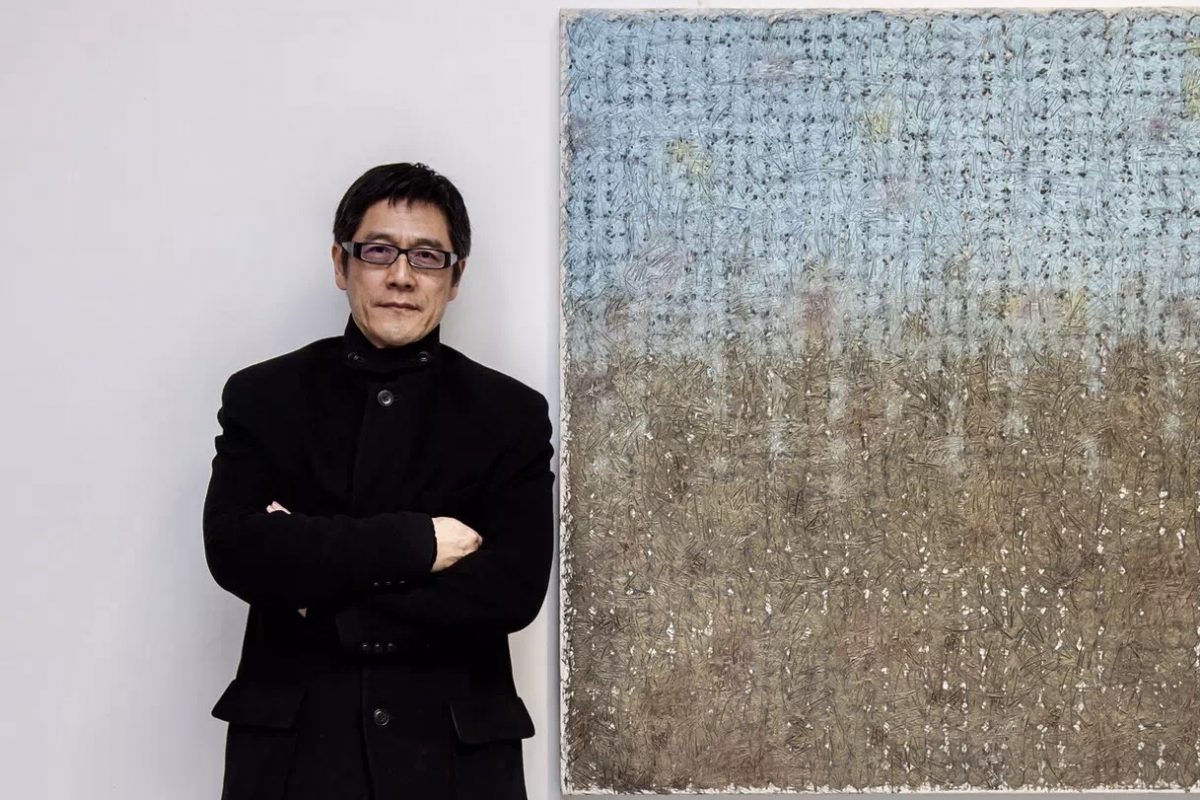
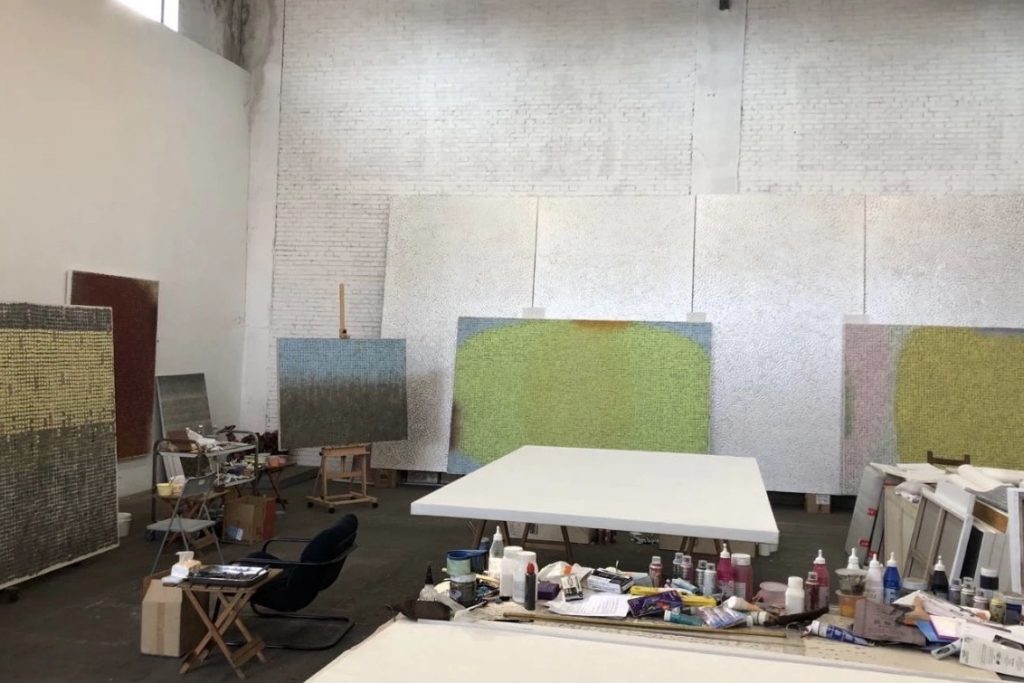
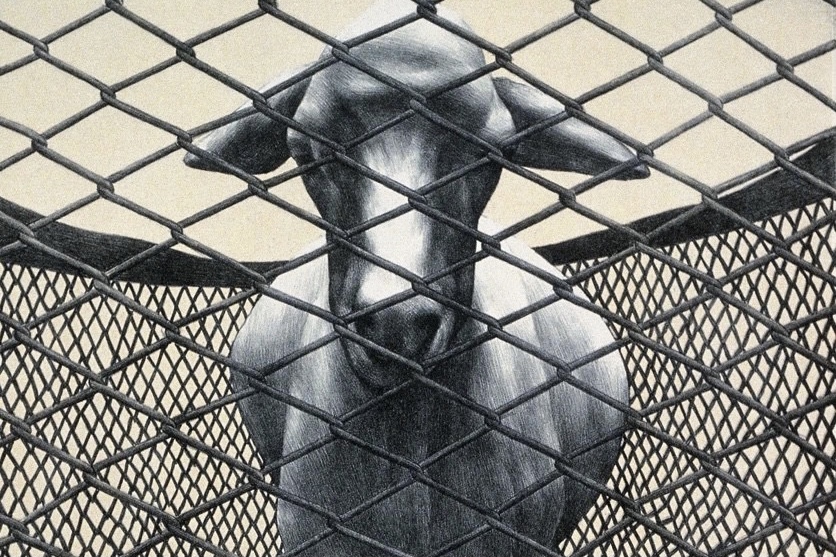
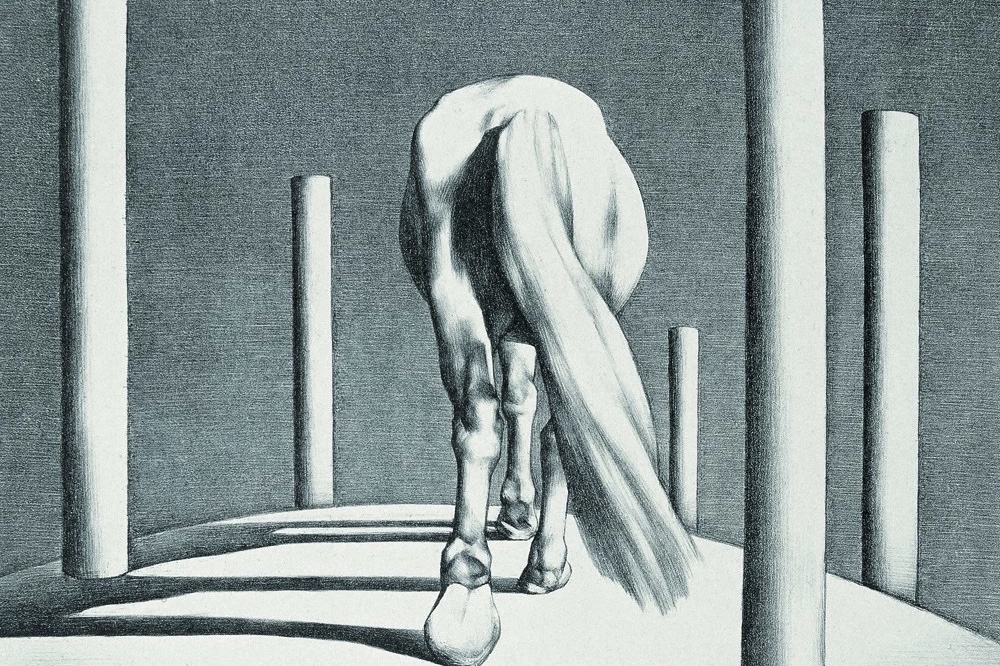
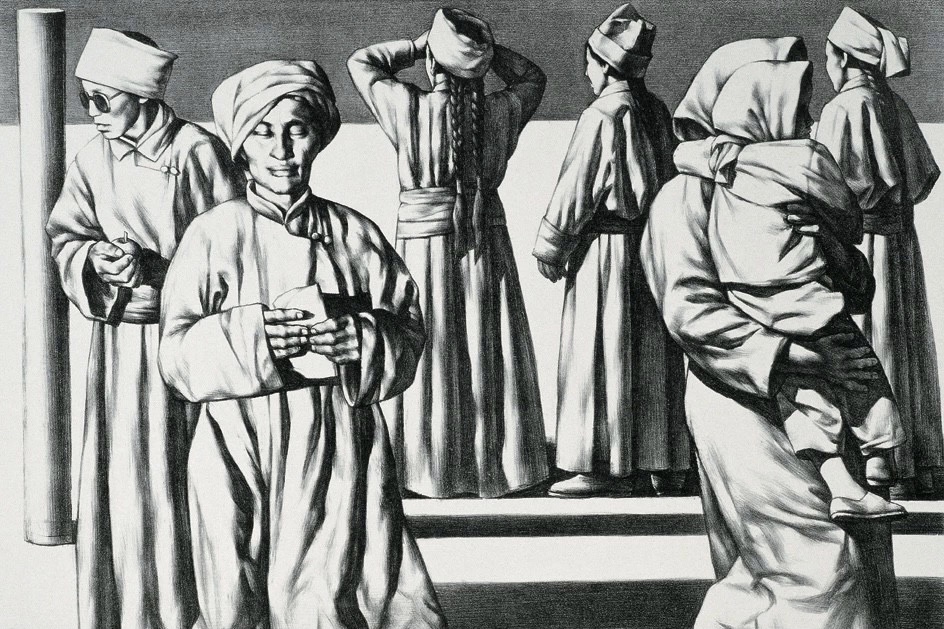
Artist: Su Xinping Born in Jining City, Inner Mongolia in 1960 Deputy Dean of the Central Academy of Fine Arts Professor, PhD supervisor
Su XinPing Perspective
Su Xin ping was born in Jining, central Inner Mongolia, and now Ulan Qab City. Where the population was only about 30,000 in the 1960s. From today’s perspective, it can only be regarded as a small town, an adobe house, and a few buildings.
In January 1977, I enlisted in the army. The army stipulates that recruits must train in the company for one year, and can only do painting-related work in the second year.
One day after living in the company for half a year, when I was studying to read the newspaper in the evening. I accidentally saw the news about the admissions of the People’s Liberation Army Art Academy . In the newspaper, which caught my attention.
Su xingping Military art
su xin ping decided to apply for the military arts exam, so I went to the leader of the army to talk about my thoughts. I didn’t expect to get the answer that ordinary soldiers can’t apply for the exam. This kind of answer can hardly hit me. At that time, there was only one way for soldiers to enter university, and that was to retire.
After I was discharged from the army, I went to work at Jining City Cultural Center, and I was able to devote all my energy to review. In May, when it was the day of college admissions and registration.
The only professional schools I could choose were the Tianjin Academy of Fine Arts and the Department of Fine Arts of Inner Mongolia Normal University.
Inner Mongolia belonged to In the North China region, national regulations did not allow cross-regional examinations at that time.
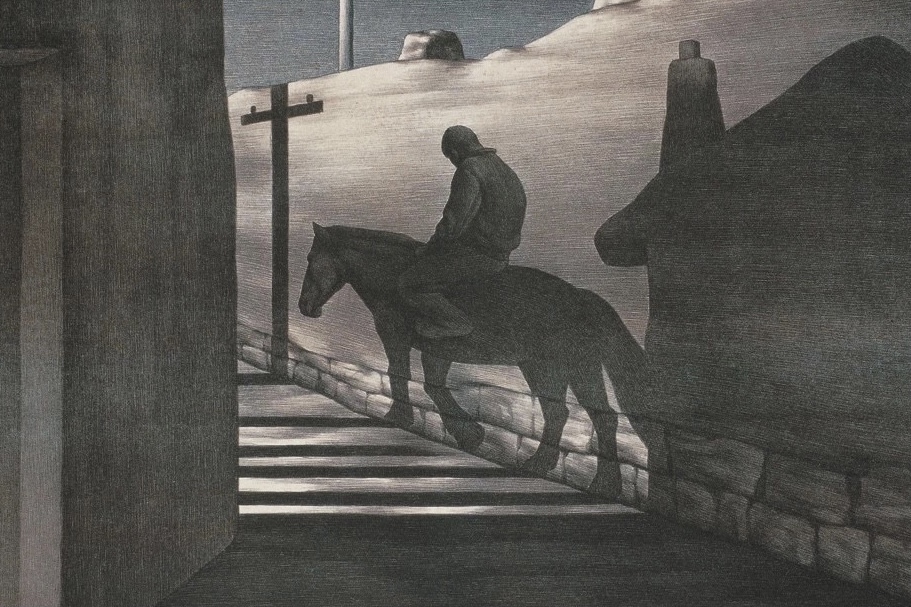
As for why I chose printmaking artist as a major, I think it may be a problem of understanding, because I have painted a lot of black and white illustrations in the army. I think black and white painting is just a printmaking.
Oversea life
I was admitted to the Central Academy of Fine Arts in 1986. At that time, the academic atmosphere of the Academy of Fine Arts was unparalleled. You can see some clues only from my classmates and colleagues. When I was in school. Yin Jinan and I lived in a dormitory.
However, the selection and conversion process of my major did not go smoothly. My master’s research direction was woodcut.
When I saw the last class of classmates painting stone plates, I was still attracted. For the first time.I saw that it can Painting, and can print very subtle changes. I wanted to try it out, so I secretly borrowed a slate from him.
At the end of the teaching inspection. the teacher in the department saw the lithograph I painted and asked who made it. I was a little nervous about being criticized.
The department leader thought that I was more suitable for professional development in lithograph. and the department decided to transfer me to study at lithograph studio.
Su XinPing Gao ming lu
At the end of 1988, Gao Minglu, the curator of the “Chinese Modern Art Exhibition”, came to the Academy of Fine Arts to select works. When he saw my lithographs. he chose two works and invited me to participate in the exhibition.
Today, it seems that the modern art exhibition is a landmark exhibition in the history of contemporary Chinese art. But su xin ping did not have this awareness at all at the beginning. and even before the opening of the exhibition. Su xin ping went back to my hometown in Inner Mongolia to visit relatives.
Only later did I hear about the grand occasion of the exhibition, and learned that on the opening day of the National Art Museum of China. Almost all participating artists were present. The shooting, the sale of shrimps, the washing of feet, and the incubation of eggs. shocked a series of contemporary art acts that challenge ideology.