Categories
Contemporary

Contemporary | Ye Funa – Nailhenge

Ye Funa was born in Kunming, China in 1986. She graduated with a BFA in Experimental Art from the Central Academy of Fine Arts, Beijing, China . MFA from the Central Saint Martins College of Art, London, UK.

Funa fictional space

Ye’s practice is concerned with the relationship between the realities of everyday life. She is interested in the perceived connection between authority and many areas of social life such as different power structures, ethnic groups. The fictional space of propaganda for the concept of ‘perfection’ in an ideological system, and utopian landscape. Her work is politically charged, subtly engaged in pastiche as a satirizing style of propaganda. 

As the concluding exhibition for the Curated Nail project, “Nailhenge” seemed a little on the somber side. Here were neither the creative manicure sessions of past events, nor the cosplay girls from “Peep Stream”. In addition to older works like “Nail Diamonds Treasure Chest” and “Nail Bank”, Ye Funa showed a recent series entitled Capture the Nail, made using cheap trinkets from small-merchandise wholesale markets, and Nailhenge: A Small Victory, a new short film shot in this gallery-turned-green-canopy-space.

叶甫纳,”甲天下”,展览现场 Ye Funa, “Nailhenge”,installation view

Family Album

The turn from “Family Album” to “Curated Nails” marks Ye’s transition from a research-oriented practice. Based on texts and history to a participatory one drawing from the realities of everyday life. In 2014, Ye Funa founded “Exhibitionist: Curated Nails” on Wechat’s public platform, a curatorial project that allowed fingernails to appropriate the exhibition function of galleries and museums.

By 2016, Ye Funa had collected over 150 submissions. In conjunction with successively promoting the proposals on the public account named “Exhibitionist”. Ye has also collaborated with various institutions for pop-up shows, including Ying Space, Nanjing Arts Institute,MoCA Pavillion, storefronts, among others. Essentially, the motive driving Ye’s implementation of this project comes from the individual’s need for manicure makeovers—she contemplates how to transfer conventional exhibition-making to feature nails. As the project developed, Ye’s interest in nails expanded to the realm of pathology and sociology. The word “exhibitionist” originally indicated a perverse behavior in which someone achieves sexual satisfaction by exposing their genitals. In the context of Ye Funa ’s work, it suggests more a certain compulsion for spontaneous showcasing in public space.

Naihenge sculpture YE FUNA
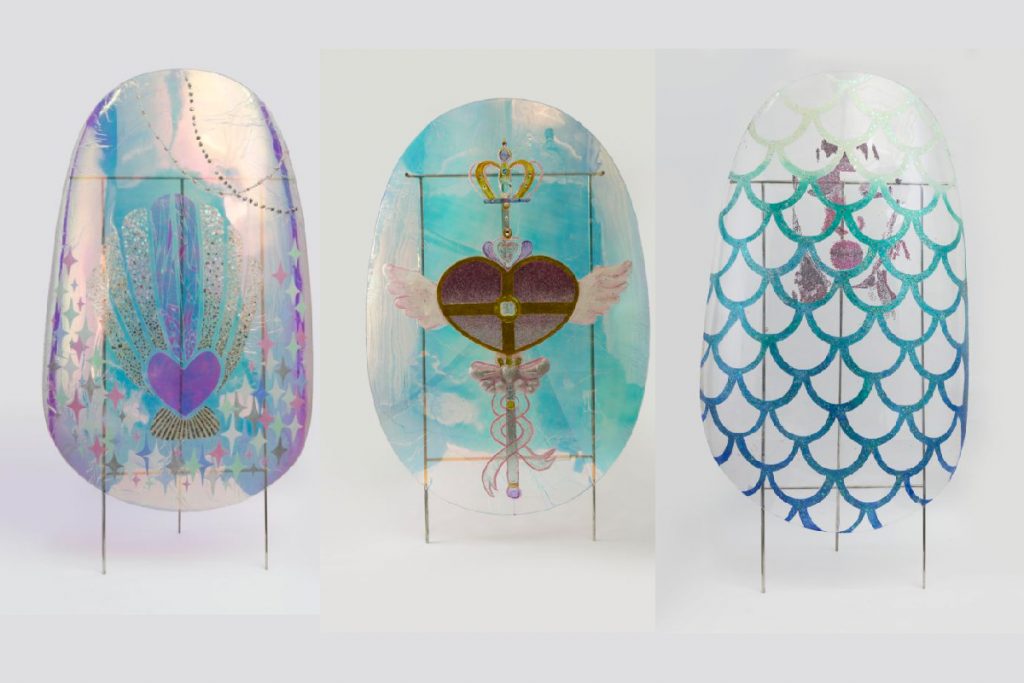
《巨甲阵- 珍珠贝》,综合材料,Nailhenge, mixed material, 205×105cm,2016

Arranged on transparent display shelves, the Capture the Nail series is made up of nails adorned with rhinestones, puppets, insects, organs, plants, hair, and other plastic materials. On first sight it seems to resemble a mini cult movie theater with a penchant for porn and gore. Although the work seeks to comment on how nails pertain to pathology and sociology. The dazzling array of trinkets is not lacking in feminine accessories such as bows, high heels, and diamonds. This manicure-themed exhibition makes it difficult for viewers to ignore a stereotypical female desire for bodily embellishment. But judging from the vulgar color palette, cheap materials, and crude craftsmanship, the work deliberately rebels against the exquisite refinement sought in popular manicure practices.

Ye Funa A small victory

Paired with an upbeat electronic soundtrack, the short A Small Victory recounts the process of Ye navigating “manicure” culture with a friend. The artist fabricated the ”genesis” of manicure culture, in which “manicure”. A culture intimately intertwined with the lives of women since the beginning of time—seems to have attained a legitimate place. Correspondingly, Ye made ten person-sized nails, taking both Eastern and Western female mythological characters as inspiration for the nail designs. In addition to symbols of Nüwa and the goddess of love in orthodox mythology. Ye also incorporated elements from different subcultures, especially manga culture. For example, the scepter adorned with crowns, hearts, and feathers is reminiscent of the role of Usagi Tsukino from the Japanese Manga series Sailor Moon (“manicure” is the initial step in the Sailor Soldier transformation process—it is as though it can bestow special powers).

When talking about the works of female artists, critics habitually employ .Words like “subversive”, “satire”, “parody”, and “self-amusement” in order to project “rebellious” personalities onto the artists. Although discourse on female artists is not novelty. It still remains a topic for museums, and curators to use to generate controversy.

Female Artist situation

Whenever institutions put up shows featuring female artists, they almost never fail either to emphasize their “particular” identity with phrases like “women’s living conditions and spiritual qualities are the benchmark for measuring the achievements of civilized society”, or to affirm the value of their cultural production with statements such as  “the works of female artists are becoming more and more powerful…etc.” At times, these circumstances result in female artists refraining from commenting on topics related to gender and refusing altogether that which is “female”. In contrast, “Nailhenge” does not shy away from women’s love for makeovers. The beauty inherent in manicure culture encompasses . Not only the sexy and the elegant, but also the weird and the bizarre. The attribution of beauty depends on the individual and what is attractive to them; the desire to look good is but a form of self-amusement.

Categories
Contemporary 当代 艺术家

Contemporary | Zhang Hui likes Beijing

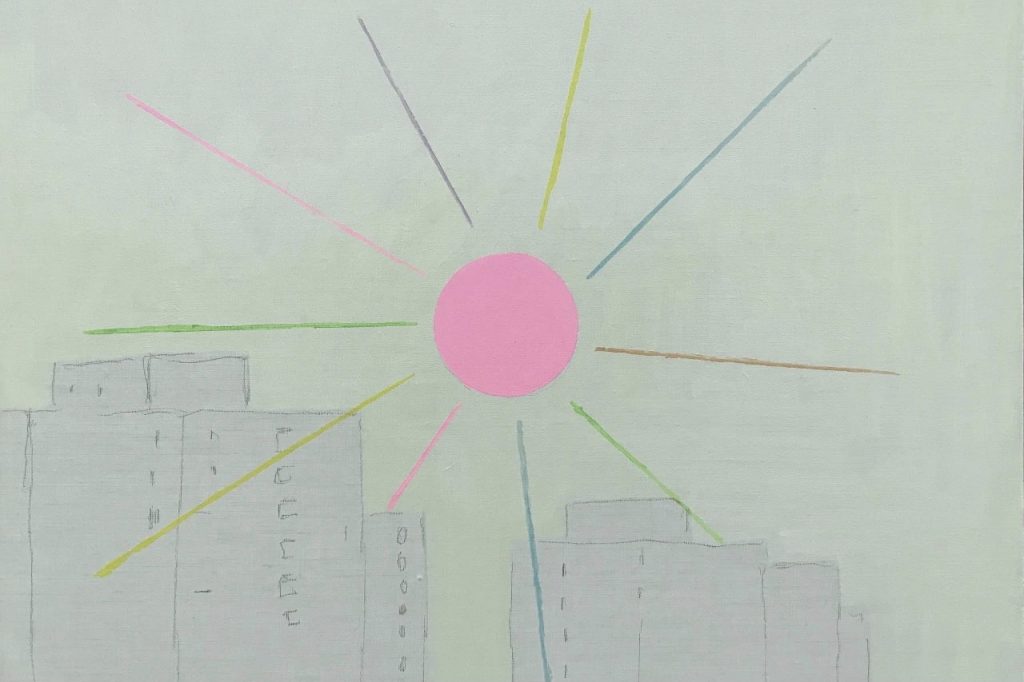
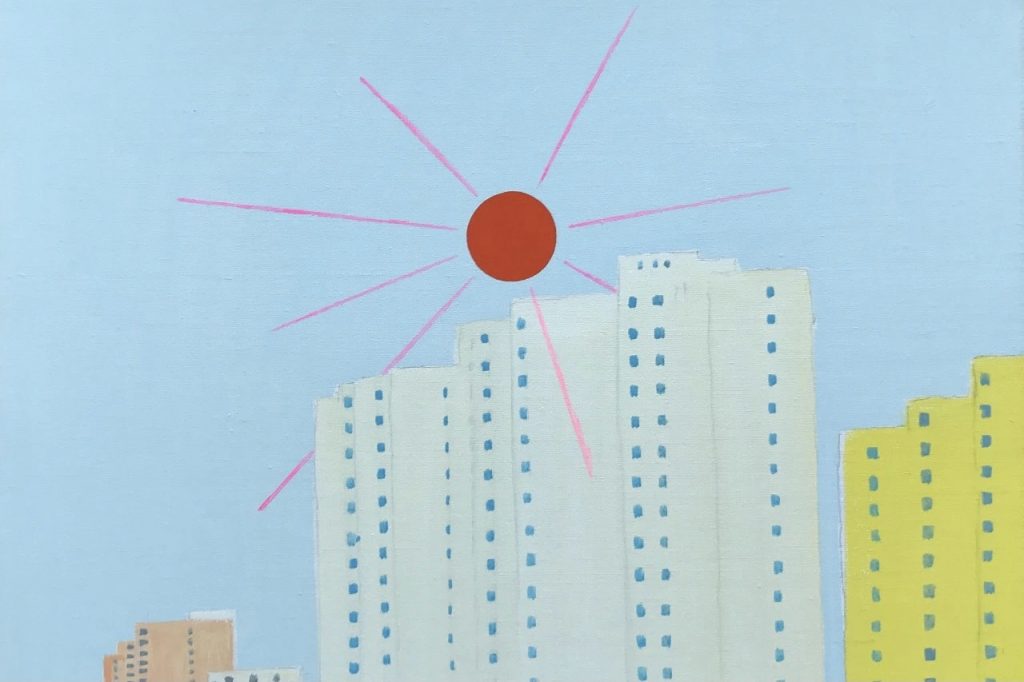
Dazzling sun

Artist: Zhang Hui

Born in Beijing in 1968

Zhang Hui Graduated from the Mural Painting Department of Central Academy of Fine Arts in 1991
2005 Master of Arts and Design, Minneapolis College of Art and Design
Currently works and lives in Beijing

walk in the surrounding

Living in Beijing, Zhang Hui like to walk in the surrounding mountains. Zhang Hui usually leave at 8 or 9 in the morning, sometimes with a couple of friends, sometimes by myself, driving for one and a half to two hours, and there are some routes around 100 kilometers away.

If it is a four- to five-hour route, Zhang Hui will bring something to eat, such as a steamed bun or a biscuits or bean buns, and sometimes a boiled egg. Generally, there is no salted duck egg, which is salty and oily, which is inconvenient. Be sure to bring something sweet, such as a few pieces of candy, two snacks, or two energy bars.

Bring a 500ml bottle of water on cold days, two bottles on hot days, and three bottles in July and August. There are many hills with an altitude of about one kilometer in Beijing, and the general parking place is about 500 meters.

There are only three mountains of two kilometers, Dongling Mountain 2,303 meters, Haituo Mountain 2,241 meters, and Wuling Mountain 2,118 meters. Outdoor hiking has sunshine, sufficient oxygen, and the atmosphere of trees, flowers, and mountains. It is a process of challenging one’s own limits and relaxing and happy.

In the book “What Do I Talk About When I Talk about Running,” Haruki Murakami describes his daily life, running in the sun, eating grilled fish, drinking beer, writing, and listening to music.

It’s a beautiful day. Zhang Hui also like the ending part of his “Norwegian Forest.” Reiko made a hot pot for Watanabe, and they sang while talking about the guitar. They held a “real” funeral for Naoko and played 51 songs in a row. The soul of Super Naoko is also redeeming himself. After that, they “hugged each other as a matter of course” and then made love.

like Bach’s music

Zhang Hui like Bach’s music, religious sense and divinity. Especially his fugue, the chase and escape of notes entangled and flowed. Zhang Hui like Indian traditional music, which is continuous and coming in a steady stream. Like jazz. Like Mahler, especially his ninth and tenth symphony, eternal, beyond death, suffocating.

Schopenhauer said that we are all slaves of our own will, trapped in the desire for food, sex, money, and control. Art is a possible way to save us from the distorted, boring and painful reality. Art can give us. Transcendence, it has such an energy to help us achieve spiritual escape.

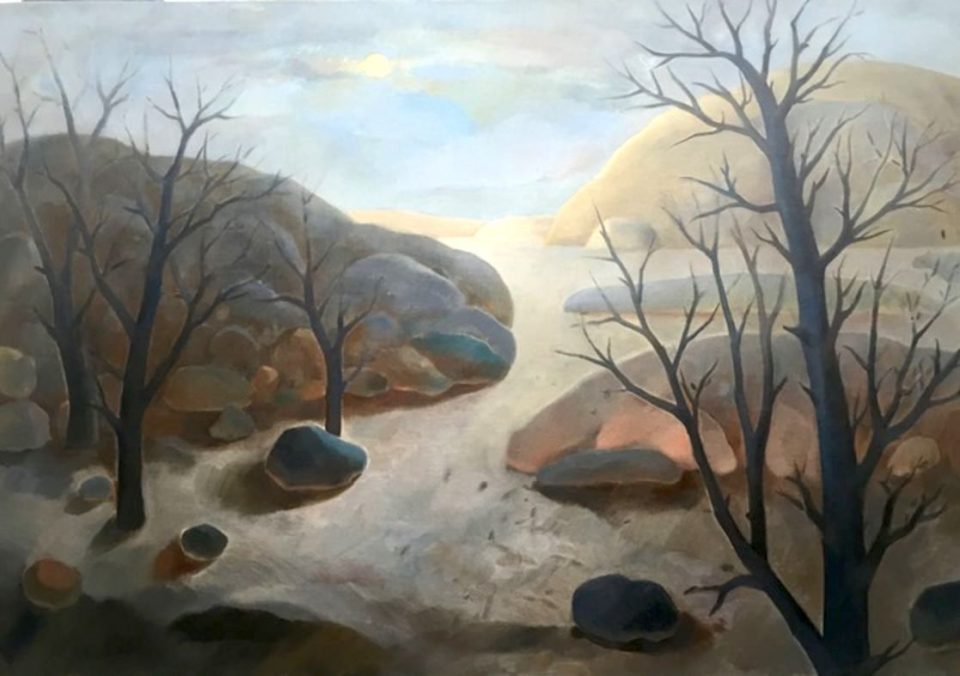
Over the years, Zhang Hui have painted several different series: cities, trees and branches, people, colored stones, clouds, grids. There are many journeys and thoughts behind these paintings. Now it is difficult for me to state clearly the background of these thoughts.

Categories
Contemporary 对话

Contemporary | Chen Ke sad girl

Chen Ke is born in 1978 in Tonjiang, China’s Sichuan province. She’s graduated from the Sichuan Academy of Fine Arts, where artists had many opportunities to explore their emotions and instincts. 
This free environment, alongside cartoons, fairy tales and comics, helped her to build her identity as an artist.
After participating in numerous national and international exhibitions, she worked on a variety of media, including painting, sculpture and fashion design.
Chen Ke is recognized as the most representative artist of the New Generation of Cartoon of China.

Background

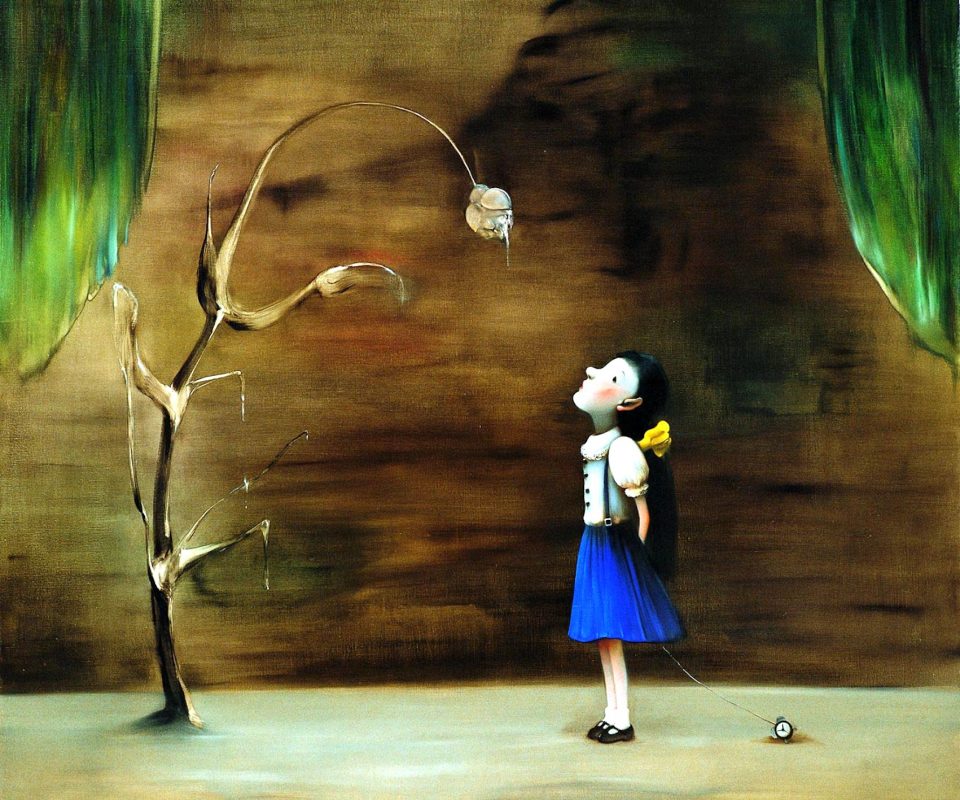
Various images of little girls, representing the core of human nature, flow like a thread through the works of Chen Ke.
Although references to the art of comics are evident, when one analyzes her works in more detail, they become visible elements of style of Western masters such as Caspar David Friedrich, as well as the influence of traditional Chinese paintings, creating an exciting tension. 
Being eager to experience Chen Ke often surprises her viewers. Not only does she produce her own paper, she embroiders canvases with beads, but she also applies oil paint to stretch cotton fabrics that are popular in her childhood days.

Chen Ke sad girl

Chen Ke is considered the most representative artist of the new generation of Chinese artists. Her melancholic paintings, which express the loneliness of growing up as an only child, show digital images made of bright and colorful light from her kaleidoscopic and dazzling imagination.
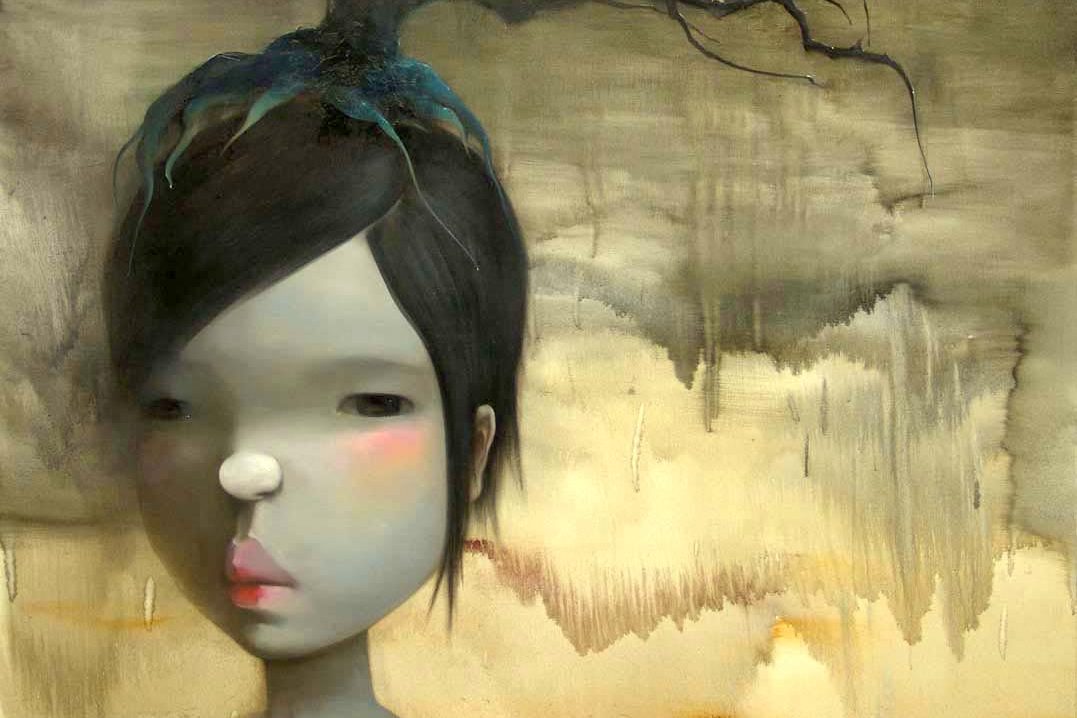
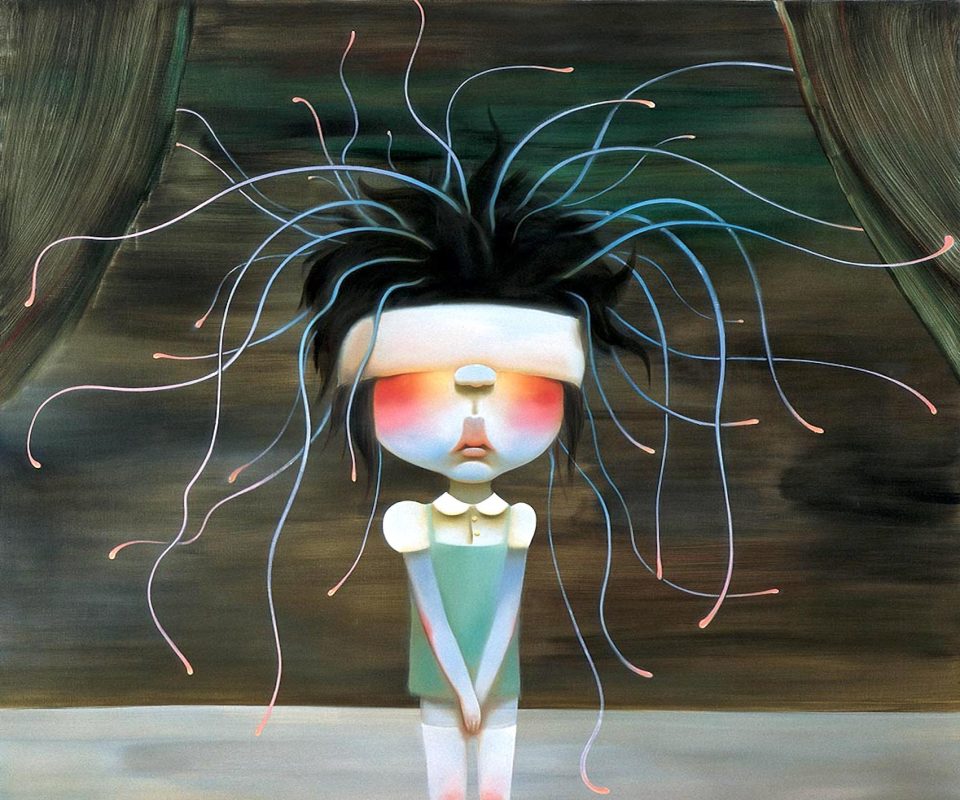
That’s why the artist says: “My characters are somewhat sad, isolated and powerless and this is exactly how I feel sometimes. My art is as real as my spirit.”As classical artworks of Chen Ke, almost every piece of work shows a little girl with a round nose, who is lost in depression, limited to herself, living in an unreal space, and seems to keep a distance from the human world.

Chen Ke
Like porcelain paintings

Usually, the sad girl takes up the center of the whole artwork. With the full expression of the blank as well as the grain like porcelain paintings, the artist fully shows the opposition of the reality. A reality that buries the audience in the waves of the sense of unknown sadness. The sad girl seems to be jumping between the virtual world and the reality, which makes the audience lost in the endless loneliness and long distraction.

Chen Ke
Chen Ke and Beijing

In her first two years in Beijing, she felt lonely and what she could do was to paint and put her moods into the painting. She believed this is the reason why many people think that the girl in her painting was actually her self. And the girl in her painting grew up with the growth of the artist. She believed her art appeared from her daily life, so she hoped art could enter the daily lives of people. 

Chen Ke and Fashion

She thought fashion and art have no differences at the top point. She has cooperated with many fashion brands. In 2008, Fendi invited Chen Ke to join the Fendi special handbags Baguette Anniversary commemorative edition series; she designed a handbag for the series. In 2014, Chen Ke designed for the Vogue FNO series to celebrate the ninth anniversary of Vogue magazine.

Chen Ke

Fonti:
Artsy
Wikipedia
Perrotin