Categories
Contemporary 当代 纵观艺术 艺术家

Contemporary| Zhou Jun – The Thick Red Line

Zhou Jun is a contemporary conceptual chinese photographer. He was born in Nanjing Province in 1965 and graduated from Nanjing Normal University in 1990.

His work revolves around construction sites and the relationship between urbanization and the preservation of ancient cultural inheritance.

Zhou Jun
Zhou Jun

Zhou Jun’s technique

The artist is best known for his series – Scaffoldings; Bird’s Nest project; The Red and the Black – featuring Chinese cities in black and white with overlays of red streamers wrapped around under-construction buildings. Zhou Jun uses large format film cameras to produce negatives, which are scanned, digitally manipulated and printed to produce large unframed photographic works. Built environment is the subject of Zhou’s work in an analysis of China’s rapid and sometimes brutal redevelopment. Created since 1992, his photographs mainly treat the conflicting relationships between Chinese traditional architecture and contemporary buildings while continuously challenging the symbolic nature of the red color.
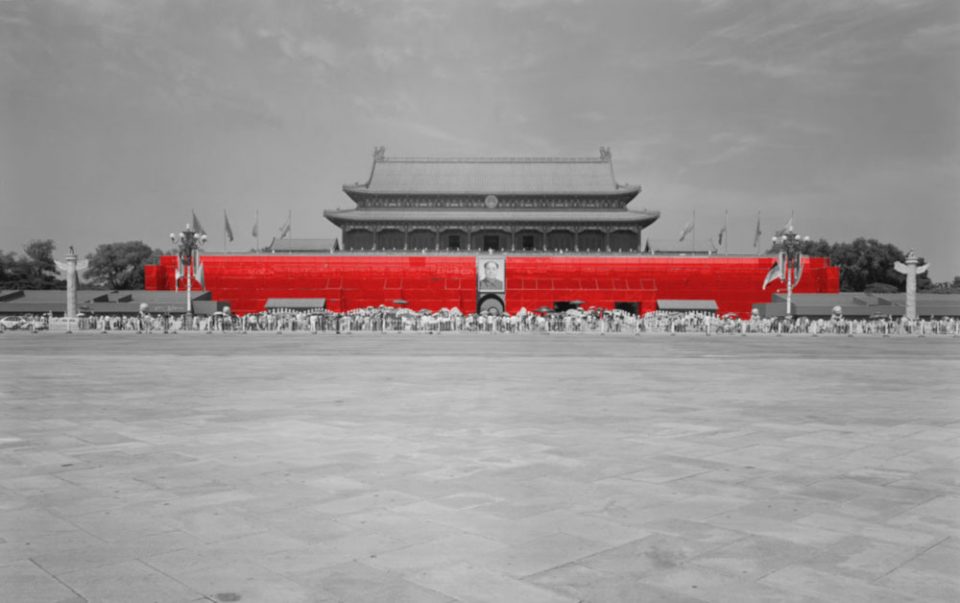
9th 2007, 2007, Digital C - print, 120 x 190 cm/180 x 286 cm
9th 2007, 2007, Digital C – print, 120 x 190 cm/180 x 286 cm
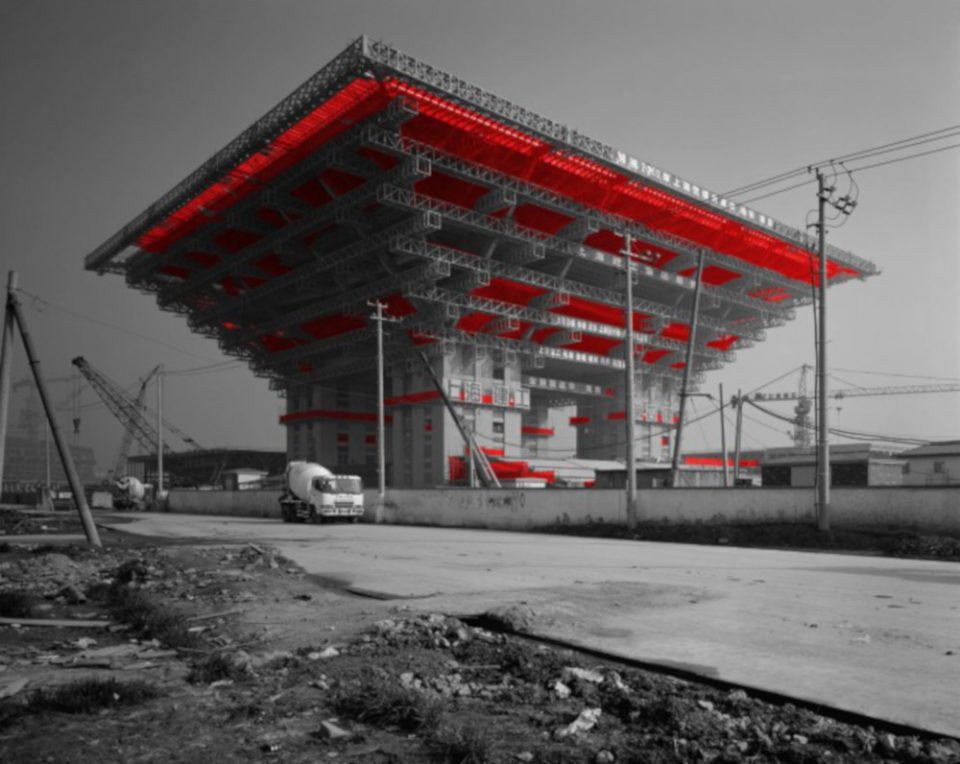
Expo 2010 Shanghai - China Pavillion, 2009, Digital C - print, 120 x 150 cm/220 x 180 cm
Expo 2010 Shanghai – China Pavillion, 2009, Digital C – print, 120 x 150 cm/220 x 180 cm

Building progress

The contradictions that are presented when trying to preserve the past in a time of China’s unprecedented economic growth underpin the work of Zhou Jun. During the last thirty years the most striking feature of China’s re-development has been its city construction. Demolition of whole villages to make way for high-rise development is a regular occurrence. The lead up to the 2008 Beijing Olympics saw massive building works and although it transformed Beijing into a modern city entire neighborhoods were ‘moved on’ in the name of progress.
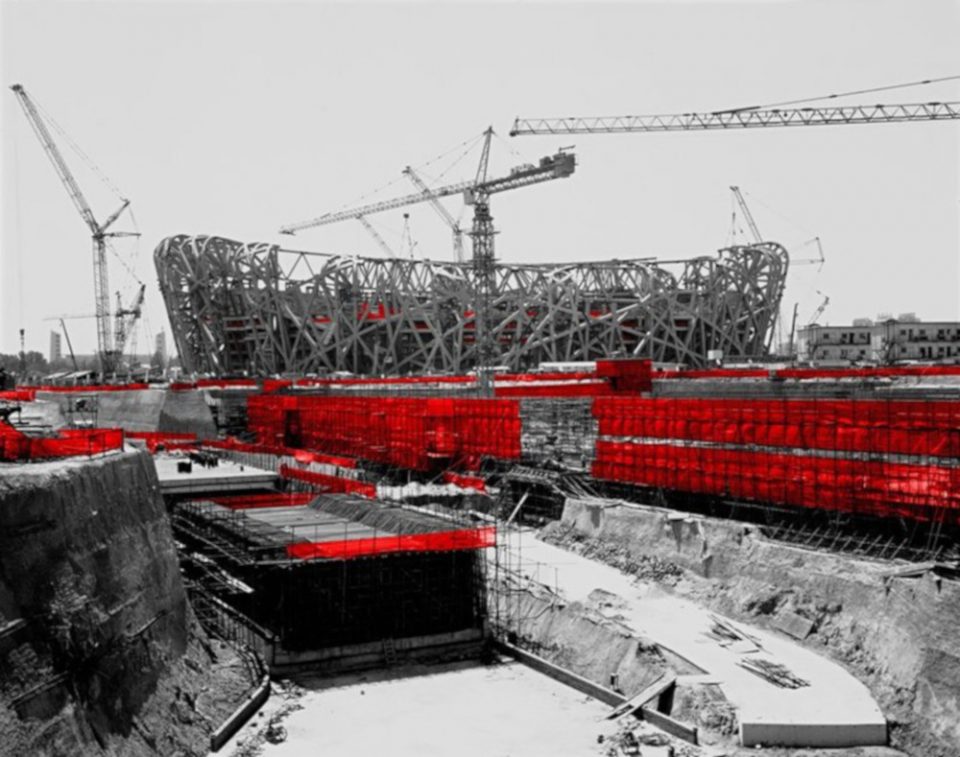
Bird's Nest No. 2, 2006, Digital C - print, 50 x 60 cm/120 x 150 cm
Bird’s Nest No. 2, 2006, Digital C – print, 50 x 60 cm/120 x 150 cm

Zhou Jun’s work embodies a quality of yearning for the past to some extent and this is seen in his photographs of historic buildings from Beijing. He is acutely aware of the expansion of Chinese cities and the loss of traditional architecture. It is the loss of Chinese culture in the pursuit of globalisation.
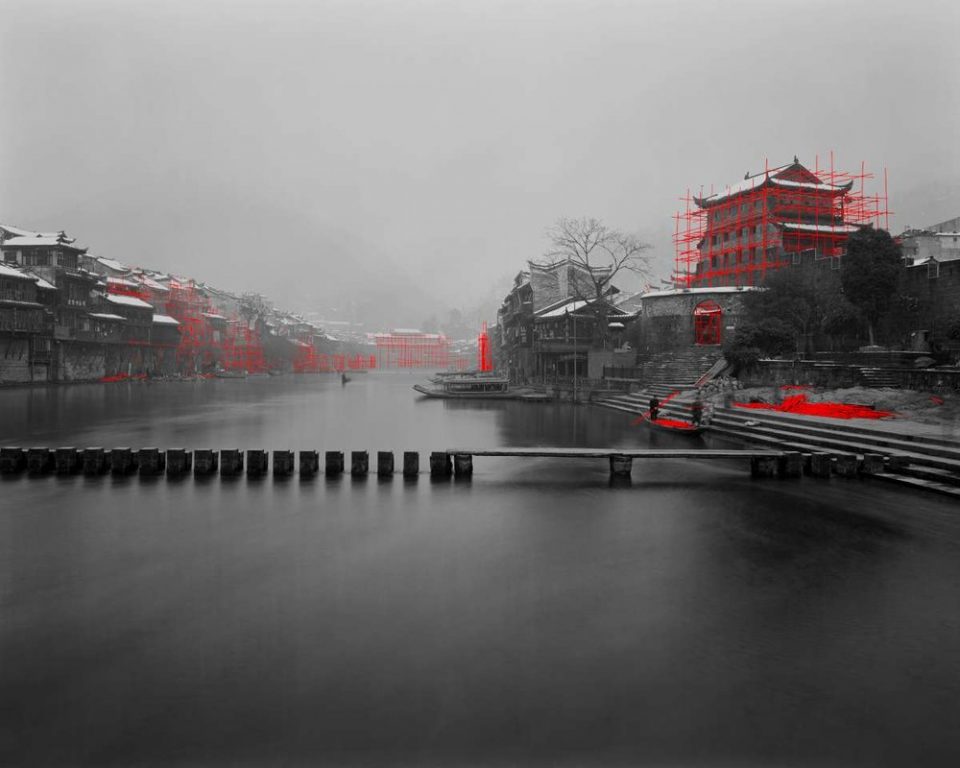
Phoenix Ancient City, 2011, Digital C - print, 120 x 150 cm/180 x 220 cm
Phoenix Ancient City, 2011, Digital C – print, 120 x 150 cm/180 x 220 cm

Seeing red

The color red has significance in Chinese cultural memory as it is used for ceremonial occasions such as weddings but it also represents revolutionary communist ideology. It is a reminder of the turmoil of the recent past. Because of this, the wide variety of perspectives of each person means completely different feelings and reactions are aroused by the color red. The partnership between the black and white photographs and the red sections of scaffolding allows the audience to produce their own meanings.

“Hanging Red”, 2009, 120 x 150 cm, Archival Inkjet Print on Fine Art Paper

A word from the author

“The three decades of development China is experiencing – building to a crescendo with the Olympics – are unparalleled in history. The colour red, which I use to highlight specific parts of the photograph, can elicit different responses in people from different countries or cultures – at times, it can even have opposite meanings for people. I want my work to be interpreted differently by people depending on their response to the symbolic meaning of red. In this sense, the work has the potential to reveal international perspectives to common subject matter.”

Zhou Jun also creates sculptural works using porcelain and other materials, always mantaining his distinctive style and his conceptual structure.
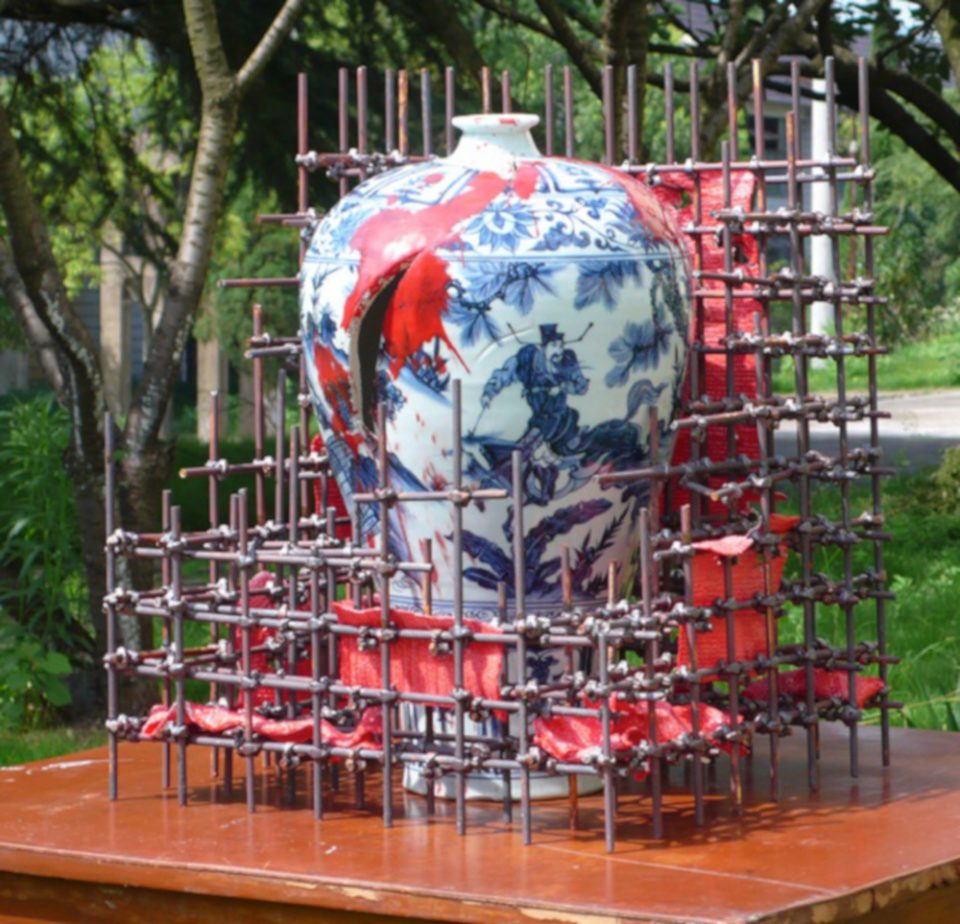
A
A “wounded” porcelain vase, surrounded by scaffoldings

For more informations about Zhou Jun’s work: https://www.redgategallery.com/Artists/Zhou_Jun-photography/index.html

or: http://www.artlinkart.com/en/artist/wrk_yr/dbabrws/1eccAtt/2006

Categories
Contemporary 当代 纵观艺术 艺术家

Contemporary | Li Xiaofeng – Porcelain Heart

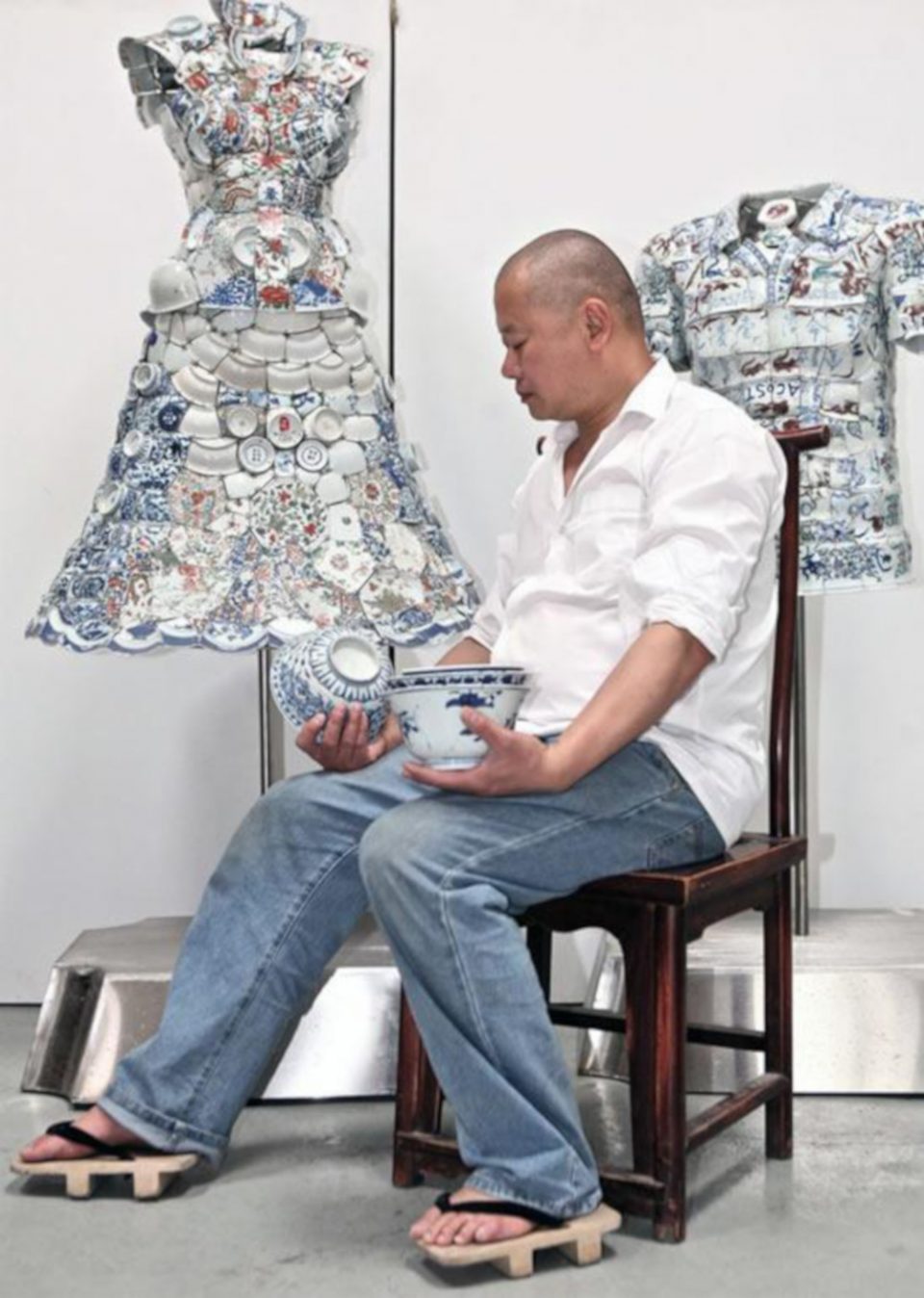
Li Xiaofeng is a Chinese sculptor and fashion designer, born in 1965 in Hubei. His unique work consists in wearable porcelain clothes.

He graduated at the Central Academy of Fine Arts (CAFA)’s Mural Department, and began his activity as a muralist. Then he began specializing in sculpture in order to explore new concepts and expressive forms to apply to the Chinese contemporary artistic scene.

Li Xiaofeng
Li Xiaofeng

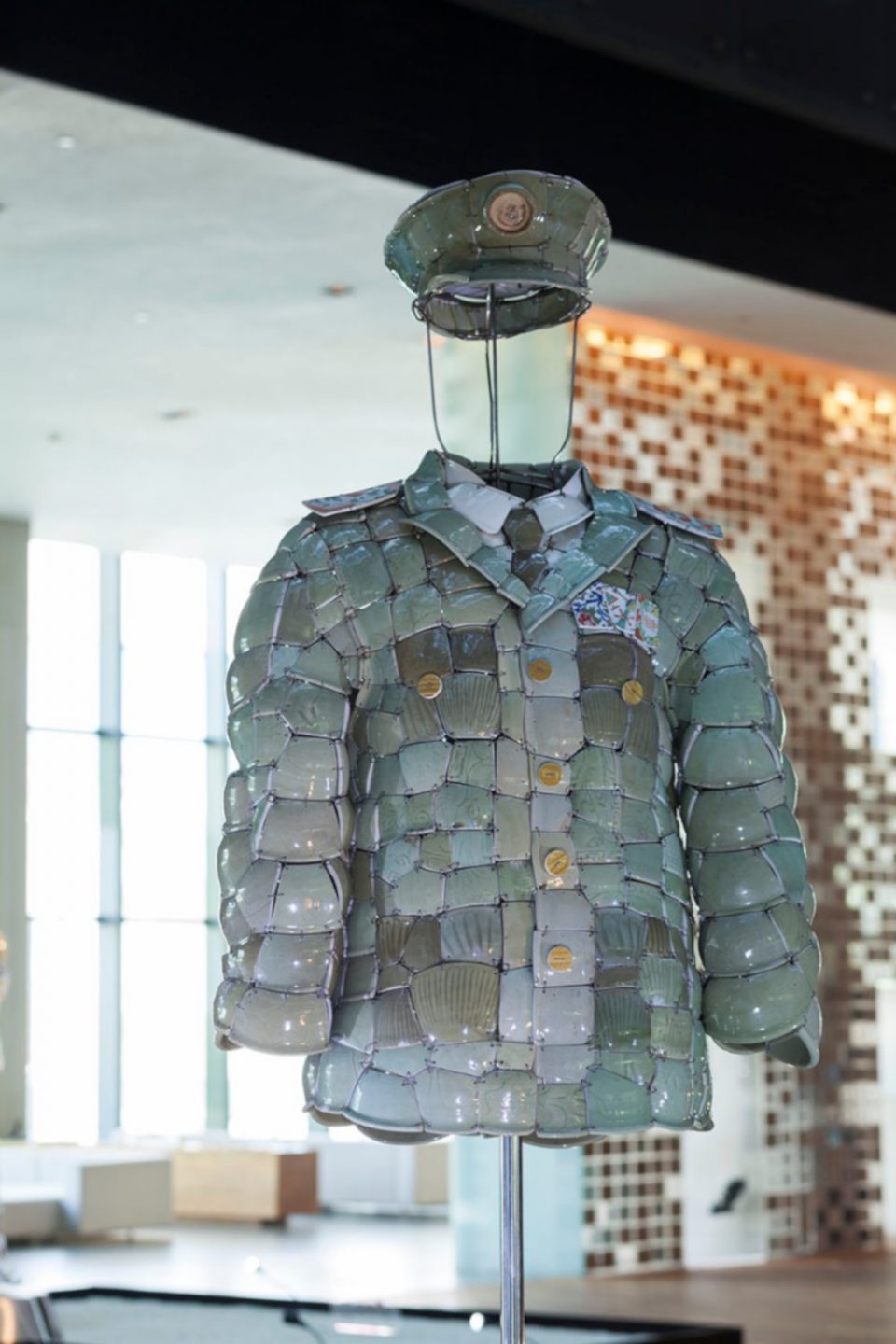
His sculpture-clothing project is truly original, both for the selected material and the idea of wearable “pieces of armor” that recall Chinese traditional works.

Li Xiaofeng’s creative process

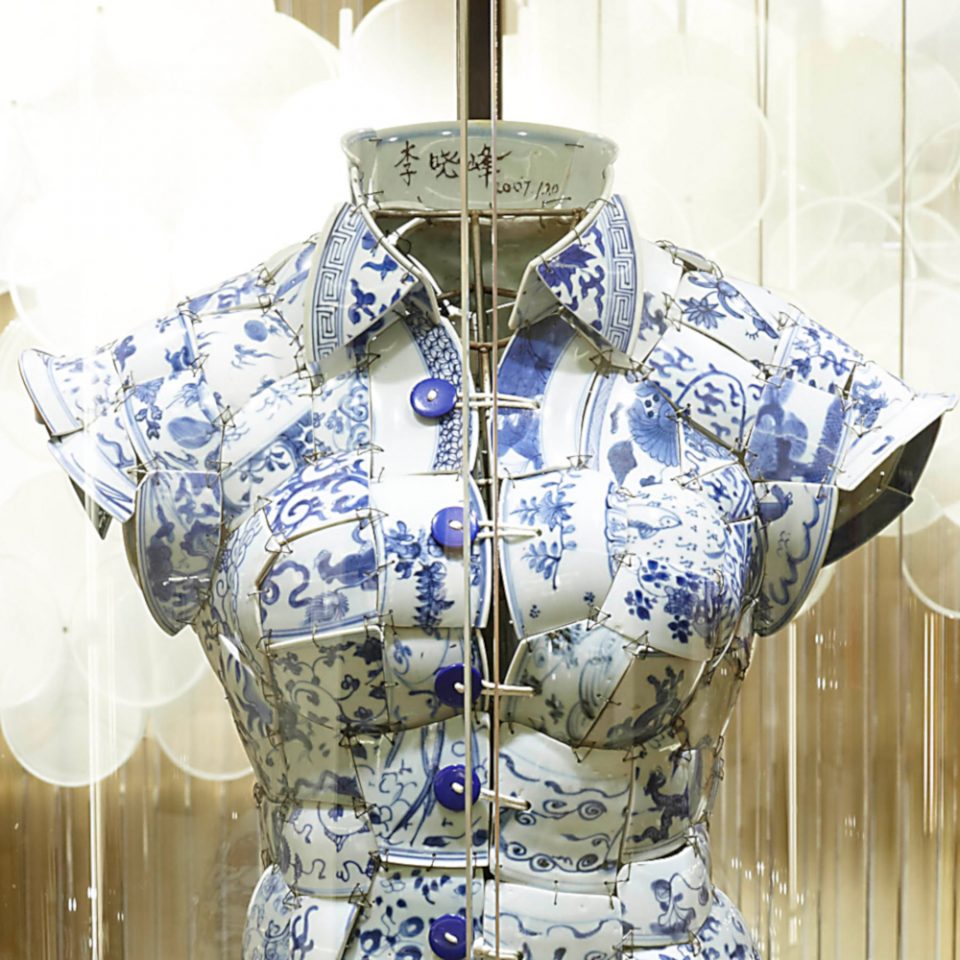
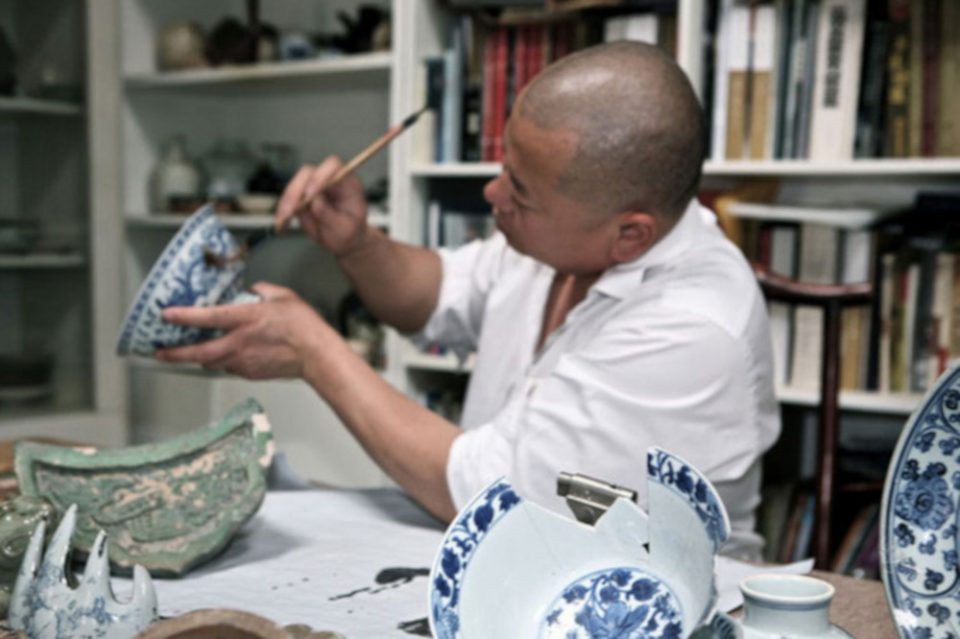
Li Xiaofeng researches and collects fragments of ancient Chinese porcelain recovered from archaeological excavations, dating back to the Yuan, Ming and Qing dynasties: he models and polishes them and punctures them, then sews them together on a leather undergarment through a silver thread, creating a “porcelain fabric”. His meticulous work is a bridge between past and present and a sharp reflection on the concept of culture. 

porcelain dress 1
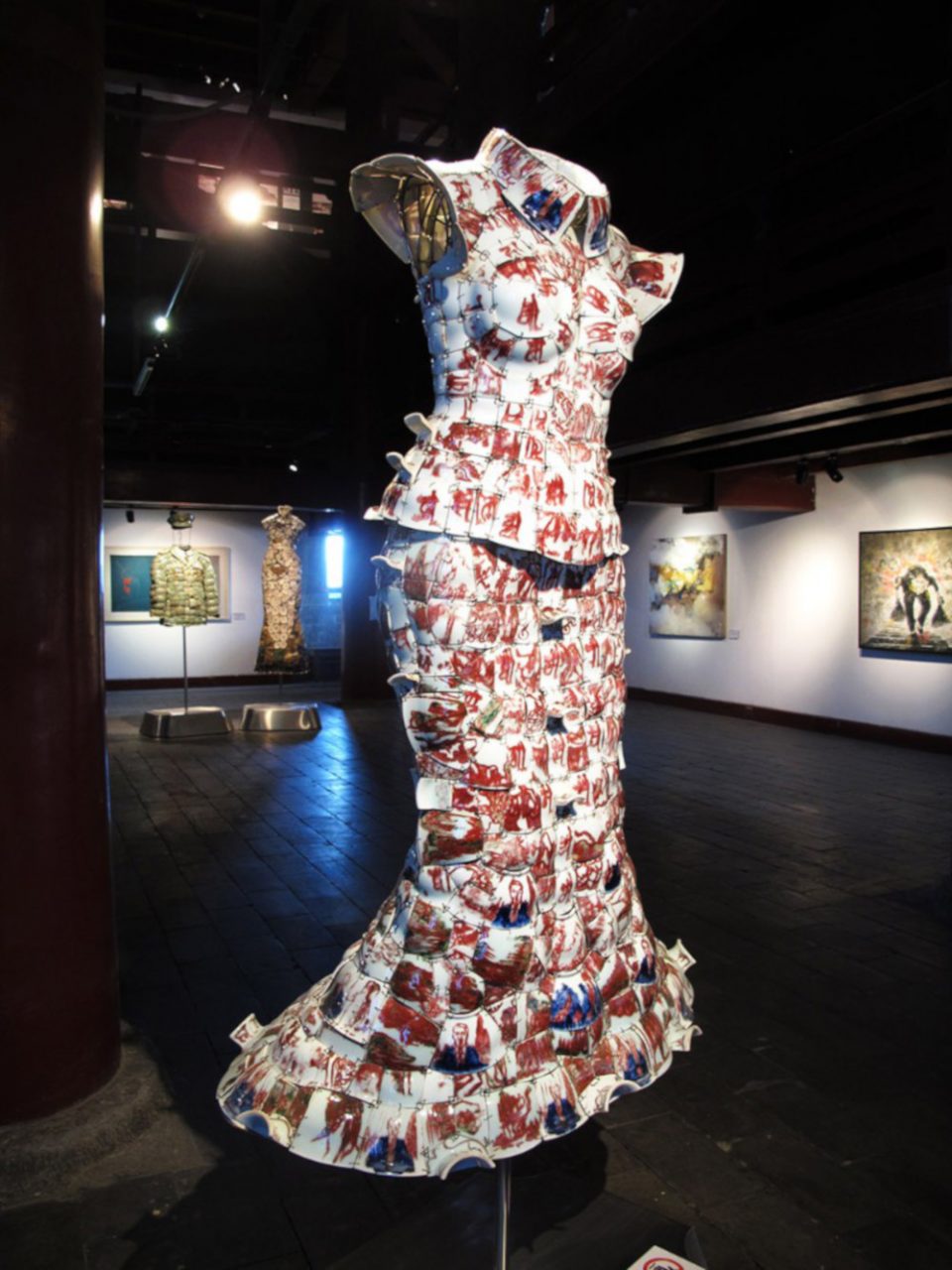
These dresses are fully wearable
porcelain dress 2

Li’s Rearranged landscapes

“Chinese culture” is the basic breakthrough point in Li’s works: he feels a sense of mission for its study and he channels it all in what he calls “Post Orientalism”. Landscape was always a major theme in his large number of paintings created in the past but, instead of simply copying like some other contemporary artists, he had always the urge to rearrange it, in a dynamic dialogue with history. 

This extract explains the reason why Li Xiaofeng’s calls his porcelain clothes “rearranged landscapes”:

“Since the time when it was the Mongol Yuan capital Khanbalik to the present day, Beijing has initiated its largest excavation projects of all time and, like a blue snake that has been hibernating for a millennium, the city is now stirring and shedding its old skin. It greedily emerges through the towering buildings, twisting free from the historical sediment of its ancient civilization. Blue-and-white porcelain shards that represent this civilization are unearthed in large quantities at the same time. These blue shards, bathed in the sunny skies of socialism and caressed by the contemporary cool breezes blowing from the west throughout the capital, assume a bewildering array of postures as fashion items entering the new century!

Xi Liaofeng at work
Xi Liaofeng at work

Among his works are women’s dresses, t-shirts and men’s jackets. His first piece in wearable porcelain fragments was “Beijing Memories”, a Mao suit.

MIlitary uniform
MIlitary uniform

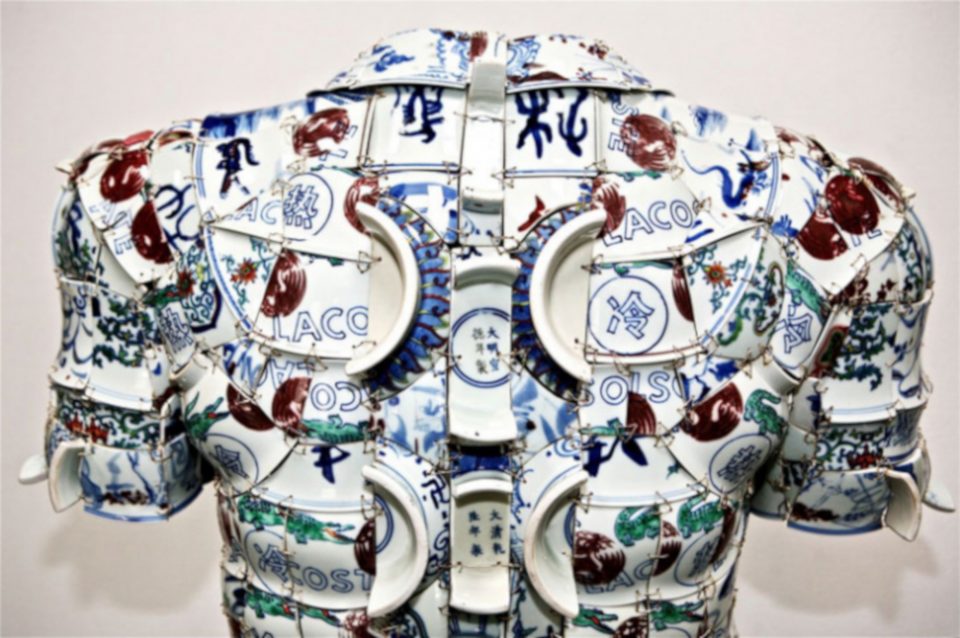
Lacoste’s porcelain shirt Li XiaoFeng

In 2010 the world-renowned brand Lacoste commissioned Li Xiaofeng a porcelain polo shirt for men and women for the Holiday Collector series. Unfortunately, a problem occurred: the PRC prohibits the export of ancient artifacts, including old porcelain shards.

Despite that, the artist did not give up and realized the porcelain himself, with the crocodile’s logo attached, and tore it apart only to recompose it into a Polo shirt, one of the most expensive and exclusive items ever sold by Lacoste.

Lacoste's porcelain shirt-sculpture
Lacoste’s porcelain shirt-sculpture

The artist also released a limited edition polo shirt, choosing blue and white fragments depicting the lotus flower and drawings of newborns from the Kangxi period and the Qing dynasty. The lotus flower represents rebirth and purity while newborns represent fertility. In that period the mortality rate among children was high and this type of decoration was in great demand in the hope of being a blessing for children.

“Porcelain shards” polo shirt

Li Xiaofeng’s main expositions

2019Dreaming of Crafts of the Future: Mongyudowon Unfolds, 11th Cheongju Craft Biennale 2019, Culture Factory C, Cheongju
2018Cracked – Porcelain, Red Gate Gallery
 2D vs 3D, Red Gate Gallery
 798, We Are Back, Red Gate Gallery
2017Red Gate on the Move, Red Gate Gallery
 Contemporary Dialogues Between Fashion and Art, Zhu Zhong Art Museum
 The Silk Road and Celestial Clothes, Taimiao Art Museum
 Fusion – The International Exhibition of Contemporary Ceramic Art, Art Museum of Nanjing University of the Arts, Nanjing
2016Red Gate: The Next 25 Years, Red Gate Gallery
2015China: Through the Looking Glass,The Metropolitan Museum of Art, USA
20145th Tanwan Ceramics Biennale, Taipei County Yingge Ceramics Museum, Tanwan
 ST. Start International exhibition of the Chinese Contemporary Ceramic Art, Today Art Museum, Beijing
20137th Gyeonggi International Ceramic Biennale 2013 Korea, Icheon CeraMIX Creative Center, Korea
2011Ming to Nirvana, Red Gate Gallery
2010Head On, Red Gate Gallery
 Width Contemporary Art Exhibition, Museum of Contemporary Art, Beijing
2008Virginia Miller Gallery, Miami
 Asian Contemporary Art Fair, New York
2006Sculpture, Pickled Art Centre
 Consumption Times I, Ha Te Art Centre
2005Diversity and Construction, Beijing
2004X Yard, Beijing
 Beijing International Art Camp
2002CAFA Graduates’ Exhibition

For more informations about Li Xiaofeng’s work: https://www.redgategallery.com/content/li-xiaofeng

or: https://www.artsy.net/artist/li-xiaofeng

Categories
LAVORATO 人物 当代 艺术家

Contemporary | Cute illustrator who loves traveling-Xu Yu


Xu Yu, whose real name is Xu Yu. She said that she started this name because it was a homophonic and poetic picture of her original name, so she uses it now.

More materials to represent the picture to Xu Yu

According to her own introduction, there are many mediums for her paintings, watercolors, colored lead, oil pastels, carbon bars, board paintings, etc. Generally, a material will be changed after a long time, because she always tries to use more More materials to represent the picture.


“Hometown”

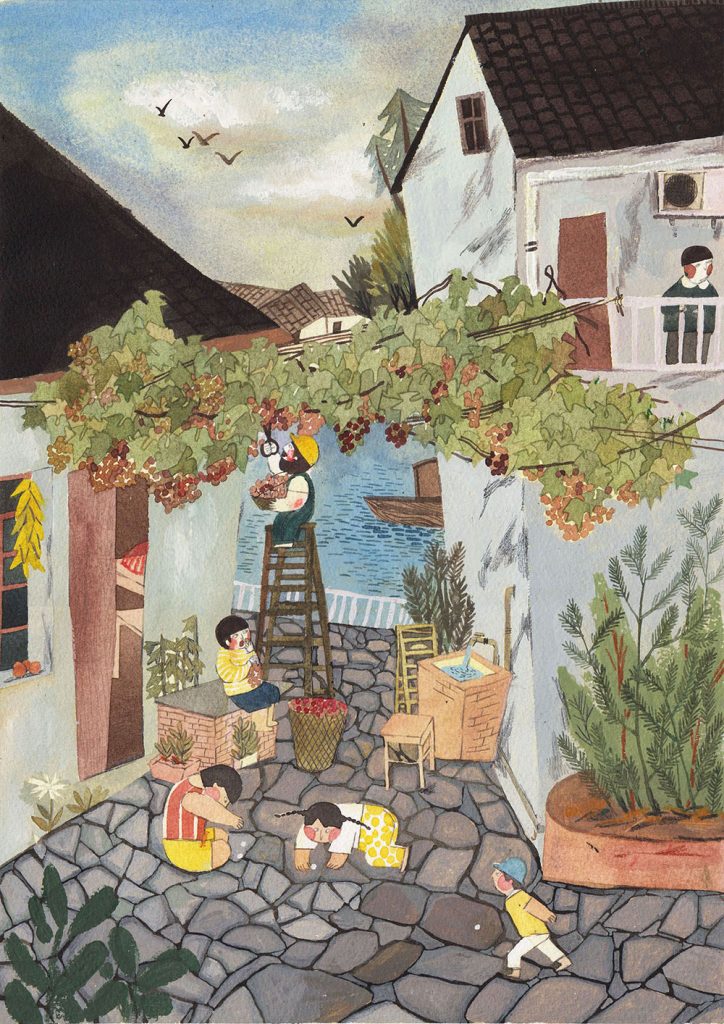
At first, I saw Xu Yu write this paragraph on Weibo’s Weibo: “My childhood was in Hangzhou, a small town in a small town in Jiaxing. The farthest place I visited was Hangzhou, when I looked at the province Travelers are envious of the glare of their eyes. When I was in high school, I saw someone going abroad to study abroad. I thought how good it would be if I were to go abroad. I have been looking up at the authors of the books and books since I bought Huaxin, thinking about if one day It ’s good to know them, and I ’d like to be able to freelance one day.

Things come to mind here, the world becomes wonderful. Later, when I went to college, I started to skip classes and save money to travel, and later I fought with my parents After studying abroad, I started to run around the world, and I also became an author of the heart and a freelancer. What ’s even more amazing is that those who I have followed since high school are much better now. Become a friend and a fan friend (speaking of a flower in my heart here).

as long as I do it, I can do it

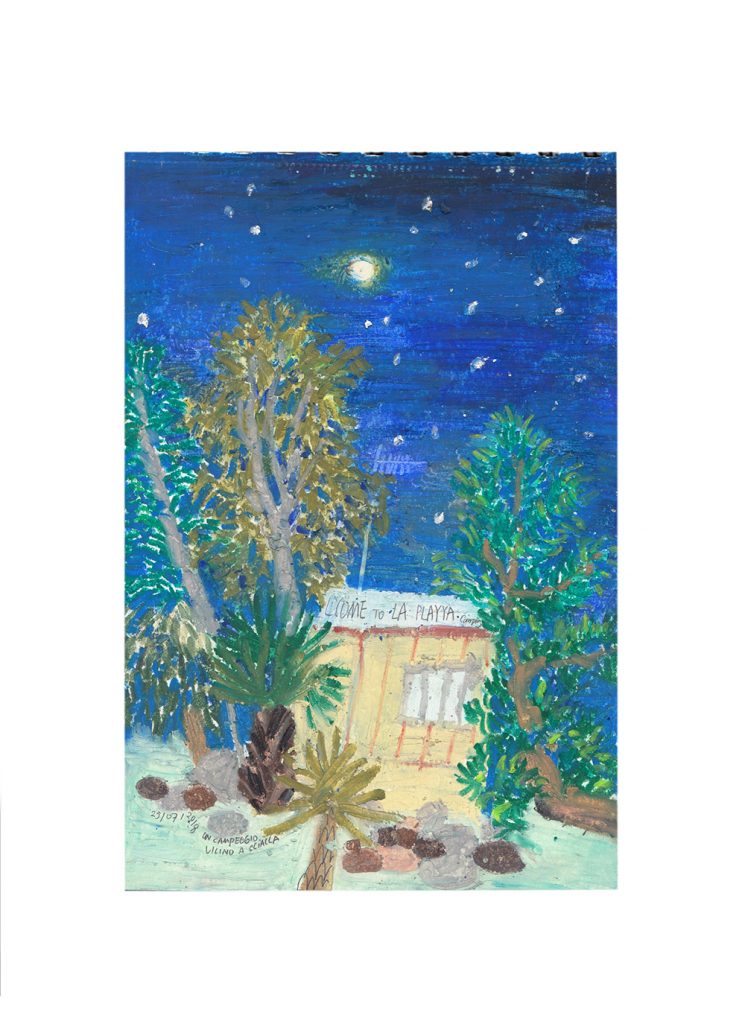
Once I only dare to think about things, I naturally reflected them into reality a little bit. Not long ago, I had a wish to go to the beach to see the stars Look at the moon. At this moment on the sea breeze terrace, the stars are all over the sky. It seems that as long as I can think of anything, as long as I do it, I can do it. “


“The watermelon field in summer is a beautiful memory of my childhood”

For Xu Yu, painting is not about how skilled you are, but about showing what you want to say. Techniques are physical things, and what you really have in mind does not depend on your skills. Anyone can draw.


“One year I lived in Tuscany, and the small country-style lifestyle allowed me to enjoy the complete life of an Italian.”

Like Xu Yu, she is a cute little girl in the eyes of friends. Her favorite things may be painting and traveling, and occasionally love cooking.


“XuYu is really a childlike girl.”


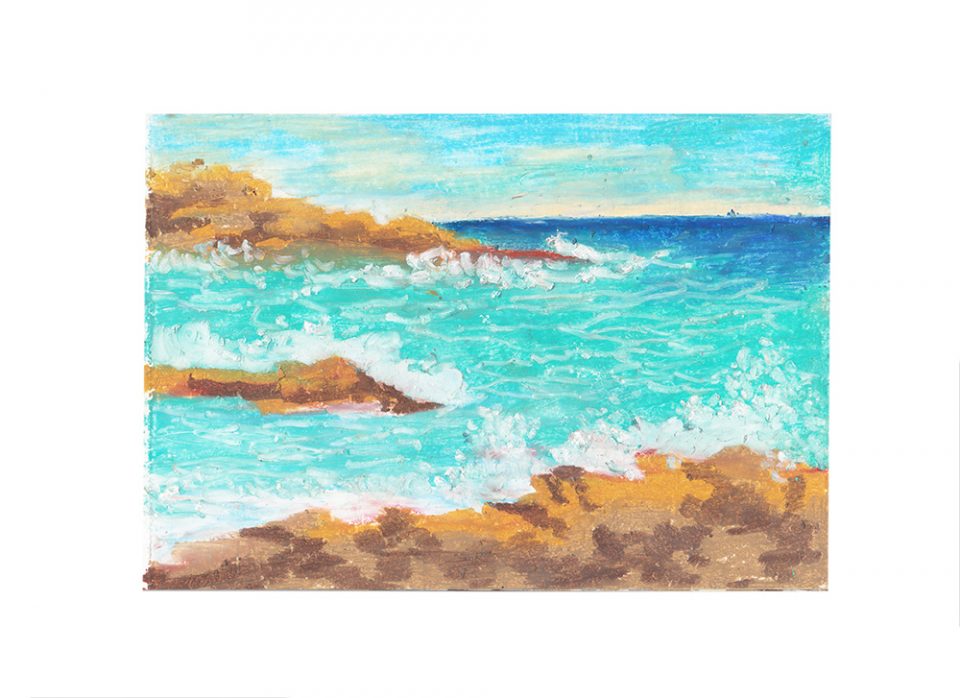
In the memory of her friend, she was a girl who ran to Sicily with her two schoolbags on her own. The schoolbag was full of equipment needed for painting. “You will be very happy to follow her, she will tell you the story she met on the trip.” My friend said “Because Xu Yu particularly likes to chat with others, I remember that when the Roman tourist encountered her, she came to know a Japanese and Korean Traveling friends have also listened to their stories. It feels amazing! Xu Yu is really interesting and interesting (Courage of the Northeast dialect). ”


“The Beautiful Legend of Sicily”

Xu Yu said: “Every aspect of life can give me a lot of inspiration. Traveling, painting, watching movies, and living in different places. I want to paint too many things every day. I just hate that time is not enough.”

“The Legend of Sicily 2”

She also said: “The perception of live painting is completely different from that of taking pictures.”


“Southern Diary”

“Southern Diary” is her graduation project and the first personal picture book in her life. This book can be regarded as an account of her in the past 20 years.


The inner page of the picture book “Distance”

Xu Yu : Let’s go travel!

In fact, Xu Yu’s painting is the story of her life experience, simple and beautiful. We always have all kinds of messy reasons to disturb our travels, but with Xu Yu’s paintings, we can see the beauty and follow her story line.

At the same time, you can also look forward to the story “Italian Alone” she has assembled for three years.


Will you finally have the urge to say?


“Let’s go travel!”


“Southern Diary”

“Southern Diary”

“Southern Diary”


xu yu resume


Xu Yu, graduated from the School of Art and Design, Zhejiang University of Technology,


Now studying at the Bologna Academy of Fine Arts as a graduate student in comics, and is also a freelance creator,

Now cooperating with magazines such as “Painted Heart”, “Picture Box”, “Middle School Place”, “Children’s Literature”, “National Geographic”, “Traveller” and so on Co-published books “Adventures of Rabichi” and “Distance”. Published works:


In 2017, cooperated with Tomorrow Publishing House to publish “Distance”


In 2017, he co-published “The Adventures of Rabbi” with Red Horse Book


Published a personal picture book “Southern Diary” in 2018 (intimate traveler)


In 2018, cooperated with Le Fun to publish the flip book “Unveiling the 24 Solar Terms”

Categories
LAVORATO 传统 艺术家

Tradition | Master of Chinese Painting “Qiao Weiming”


The master of Chinese painting Qiao Weiming

Chinese painting emphasizes him as an excellent artist, who needs to learn from the outside world and get the source from his heart, in order to have the wonderful feeling of creating the gods, mountains and rivers at the same time. Helping artists understand the true meaning and essence of art.
Canzone d’autunno
Chinese art requires saving the intention with the pen first, when the painting is finished the existence of the intention is still here. Emphasize the dissolution of things, create an artistic conception, arrive at drawing mien with form, form and spirit that must be established together.
Silenzio

And him, he did it. He is the outstanding Chinese artists – Qiao Weiming, born in 1961 in Luo yang Xiaolangdi. He is the member of China artists association. The researcher at the Chinese poem calligraphy institute of fine arts. The visiting professor of Lu Xun Academy of Fine Arts. Hebei Academy of Fine Arts and PLA Information Engineering University, the expert of cultural relics appreciation.the member of Luoyang CPPCC. The dean of Luoyang University Painting and Calligraphy Institute, and the art teacher of Luoyang Institute of Technology.

Chinese painting

Untitle

His material comes from the flowers and birds in his hometown. The composition of painting is a concrete embodiment of years of experience. For example, the basket series of paintings. All of which are mainly composed of baskets, are composed in the middle. However, the most annoying part of the composition of Chinese painting is that the main body is placed in the middle. which is precisely because the basket series is placed in the middle, which makes it very comfortable to look at. It breaks the limitation of the traditional painting composition from Song dynasty to modern times, which also forms its personal characteristics.

Fish Basket
Childhood Fun

In 1982, the work “Underestimating the wealth”, won the first prize of the Army Art Exhibition.

Red and fragrant peony

In October 1988, he held his solo exhibition in the Cultural Center in Tainan City, Taiwan.

In 1992, the work “Red and fragrant peony ” won the bronze medal in the International Chinese Painting Grand Prix.

In July 1993, he was graduated from the Fine Arts Department of Xinjiang Normal University.

From September 1993 to July 1994. he studied master’s degree in flower and bird painting at the Chinese Painting Department of Guangzhou Academy of Fine Arts. His creation “Red Kaki” was collected by the college.

In October 1994, his work “Reminiscences of Childhood” was selected for the 8th National Art Exhibition and won the first prize of Henan Art Exhibition.

In July 1997, his work “People in the Country” was selected by the China Artists Association, which held the Exhibition of  welcoming Hong Kong return to the Chinese artists .

In November 1997, the work “The Nest” won the second prize of contemporary Chinese meticulous paintings organized by the Ministry of Culture.

In August 1999, the work “Return” was selected by the China Artists Association which held the “welcome Macao to return to China’s calligraphy and painting exhibition.”

In October 1999, the work “Homeland” was awarded the Achievement Award by the China Artists Association for. “Celebrating the 50th Anniversary of the Founding of the Republic of China”.

In November 1999, the work “Bumper Harvest” was selected into the National Second Flower and Bird Painting Exhibition organized by the China Artists Association.

In February 2001, he participated in a joint exhibition of eight paintings and calligraphy organized by the Ministry of Culture of the People’s Republic of China to Egypt, Britain, France and Italy.

Hometown
Flowers

SEE FOR DETAILS:http://qiaoweiming.orgcc.com/works/v3710.html

Categories
LAVORATO 当代

Contemporary | Dai Guangyu: Transfer in Ink

Dai Guangyu is a self-taught artist born and raised in 1955 in a family of scholars in Chengdu, Sichuan Province, China.


Since childhood Dai Guangyu has studied calligraphy, painting and literature and his career as a contemporary artist includes his long experience as a visual and performative artist, curator and cultural critic, and poet.

Dai GuanYu

His work involves the history of Chinese art, the culture of ink painting, as well as Chinese poetry and politics.


In 1985, Dai Guangyu became part of the revolutionary movement New Wave, soon becoming the leader of what develops in Southwest China, after becoming a leader of the Sichuan artistic avant-garde scene, which proves to be very stimulating and perfect for the development of its creative purpose.

Dai Guangyu – White is not necessarily good

During this period he took part in several exhibitions including, in 1986, “Red Yellow Blue – Young Artists of Sichuan”, the first modern art exhibition in the Sichuan province, at the Sichuan Art Gallery.


In 1989 he participated in the historic China Avant-Garde exhibition at the National Art Museum of China in Beijing and after the end of the 1989 student movement protests, when Chinese art entered a depressed and withdrawn state, Dai Guangyu continued his active interventionist work, curating exhibitions and public performance interventions far from the capital.

Dai Guangyu – Untitled

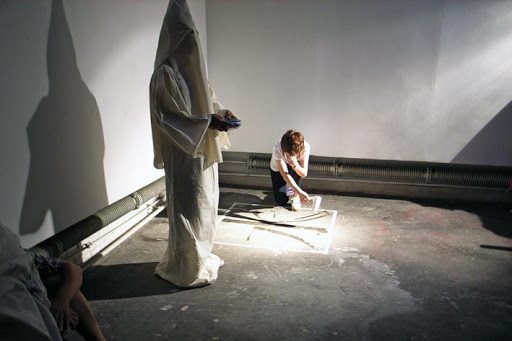
In the 1990s, Dai Guangyu discovered artistic performance, which employs the body as a key artistic medium.
The artist has found this artistic medium very interesting and very suitable for expressing himself, artistically speaking, as it allows him to be powerful in movement, incisive in meaning, radical and transitory.

Dai Guangyu – Absorbing – being absorbed

With Dai Guangyu, performance and artistic activities such as conceptual art had found their mentor.
In 2003, the artist moved permanently to Beijing where, during these years, he developed a body of art and a strong conceptual approach in cultural references, rich in poetry and symbolism, and beautiful in form, which has aroused continuous criticism.

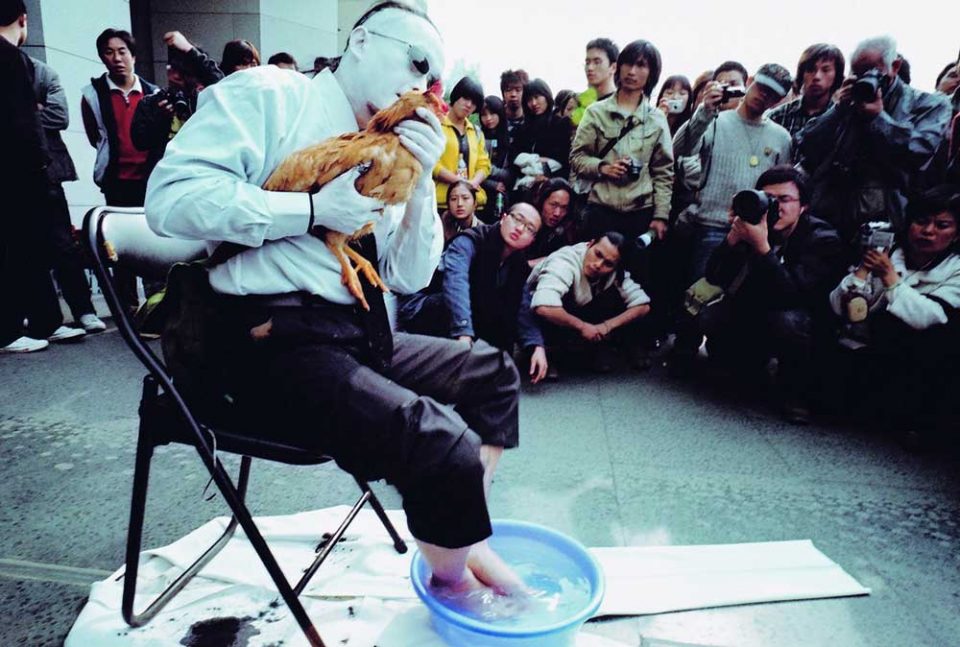
Dai Guangyu – To identify a chicken artistic image of a dead rabbit is difficult

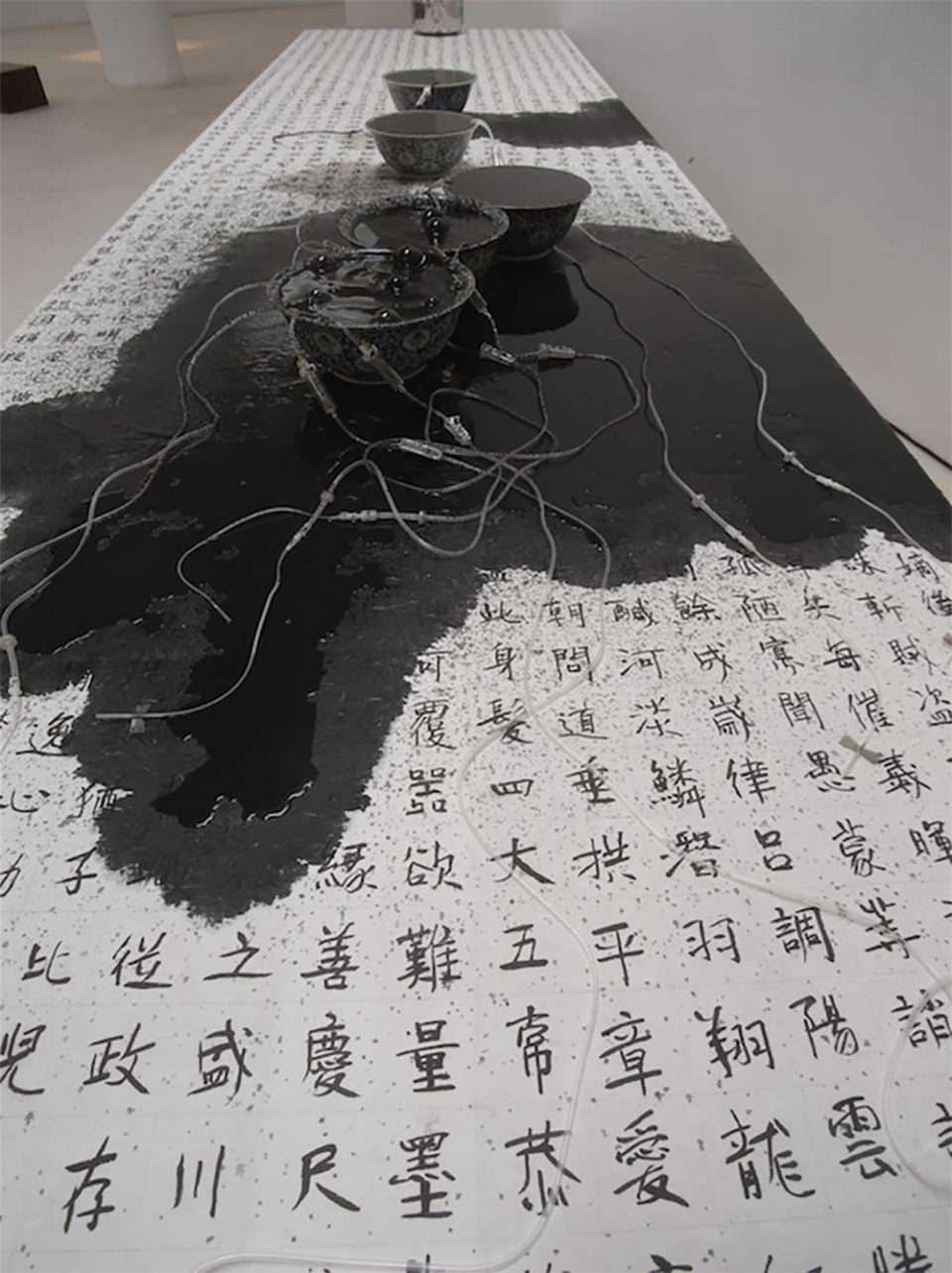
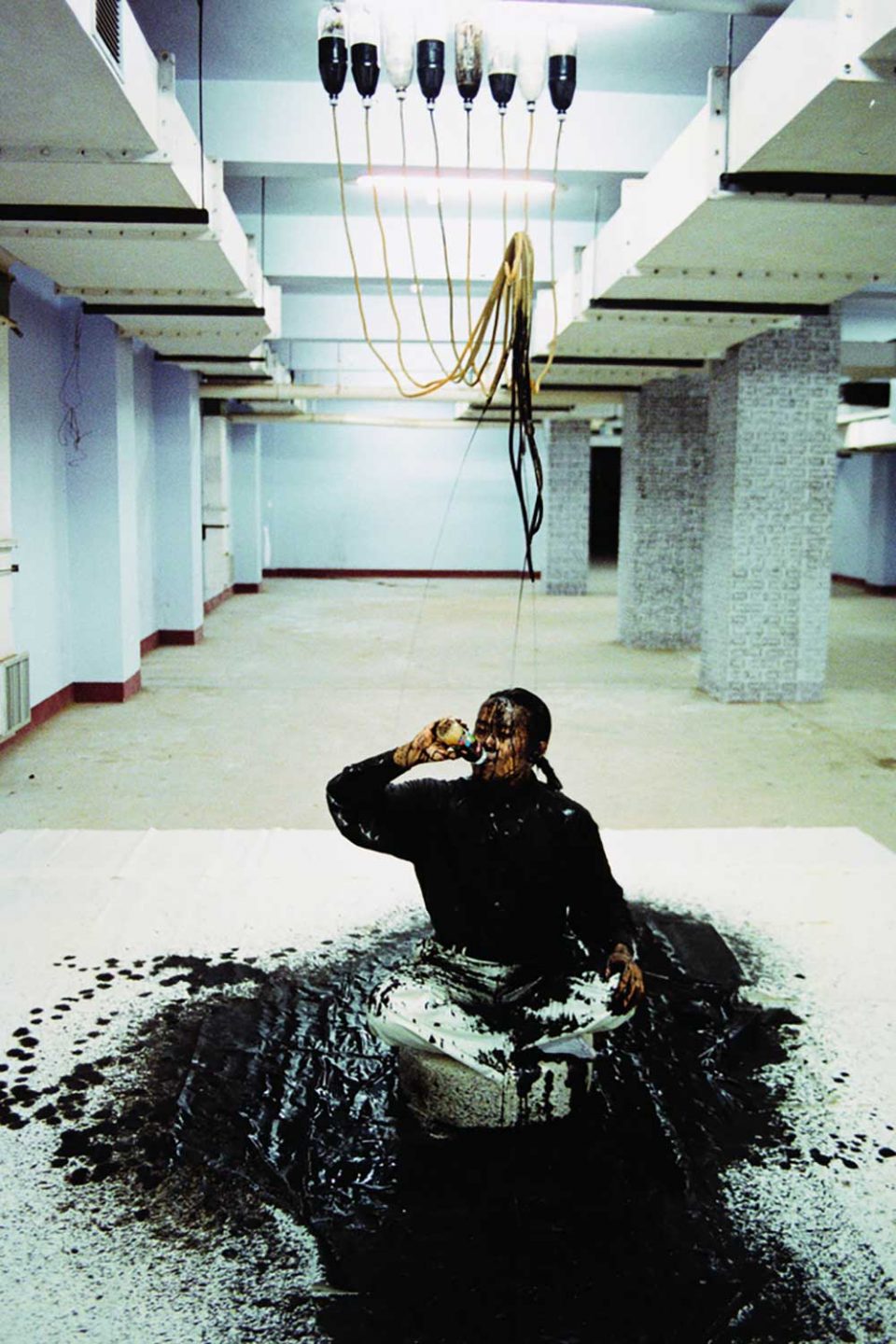
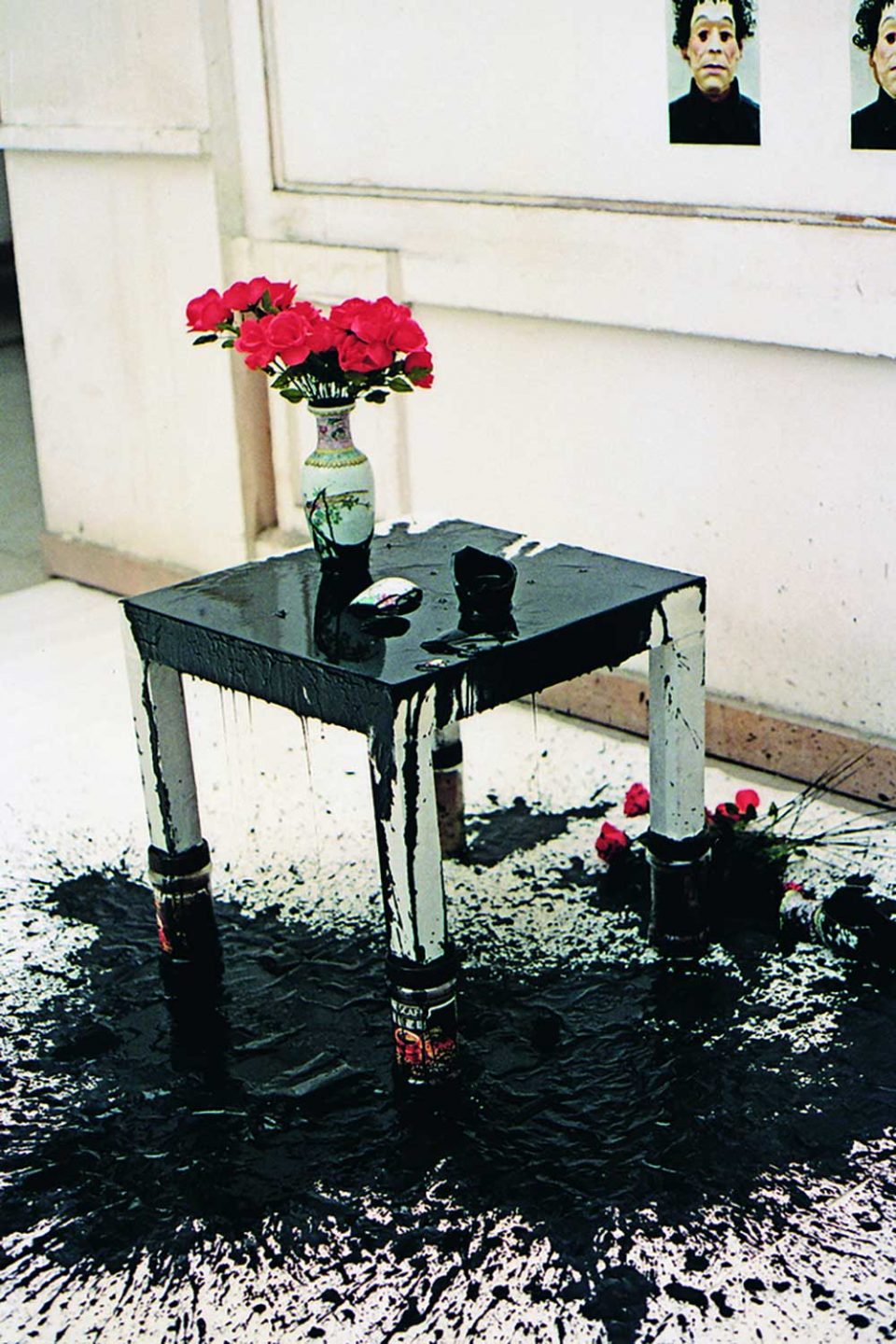
Dai Guangyu, he has created a system of codes and symbols that has intensified along with the progress of his installations and performances. For example, it uses black Chinese ink pots or porcelain, symbols of the complexity of Chinese culture, flour to evoke the basic food of the community and finally also men with faces painted in white and gold as metaphors of Westernization or the pursuit of wealth.

Dai Guangyu – Auction

He argues that through the act of performance, a temporary action that passes from one state to another, all solid forms belong to a single moment and that all circumstances are in the process of transformation.
His installations and his photographs maintain a trace of this “state of procreation” which is the essence of the performance and gives a poetic intonation to the forms.

Dai Guangyu – Shooting at myself

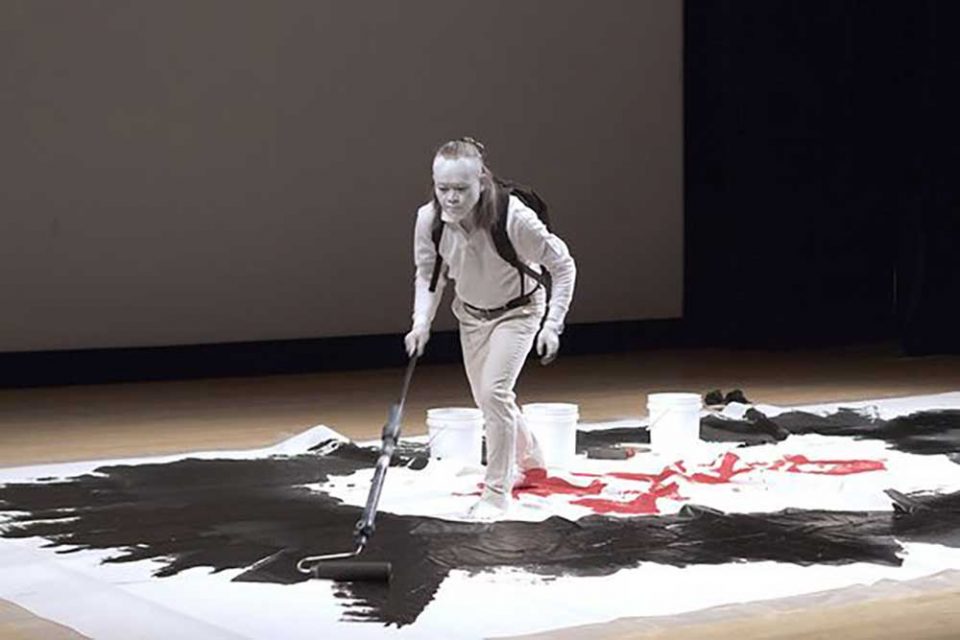
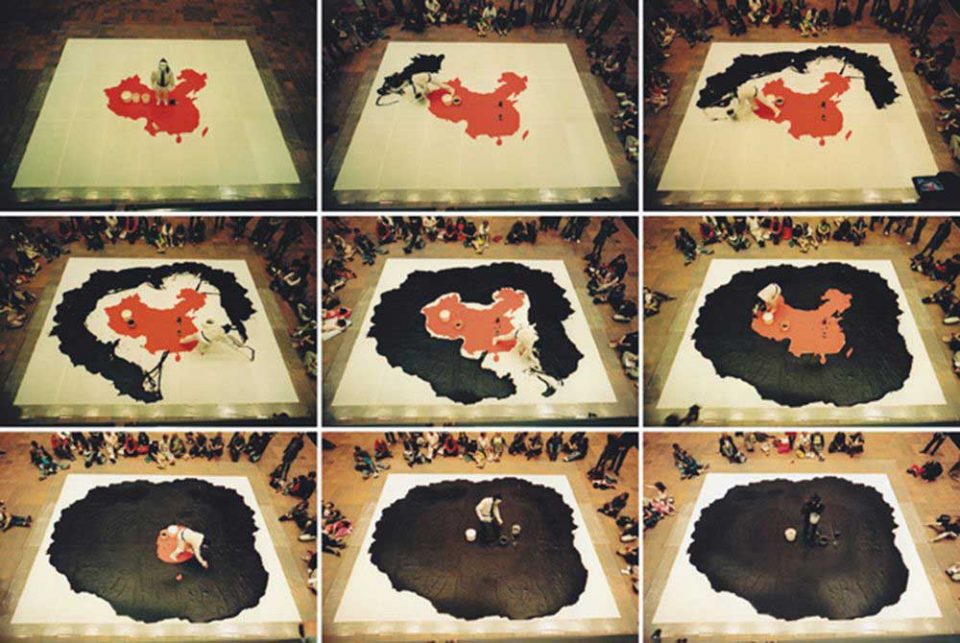
In 2017 the artist realizes the performance The Failure of Defense-America, 2017.

During the performance he expresses his personal struggles against having to live under a repressive political regime. Dai Guangyu through the performance of the performance wants to move the focus, which originally is based on the ideological and class division in China, to the forces that threaten the American nation.

Dai Guangyu – “The Failure of Defense America 2017”

By painting the seemingly empty white paper that covered the stage with black and red ink, the outlines of a series of critical and consequential relationships emerged, asking questions about where we are all in relation to the character and inclusiveness of today’s nation.

Dai Guangyu – “The Failure of Defense America 2017”

Dai Guangyu is now recognized as an important and original figure in the Chinese art scene. His interdisciplinary practice is written within a socially engaged trajectory.

Through his performances, photographs, paintings or calligraphy, he stages his body and the symbolism of Chinese society until the end of their resistance or their disappearance.

Dai Guangyu – Untitled

Exhibitions:
2005 Artists in Action – Performance Art Project, HongKong, China
2005 Inward Gazes – Performance Art in China Exhibition by Invitation, Macau Art Museum, Macau
2005 In Honour of ‘85, Duolun Modern Art Museum, Shanghai, China
2005 Transborder Language: Performance Art /Language Art, Tokyo Art Projects, 798 Factory, Beijing, China
2004 Double Happiness Festival, Tokyo Art Projects, 798 Factory, Beijing, China
2004 Matchmaking, Eastlink Gallery, Shanghai, China
2003 NIPAF: Asia Central Europe, Performance Art Meeting 2003, Slovakia, Hungary, Poland
2003 Chinese Ink in Contemporary Art, National Gallery, Kualalumpur, Malaysia
2003 China – Japan Performance Art Exchange Project / 2003, Chengdu, Xian, Chongqing, China
2002 Fruitfulness – Contemporary Art Exhibition, Beijing Agriculture Hall, Beijing, China
2002 Food and Words, Performance, Chengdu, China (solo)
2002 Shooting at Myself, Installation and Performance, Duisburg University, Germany (solo)
2001 Physical Resources and Objects, Hong Kong, China
2001 Dialogo – Other, Chinese Contemporary Art Exhibition, Chiesa Santa Teresa dei Maschi, Bari, Italy
2001 Chinese Festival – Touring Art Exhibition, Faust Museum, Hannover, Germany
2001 First Chengdu Biennale, Chengdu Museum of Modern Art, Chengdu, China
2000 Heaven Stonehenge, Hannover, Duisburg, Düsseldorf, Germany
2000 Turn of the Century – 1979-1999 – Chinese Contemporary Art, Museum of Modern Art Chengdu, China
2000 Chinese Glamours – Conceptual Images, East Link Gallery, Shanghai, China
1997 How a Frog in a Well Sees the Sky, Open Exhibit, 152B Studio, Chengdu, China (solo)
1996 Resurrection in Chengdu ‘96, Installation, Sichuan University, China (solo)
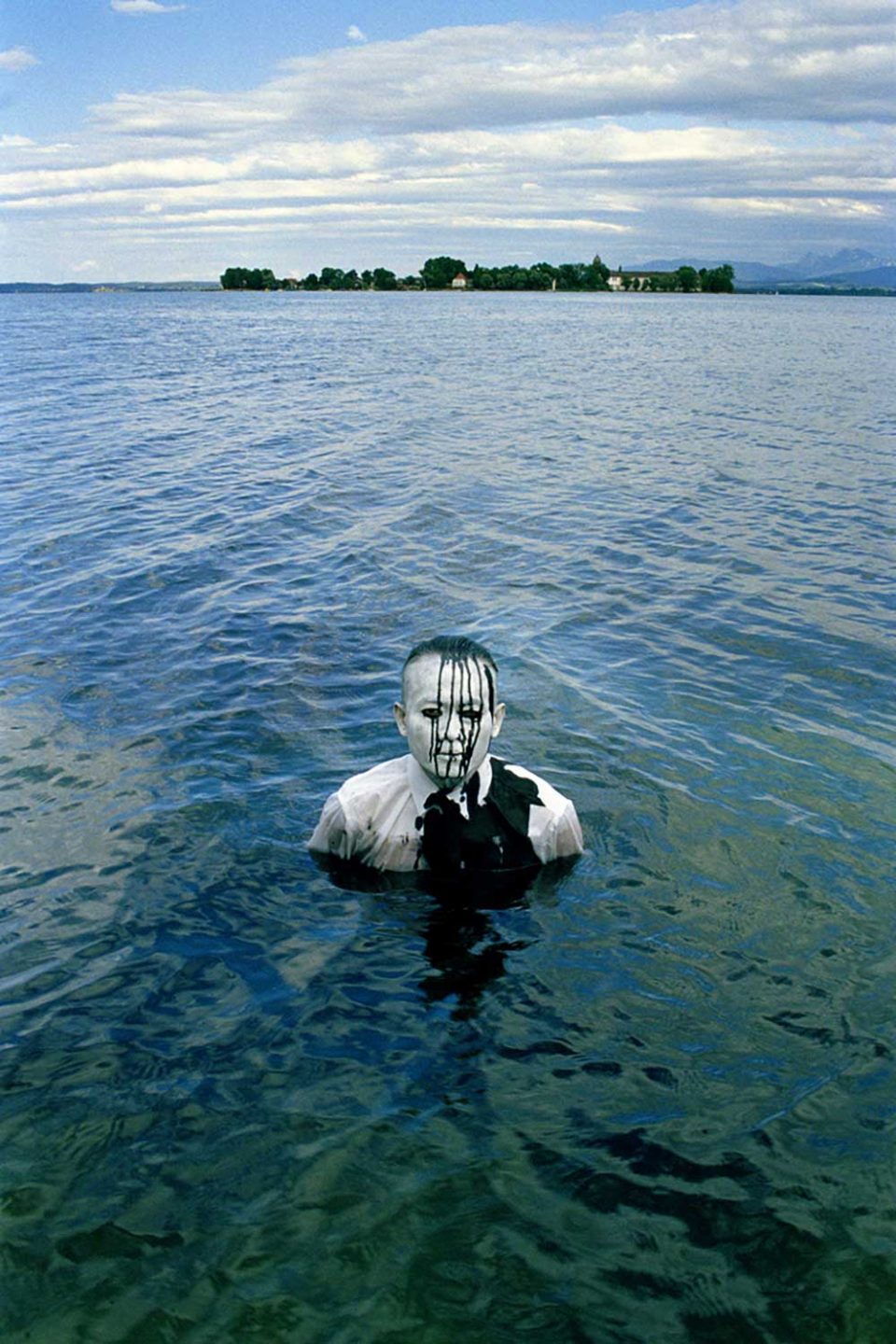
1995 Scenery Inside and Outside a Red Room, Installation, Chengdu, China (solo)
1994 Chinese Landscape, Installation, Chengdu, China (solo)
1993 Dai GuangYu – Exhibition of Paintings, Lallouzet Waterson, Montreal, Canada

References:
http://ifa-gallery.com/artists/dai-guangyu/
https://www.inkstudio.com.cn/artists/64-dai-guangyu/overview/
https://www.artsy.net/artist/dai-guangyu-dai-guang-yu?page=1&sort=-partner_updated_at
https://ocula.com/artists/dai-guangyu/
http://www.artnet.com/artists/dai-guangyu/biography
http://www.artlinkart.com/en/artist/overview/3f8iy
https://www.youtube.com/watch?v=qqznqeoCfRU